
Have you ever stopped to think about where your photos and files actually live when you upload them to the cloud. Most of us just trust that they are safe on some server owned by a big company.
But what if that company changes its rules or has a major outage. This is where we start talking about decentralized storage and a very cool project called Walrus.
I want to share with you how Walrus is trying to change the game by making sure our data isn't just sitting in one basket.
It is a new way of thinking about the internet where we all have a bit more control over our digital lives.
Let Us Talk About How Walrus Keeps Things Safe
When we want to keep something safe we usually make copies of it. In the world of tech we call this replication. Some older systems make dozens of full copies of your files to ensure they never disappear.
While that sounds safe it is actually a bit wasteful. Imagine if Walrus had to store twenty five versions of every single video you uploaded.
That would make the network very heavy and expensive for everyone involved. Walrus looks at this problem and asks how we can stay secure without being so inefficient. We want a system that is fast and light but still keeps our memories protected forever.
The traditional way of copying everything over and over creates a lot of extra work for the computers in the network. If Walrus followed that old path it would be hard for regular people to join in and help.
We want a network that is open to everyone not just people with giant data centers. By rethinking how copies are made Walrus helps create a balance.
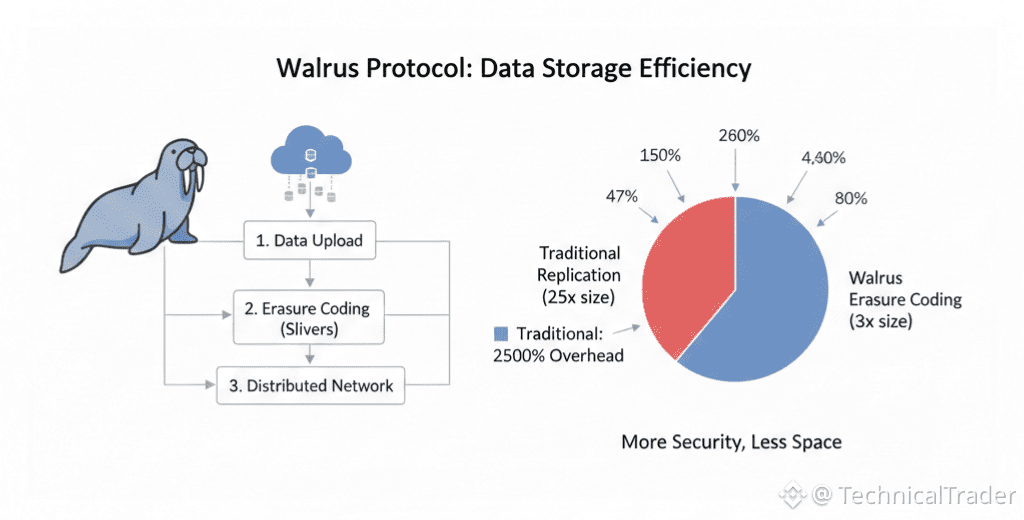
We get the security of knowing our files are in multiple places without the high cost of storing massive amounts of extra data. It is all about being smart with the resources we have on the web.
The Clever Way Walrus Uses Coding
You might be wondering how Walrus can save space while still being super secure. Well there is a bit of math magic involved called erasure coding.
Instead of making a full copy of your file Walrus breaks it into tiny pieces. Think of it like taking a letter and turning it into a bunch of different scraps.
The amazing part is that you do not need all the scraps to read the letter. You only need a few of them to put the whole story back together.
This allows Walrus to protect your data using much less space than older methods. We call these pieces slivers and they are the secret to why this system works so well.
Using this method means that even if a few storage providers go offline your file is still perfectly fine. Walrus can take the remaining pieces and rebuild the original file in an instant.
For you and me this means our data is incredibly resilient. We are moving away from needing twenty five copies down to maybe only three times the original size. This makes Walrus one of the most efficient ways to store things on a blockchain network.
We get to enjoy a high level of safety while knowing the system is running in a very modern and streamlined way.
How Walrus Handles Repairs on the Go
One of the trickiest parts of a decentralized network is when a computer decides to leave or breaks down. In many systems this causes a bit of a headache.
To fix the missing piece the network usually has to download a ton of data which can slow everything down for us. Walrus is designed to be aware of this "repair cost" and tries to keep it as low as possible.
We want a network that can heal itself quickly without using up all the internet bandwidth in the world. This is a big part of making Walrus a reliable place for our long term storage.
If a system is too hard to repair it becomes a closed club where only the biggest players can survive. We want Walrus to stay open and permissionless so that anyone can contribute storage.
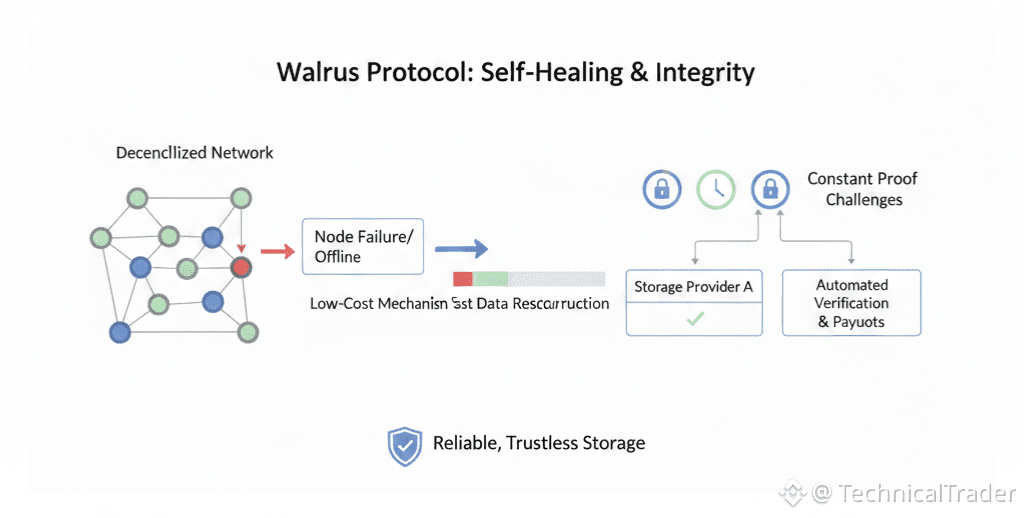
By focusing on low churn and easy recovery Walrus makes sure the network stays healthy and active. When a node goes offline the system handles it gracefully.
This means we do not have to worry about our files getting lost in the shuffle of a changing network. Walrus is built to handle the ups and downs of the real world internet.
Making Sure Everyone Stays Honest in Walrus
In a world where we do not necessarily know who is storing our data we need a way to build trust. Walrus does this by using constant challenges.
It is a bit like a digital check in where the network asks a storage provider to prove they still have your file. If they can’t prove it they don't get paid.
This keeps everyone on their best behavior. We want to know that when we use Walrus our data is actually being looked after and not just deleted to save space. It is a fair system that rewards honesty and keeps the network reliable for all of us.
These challenges happen all the time in the background so we do not even see them. But for the health of Walrus they are vital.
They ensure that the people providing the storage are actually doing the work they promised to do. This creates a marketplace where quality and reliability come first.
We are building a future where you do not have to just take a company's word for it. In Walrus the proof is built right into the code.
This gives us peace of mind that our digital footprints are being preserved exactly as they should be.
Why Walrus Matters for Our Future
As we spend more of our lives online the amount of data we create is exploding. We need places like Walrus that can grow with us and keep our information safe from hackers or big tech failures.
By spreading data across many different places Walrus makes the internet harder to break and more fair for everyone.
We are moving toward a web where the users have the power and Walrus is a huge step in that direction.
I think it is really inspiring to see how technology can be used to protect our freedom and our memories at the same time.
We are all learning together how to navigate this new digital world. Projects like Walrus show us that there is a better way to handle the things that matter most to us.
Whether it is a family photo or an important document we deserve storage that is efficient and secure.
I am excited to see where this journey takes us and how Walrus continues to improve.
By understanding these systems we can make better choices about how we live our lives online.
The future of storage is decentralized and it is looking very bright indeed.
what you think about this? don't forget to comment 💭
Follow for more content 🙂

