

As blockchains evolve from speculative settlement layers into platforms for artificial intelligence, gaming, social networks, and real-world finance, one challenge has become impossible to ignore: data. Large files, model weights, media assets, decentralized websites, rollup proofs, and training datasets do not fit neatly inside traditional blockchains.
Walrus Protocol is designed specifically to solve this problem.
Rather than competing with execution chains, Walrus positions itself as a decentralized storage and data-availability network optimized for the AI era — one that makes large unstructured datasets reliable, verifiable, governable, and economically sustainable at scale.
With mainnet live, hundreds of storage operators, native token economics, and deep integration with the Sui blockchain, Walrus is attempting to become something far more ambitious than cloud replacement infrastructure. Its long-term vision points toward becoming the memory layer of Web3 and AI systems.
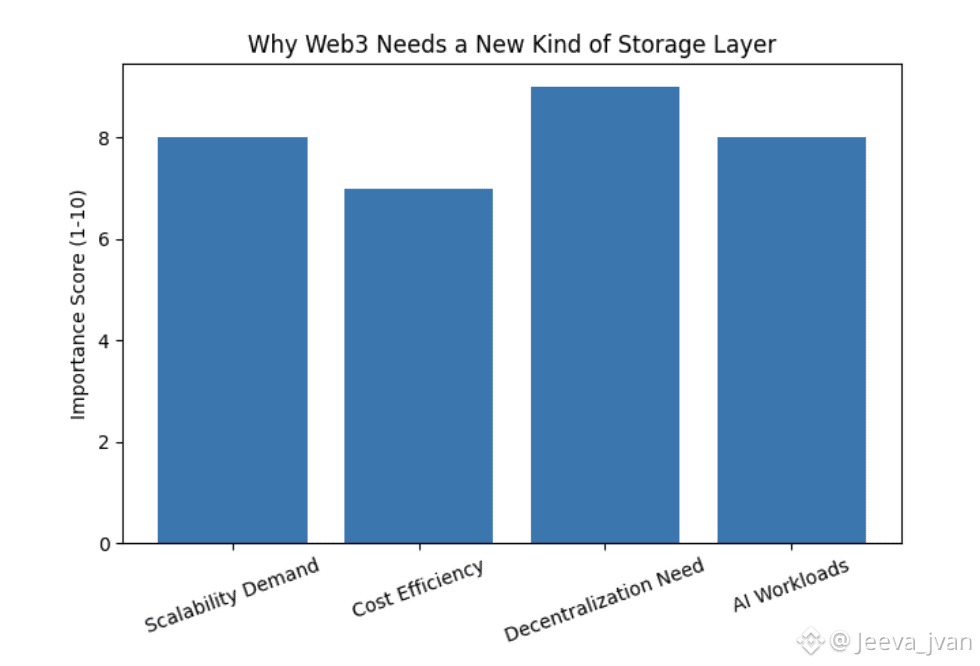
🧱 Why Web3 Needs a New Kind of Storage Layer
Modern decentralized applications are no longer lightweight smart contracts. They depend on:
• large multimedia files
• AI model checkpoints
• training corpora
• rollup transaction batches
• decentralized websites
• data lakes for agents and analytics
Storing this information directly on Layer-1 blockchains is prohibitively expensive. Relying on centralized clouds undermines decentralization and introduces censorship, custody, and geopolitical risk.
Walrus enters this gap with a simple thesis: storage must be decentralized, programmable, and economically efficient — without sacrificing reliability.
The protocol focuses on storing “blobs,” large data objects that can be retrieved later with cryptographic guarantees. These blobs are distributed across a global network of storage operators who are incentivized to keep them available through staking and rewards.
Instead of trusting a single provider, applications rely on a decentralized committee of nodes whose behavior is enforced through cryptoeconomic mechanisms.
⚙️ Inside Walrus: Erasure Coding and Byzantine Resilience
At the technical core of Walrus lies advanced erasure-coding schemes combined with Byzantine-fault-tolerant assumptions.
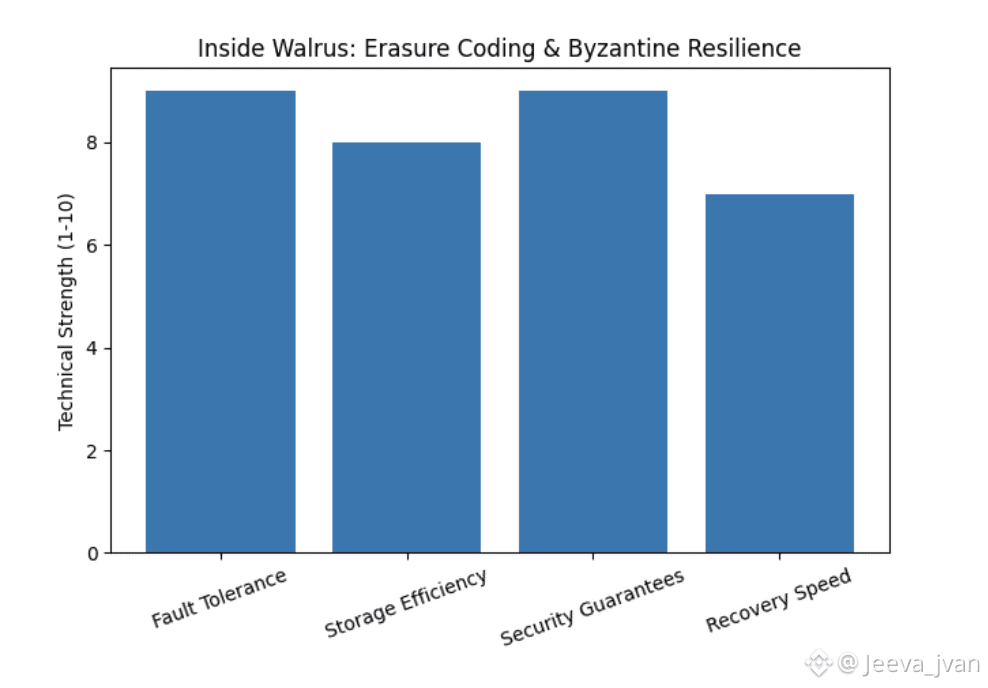
Traditional decentralized storage systems often replicate entire files across multiple nodes, which is robust but expensive. Walrus takes a more efficient approach: each blob is encoded into fragments and distributed across the network. As long as a sufficient subset of those fragments remains accessible, the original data can be reconstructed.
This drastically reduces storage overhead while maintaining fault tolerance.
To defend against malicious or unreliable operators, Walrus requires nodes to periodically prove they are still storing assigned data. These proofs of availability are tied directly to rewards and penalties, ensuring that honest behavior is economically rational.
This architecture is particularly well-suited to AI workloads and rollups, where data volumes are massive but retrieval reliability is mission-critical.
🔗 The Role of Sui in Walrus’s Architecture
Walrus does not operate in isolation. It uses the Sui blockchain as its coordination and settlement layer.
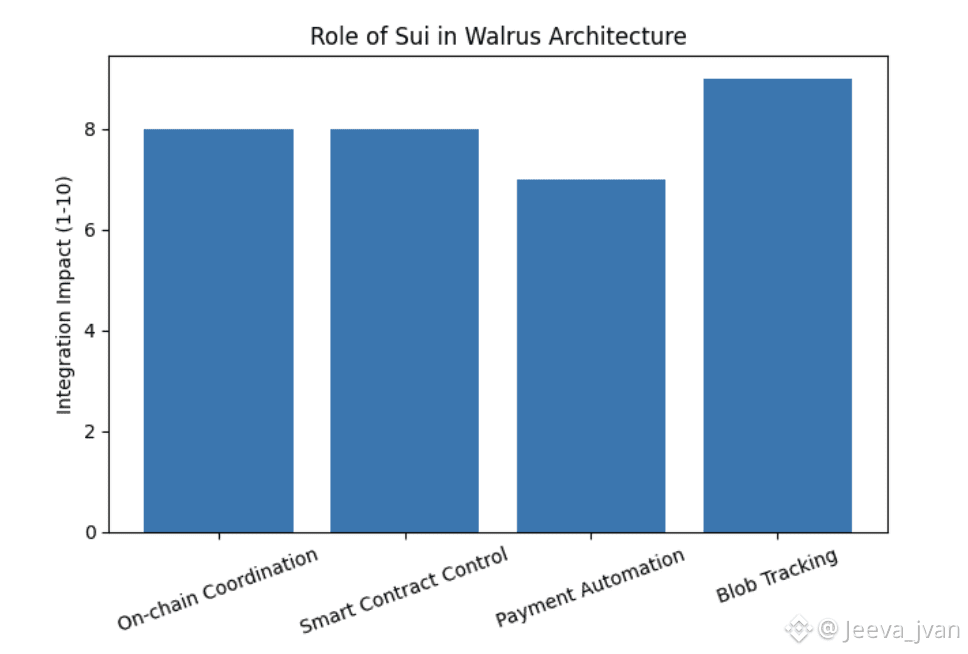
On Sui:
• storage capacity is represented as on-chain objects
• blobs are tracked as programmable resources
• availability commitments are enforced by smart contracts
• payments for storage flow automatically
• lifetimes of data can be extended or allowed to expire
This tight coupling allows developers to reason about data storage in the same way they reason about tokens or NFTs — as programmable objects governed by smart contracts.
Applications can check whether a dataset is still guaranteed to exist, renew storage leases, or integrate blob availability directly into their business logic. This creates a bridge between off-chain data and on-chain execution — one of the hardest unsolved problems in modular blockchain design.
🪙 WAL Tokenomics and Network Security
Walrus is secured by a delegated proof-of-stake mechanism powered by the WAL token.
Storage operators stake WAL to signal reliability and compete for inclusion in the active committee for each epoch. Delegators can assign their stake to operators, sharing in rewards while strengthening the network’s security.
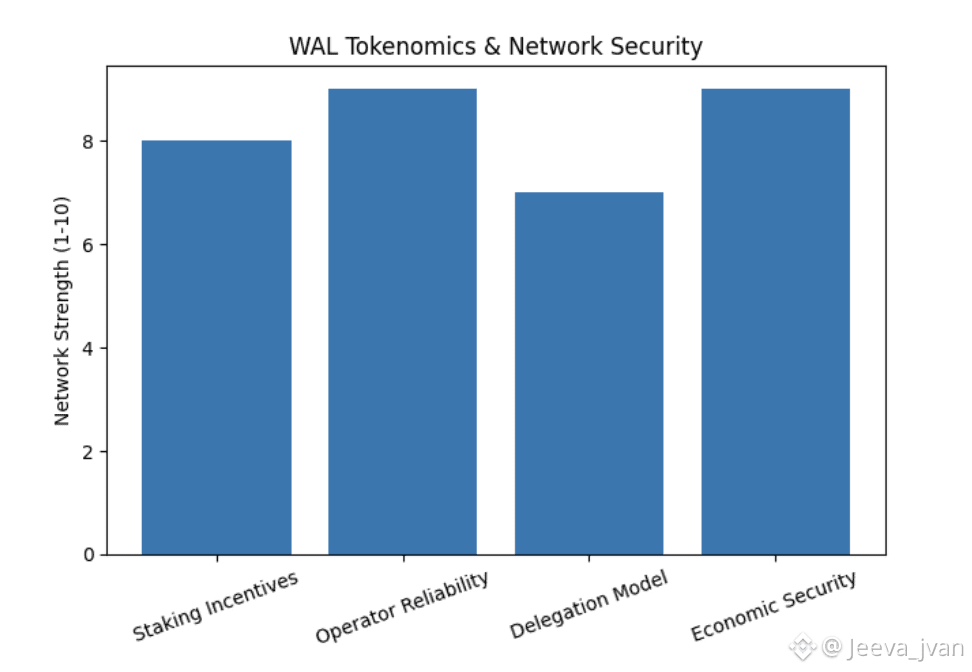
At the end of each epoch, rewards are distributed based on:
• uptime
• data availability proofs
• correct participation
• service quality
WAL is also used to pay for storage itself, creating a closed economic loop between users who need data persisted and operators who supply capacity.
This structure aligns incentives across all participants. Nodes that fail to store data lose future rewards and may be removed from committees, while reliable operators gain more stake and long-term revenue.
In infrastructure networks, these incentive systems often matter as much as the technology itself.
🌐 Use Cases: From AI to Decentralized Websites
Walrus is intentionally broad in the markets it targets.
🤖 AI Systems and Autonomous Agents
Training datasets, embeddings, model checkpoints, and memory graphs require persistent storage. Walrus provides a decentralized substrate where AI agents can read and write knowledge without relying on centralized providers.
🌍 Walrus Sites
Developers can deploy static websites entirely on Walrus, turning storage nodes into censorship-resistant hosting providers. This mirrors Web2 CDNs while preserving decentralization.
🧾 Rollups and Modular Chains
Layer-2 networks and modular blockchains need data-availability layers for publishing transaction batches. Walrus can act as an alternative DA solution, particularly for applications that prioritize cost efficiency.
🖼️ Media and Archives
NFT metadata, video libraries, scientific datasets, and cultural archives all benefit from storage that remains verifiable and durable for long periods.
Across these use cases, Walrus frames itself not as a niche service, but as general-purpose decentralized memory.
📊 Walrus in the Competitive Landscape
Walrus operates in a crowded but increasingly important sector that includes decentralized storage networks and modular DA layers.
What differentiates Walrus is its combination of:
• AI-scale blob support
• programmable storage lifetimes
• committee-based node rotation
• Sui-native integration
• on-chain accountability
• cost-optimized erasure coding
Rather than focusing solely on archival permanence or speculative storage markets, Walrus emphasizes active, service-level-oriented infrastructure — closer to enterprise cloud behavior, but enforced by cryptography.
As AI and on-chain automation converge, the importance of reliable data layers is likely to grow faster than execution throughput alone.
🔮 The Long-Term Vision: Walrus as Web3’s Memory Layer
Perhaps the most ambitious aspect of Walrus is its positioning in the broader crypto stack.
Execution layers compute.
Rollups settle.
Bridges transfer value.
Walrus wants to remember.
In a world where autonomous agents negotiate contracts, DAOs train models, and decentralized markets process massive data flows, persistent decentralized memory becomes as critical as blockspace itself.
If Walrus succeeds, it could underpin entire ecosystems quietly — invisible to end users but fundamental to everything they interact with.
Infrastructure projects often operate in the background until suddenly nothing works without them. Walrus is clearly targeting that tier of relevance.
🎯 Final Thoughts
Walrus Protocol is not chasing hype narratives. Its focus on data availability, AI workloads, programmable storage, and economic alignment places it firmly inside the deepest layers of the Web3 stack.
With mainnet live, token-driven security, and expanding developer tooling, Walrus is attempting to solve one of decentralized computing’s hardest problems: how to store the world’s data without trusting any single entity.
If the next decade of crypto is defined by AI agents, modular blockchains, and on-chain economies built on massive datasets, protocols like Walrus may quietly become some of the most important networks in the ecosystem.

