
@Vanarchain draws attention among observers like me who track blockchain ecosystems through their daily operations. I have followed its development over months watching how the network handles transactions and integrates tools. The core idea here revolves around building intelligence directly into the infrastructure rather than adding it later. This approach shows in projects running on Vanar. Think about myNeutron as one example. It processes data sources into structured elements called Seeds. These Seeds then group into contexts that users query with built-in references. I recall seeing early adopters experiment with this in real time. They fed in market feeds or document sets. The system preserved origins without losing track. Over time this built a kind of durable memory that agents could rely on. In my observations such setups prevented the usual silos where data gets forgotten or misplaced. Vanar designed this from the start making AI feel native to the chain.
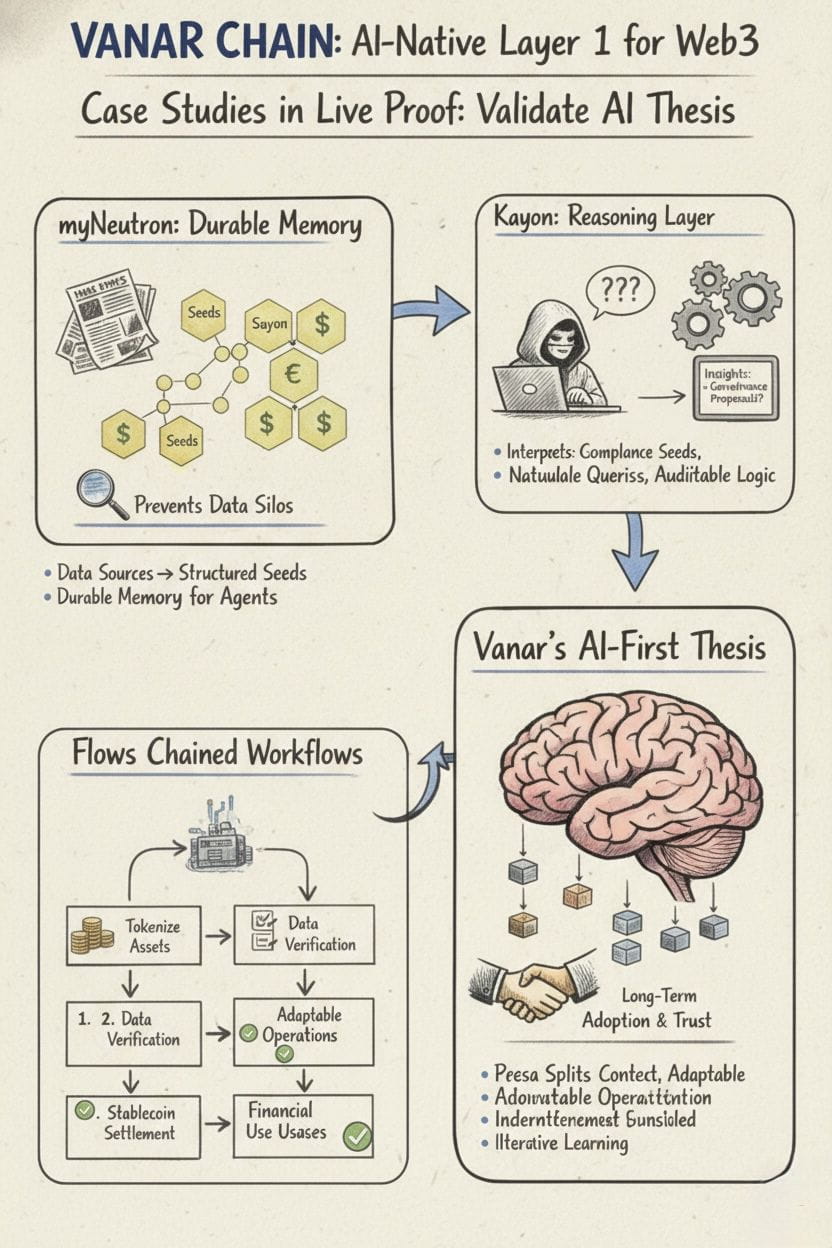
Watching myNeutron in action reveals subtle shifts in how users interact with blockchain data. Traditional chains store information in blocks. Vanar takes a different path. It emphasizes semantic understanding right at the base layer. I noticed developers using myNeutron to handle compliance checks. For instance one team integrated enterprise records. The tool turned raw inputs into verifiable contexts. This meant decisions carried provenance. What happened next interested me. Agents built on top started making inferences without constant reprocessing. Efficiency improved in ways that felt organic. Not forced. I wonder sometimes if this reduces overhead in high-volume scenarios. Yet it depends on the workload. From what I have seen in usage logs and community discussions myNeutron validates the thesis by proving memory can act as a foundational element. It turns passive storage into active intelligence. That shift matters for long-term adoption.
Kayon builds on this foundation. As the reasoning layer it interprets those Seeds from myNeutron. I have observed it querying blockchains in natural language. Users pose questions about governance or market states. Kayon blends contexts to deliver insights. One case that stands out involved tokenized assets. A project team used Kayon to automate compliance. It cross-referenced regulations with onchain data. The process felt seamless. No heavy scripting required. In market behavior I see this reducing friction. Teams move faster when intelligence handles the logic. Vanar’s design ensures this reasoning stays auditable. Every step traces back. This aligns with the AI-first idea. Intelligence embeds in the workflow. Not bolted on. I have tracked similar tools on other chains. They often struggle with context loss. Kayon avoids that by leaning on the chain’s structure. It makes me curious about scaling limits. For now the live examples show promise in enterprise settings.
Flows takes these pieces further. It preserves context across multiple steps. Think of it as chaining workflows where each part retains prior knowledge. In my time observing Vanar I saw Flows applied to financial operations. One instance involved stablecoin settlements. The system orchestrated transfers while maintaining audit trails. Intelligence from Kayon informed each move. Memory from myNeutron supplied the base. This created a loop where applications learned over iterations. Not static. Market observers like me note how this differs from rigid smart contracts. Flows introduces adaptability. I recall a demo where it handled real-world asset tokenization. Data flowed through verification stages. Adjustments happened based on live inputs. No interruptions. This validates the thesis because it demonstrates AI driving the entire process. Vanar built the chain to support such fluidity. Usage signals suggest growing interest. Developers experiment more freely. Yet challenges remain in complex integrations. Still the proof lives in these deployments.
Reflecting on these case studies brings clarity to Vanar’s approach. myNeutron lays the memory groundwork. Kayon adds reasoning depth. Flows ties it into practical applications. Together they embody the AI-first thesis. I have watched the chain’s infrastructure support this without strain. Transactions process efficiently. Usage grows steadily in niches like finance and assets. Market behavior reflects curiosity rather than hype. Teams explore possibilities. This feels sustainable. Looking ahead I see potential in broader adoption. As more projects test these tools understanding deepens. Vanar might shape how chains incorporate intelligence. For now the live proof speaks through these examples. It invites careful observation.
