

Vanar was not built in response to a trend. It was built from an assumption. That intelligent systems would eventually stop being experiments and start behaving like real participants in digital economies. That assumption is quiet but it is heavy. It changes how infrastructure is shaped long before anyone talks about narratives.
Most blockchains still assume humans sit at the center. Wallet approvals dashboards prompts interfaces. That model breaks once AI agents enter the picture. Agents do not click. They do not wait. They do not tolerate broken context or fragmented execution. They either operate continuously or they fail silently.
This is where many AI conversations become surface level.
AI readiness is often reduced to performance metrics. Faster blocks higher throughput better benchmarks. Those things matter less than people think. Intelligence requires persistence. It requires reasoning that can be traced. It requires automation that does not act recklessly. And it requires settlement that works without human UX.
Vanar organizes itself around those requirements rather than around slogans.
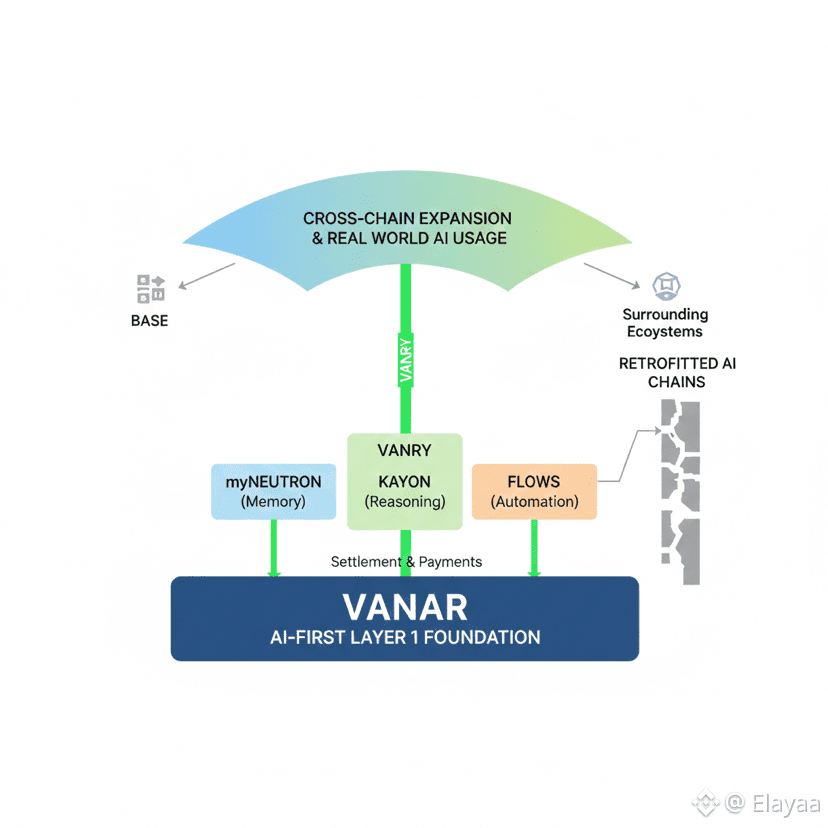
This becomes visible when looking at what actually runs on the network. myNeutron shows that semantic memory can exist at the infrastructure layer. Not cached memory. Not session memory. Persistent context that carries forward. For AI systems this is the difference between reacting and accumulating understanding.
Kayon addresses another weak point. Reasoning. AI that cannot explain itself quickly hits a ceiling especially outside experimental environments. Kayon brings reasoning and explainability on chain as part of the logic itself. That matters when trust is not optional.
Flows closes the loop. Turning intelligence into action is where most systems fail. Automation without guardrails becomes dangerous. Flows demonstrates how execution can be controlled constrained and safe. Intelligence does not just think. It acts with boundaries.
Together these components form something closer to an intelligent stack than a collection of tools. Memory feeds reasoning. Reasoning informs action. Action settles value. None of these layers stand alone.
This is also where retrofitting becomes obvious. Infrastructure that was never designed for intelligence ends up fragmented. Memory lives off chain. Reasoning happens elsewhere. Automation relies on scripts. Settlement lags behind intent. It works until scale exposes the seams.
Vanar avoids some of this by having fewer assumptions baked in from the start.
Cross chain availability beginning with Base is not framed as expansion for its own sake. It is about reach. AI infrastructure cannot remain isolated and still claim readiness. Intelligence needs interaction with live ecosystems. Users data liquidity and activity already exist elsewhere. Access matters.
This shift also reframes the role of VANRY.
VANRY is not positioned as a narrative asset. It sits underneath usage. It enables settlement participation and economic activity across the intelligent stack. AI agents do not open wallets or wait for prompts. They require value movement that behaves like infrastructure not ceremony.
This is why payments are not optional in AI first systems. Without settlement intelligence remains impressive but economically inert. VANRY connects decision making to consequence.
It is worth stating plainly. Web3 does not lack base layers. It lacks proof that AI can operate natively and safely at scale. Many new L1 launches will struggle not because they are poorly built but because they were designed for a different era.
Vanar does not try to solve everything. It focuses on being ready for the kind of usage that does not announce itself. Agents enterprises systems that simply expect infrastructure to work.
That kind of usage is unforgiving. Infrastructure either holds or it disappears.
Vanar feels like it was built with that pressure in mind.
