

When crypto talks about finance, it often talks in shortcuts. Faster payments. Open access. No middlemen. Those ideas sound good, but they usually ignore what happens when real money, real companies, and real laws get involved.
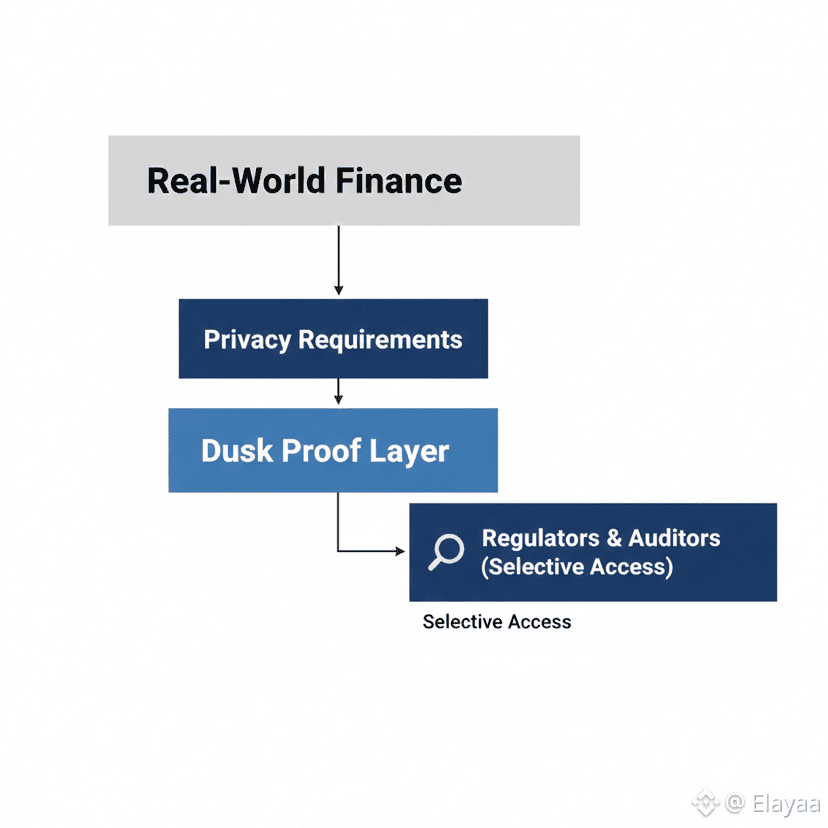
Real finance is not built on speed alone. It’s built on responsibility.
Someone has to approve things. Someone has to explain decisions later. Someone has to prove that rules were followed without exposing everything to the public. That part rarely fits into simple blockchain narratives.
This is where Dusk starts to make sense.
Dusk is a Layer 1 blockchain designed for regulated financial infrastructure. Not speculative finance. Not anonymous experiments. Actual financial systems that expect oversight. Systems that will be audited. Systems that can’t afford surprises.
Most blockchains make a hard choice. Everything is public, or everything is hidden. Public chains expose too much sensitive data. Fully private systems make verification difficult. Dusk doesn’t choose either extreme.
On Dusk, data can stay private, but proofs can still be produced when required. That’s a subtle design choice, but it changes everything. It means a transaction doesn’t need to be public forever just to be trusted. It only needs to be provable to the right parties at the right time.
That mirrors how real finance already works.
Banks don’t publish every transaction on a public board. Regulators don’t need to see everything all the time. They need access when it matters. Audits are selective. Disclosure is conditional.
Dusk is built around that reality instead of pretending it doesn’t exist.
Another important detail is how Dusk approaches structure. Financial products are not identical. A trading platform, a tokenized bond, and a regulated investment product all follow different rules. Forcing them into a single rigid blockchain model usually creates hidden problems.
Dusk uses a modular architecture so different applications can operate under different conditions while still settling on the same Layer 1. This allows flexibility without losing consistency or security.
That matters for institutions.
Institutions don’t experiment lightly. They look for systems that won’t break when regulators show up. They need clarity, documentation, and predictable behavior. Dusk was designed with those expectations in mind from the start.
This is also why Dusk focuses on tokenized real-world assets and compliant DeFi instead of open-ended experimentation. These are areas where blockchain can add value without ignoring legal and operational reality.
$DUSK exists because putting finance on-chain doesn’t remove responsibility. It increases it.
And infrastructure that can carry that weight quietly is often the most important kind.