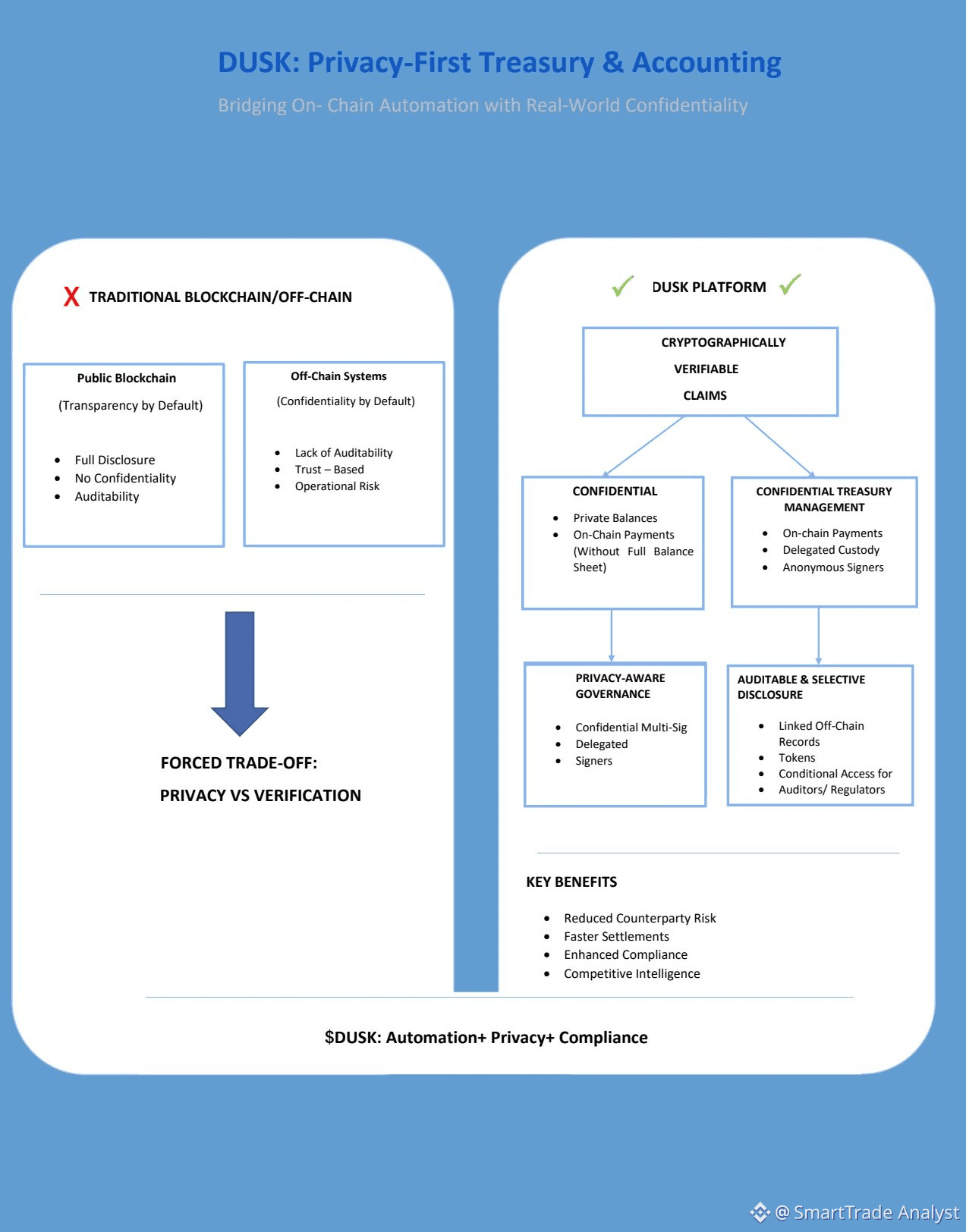
For many organizations, moving treasury operations on-chain feels unsafe—not because blockchain technology is underdeveloped, but because confidentiality often comes at the cost of full disclosure. Most existing blockchain systems are built around transparency by default, while off-chain systems require sacrificing auditability and trust. This forces organizations into an unnecessary trade-off between privacy and verification.
That trade-off is not necessary with DUSK.
DUSK enables organizations to manage treasuries, execute on-chain payments, and handle financial operations while keeping sensitive information private. Rather than publishing raw financial data on a public ledger, organizations using $DUSK make cryptographically verifiable claims about their information. The proofs are visible and auditable, while the underlying details remain confidential.
This approach fundamentally changes how corporate treasury functions can operate. A company can prove solvency without revealing its full balance sheet. A fund can demonstrate that liquidity requirements are being met without exposing its portfolio composition. A stablecoin issuer can prove reserve backing without disclosing custodians, asset structures, or counterparty relationships. Trust is achieved through a proof-oriented model rather than forced transparency.
Governance and approvals are handled with the same level of care. DUSK supports privacy-aware multi-signature and delegated custody workflows, where approval logic, signer weights, and delegation rules are enforced on-chain, while the identities of signers remain confidential. This provides strong internal controls while reducing operational risk and unnecessary internal data exposure.
Accounting and reconciliation also become more practical. On-chain commitments can be linked to encrypted or hashed versions of an organization’s off-chain records, allowing each party to independently verify consistency. Selective disclosure tokens make it possible to reveal only specific information, only when required, and only for limited periods of time.
This new model significantly improves counterparty risk management. Multiple positions can be netted across counterparties without revealing individual transactions. Proofs of net exposure limits can be generated without disclosing contract structures. Insurance and reinsurance arrangements can rely on proofs showing that claims and reserve conditions have been met, enabling faster settlements without compromising privacy. Syndicated transactions also benefit, allowing private covenants and collateral arrangements while still providing verifiable compliance.
Importantly, adoption does not need to be revolutionary. Organizations can implement DUSK incrementally—starting with narrow use cases such as liquidity buffer attestations or private multi-signature treasury accounts—and expand gradually. Over time, on-chain commitments can be combined with confidential compute, selective disclosure flows can be validated through parallel audits, and middleware can connect existing ERP systems to cryptographic commitments. Legal playbooks can define how auditors and regulators receive limited, contract-based access when required.
Operational risk is managed through a combination of cryptographic proofs and governance processes. Disputes can be resolved using escrowed proofs and auditor attestations without full record disclosure. Incident response can rely on revocation proofs and forensic disclosure tokens, minimizing exposure during investigations while preserving confidentiality.
For organizations that rely on competitive intelligence, DUSK enables the benefits of blockchain automation—such as settlement certainty and programmable control—without sacrificing discretion or regulatory compliance. This lowers the barrier for organizations seeking to modernize financial operations responsibly.
Overall, DUSK fills the gap between on-chain treasury management and real-world organizational complexity by transforming sensitive financial data into cryptographically verifiable and selectively disclosable assets—bringing privacy, compliance, and automation together instead of forcing them to work against each other.