
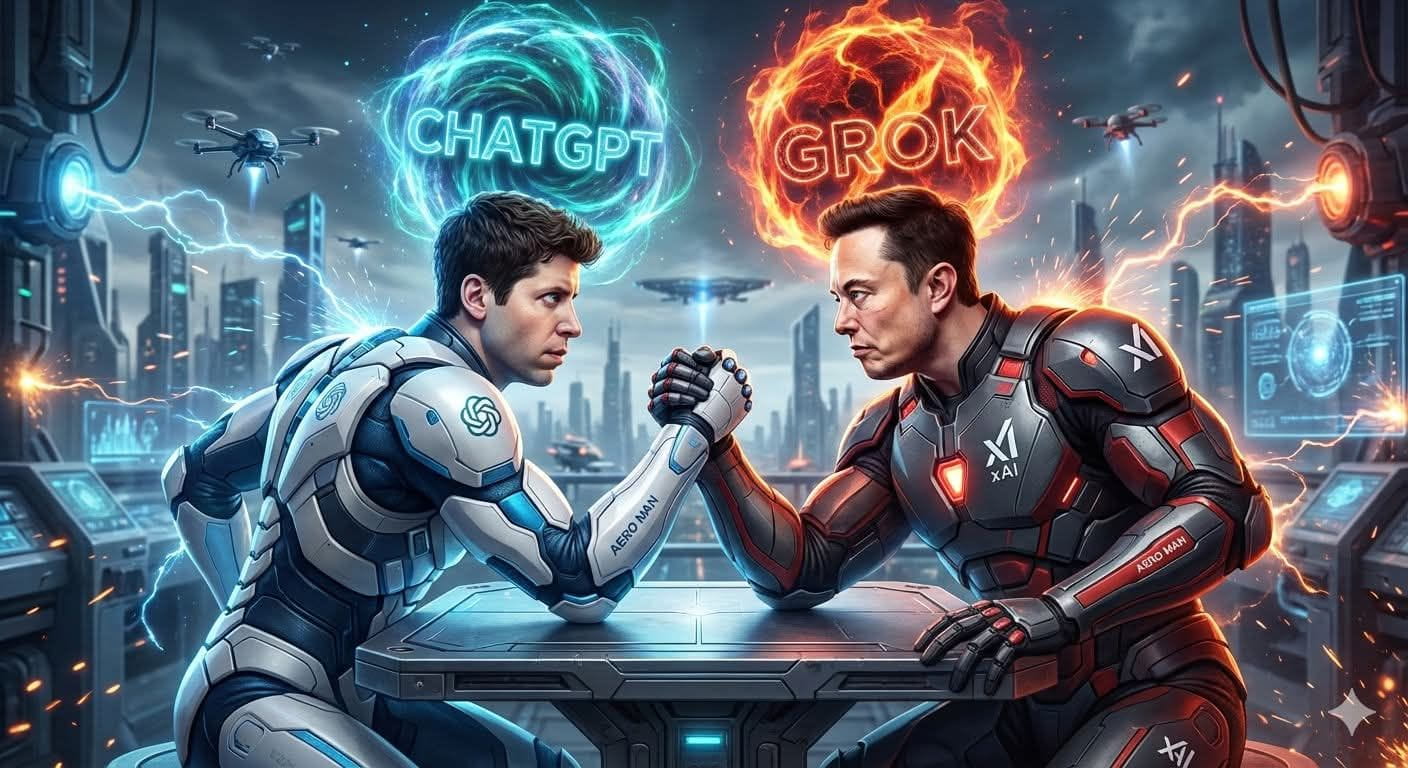
On April 27, the Oakland court in California will be the stage for an unprecedented legal confrontation. Elon Musk, founder of SpaceX and Tesla, will face his former ally Sam Altman, CEO of OpenAI. This trial, which is expected to last four weeks, raises fundamental questions about ethics, profit, and governance in artificial intelligence.
From alliance to rupture: a betrayed ideal?
Everything starts in 2015. At that time, Elon Musk and Sam Altman are among the 11 co-founders of OpenAI. Their mission is philanthropic: to create a nonprofit organization to ensure that AI benefits all of humanity, far from the profit motives of giants like Google. Musk invests 45 million dollars and co-chairs the organization.
However, the vision quickly diverges. In 2018, Elon Musk left the ship after the other founders refused to merge OpenAI with #Tesla. Since then, the game has changed: with the global success of ChatGPT at the end of 2022, OpenAI underwent a radical transformation, shifting from an open research lab to a "mission-driven" company with a hybrid status, attracting colossal investments, notably from Microsoft and SoftBank (valued at nearly 40 billion dollars).
Elon Musk's grievances: Open Source and "AI Capitalism"
The billionaire bases his offensive on two major points:
1- The abandonment of altruism: Musk believes that OpenAI has betrayed its original statutes. For him, the shift to a commercial model exclusively benefits shareholders and diverts initial funds (including his) from their social purpose.
2- The locking of the code: While OpenAI advocated for Open Source in its early days, the company has gradually closed its language models. #Musk accuses the company of no longer making its research accessible, thus hindering global collaboration in favor of commercial exclusivity.
Visionary strategy or trade war?
If Elon Musk positions himself as a defender of the common good, many observers point out a blatant conflict of interest. In parallel to his lawsuits, the businessman launched his own startup, xAI, and his conversational agent Grok.
Weakening OpenAI in court could be a strategy to catch up on the market. Moreover, Musk is not new to this: he recently sued Apple, accusing them of favoring ChatGPT to the detriment of #Grock on the App Store.
A variable geometry ethics
The trial also takes place in a climate of controversy for Elon Musk. His AI, Grock, is under fire for ethical missteps, particularly the generation of non-consensual explicit content. The billionaire's nonchalant attitude towards these issues undermines, according to his critics, his credibility as a moral "safeguard" of the industry.