

Money is personal. Even when we don’t say it out loud, our financial choices carry emotion, pressure, and responsibility. When every transaction is fully public, people hesitate. When systems can’t prove compliance, institutions hesitate. Dusk Network exists to solve both problems at the same time.
Dusk is a Layer 1 blockchain designed specifically for regulated finance, where privacy is treated as a basic human need, not a luxury, and compliance is built into the protocol instead of added later as paperwork. It is not trying to be a playground for experiments. It is trying to be infrastructure that real markets can rely on.
What Makes Dusk Different
Most blockchains force a hard choice:
Full transparency with no privacy
Or full privacy with no accountability
Dusk refuses this trade-off.
Its core idea is simple:
Protect user data by default, but allow proof and disclosure when rules require it.
That is why Dusk describes itself as “the privacy blockchain for regulated finance.” It is built with frameworks like MiCA, MiFID II, the DLT Pilot Regime, and GDPR-style expectations in mind. This means eligibility rules, reporting, audits, and controlled disclosure are not optional extras — they are part of the design.
A Network Built to Last
Dusk has been building for years, not months. The project traces back to 2018, went through early market exposure in 2019, and has continued developing through changing regulations and market cycles. That long timeline matters because financial infrastructure is about trust, and trust is earned slowly through consistency and delivery.
This is not a short-term experiment. It is a system designed to survive scrutiny.
Modular by Design, Stable at the Core
Dusk separates settlement from execution, which is critical for regulated environments.
DuskDS sits at the base, handling consensus, data availability, and final settlement.
On top of that sit execution environments:
DuskEVM for Ethereum-compatible smart contracts
DuskVM for privacy-focused applications
This modular design allows applications to evolve without constantly changing settlement rules. In finance, stability matters more than novelty, and Dusk is built with that reality in mind.
Fast, Final, and Predictable Settlement
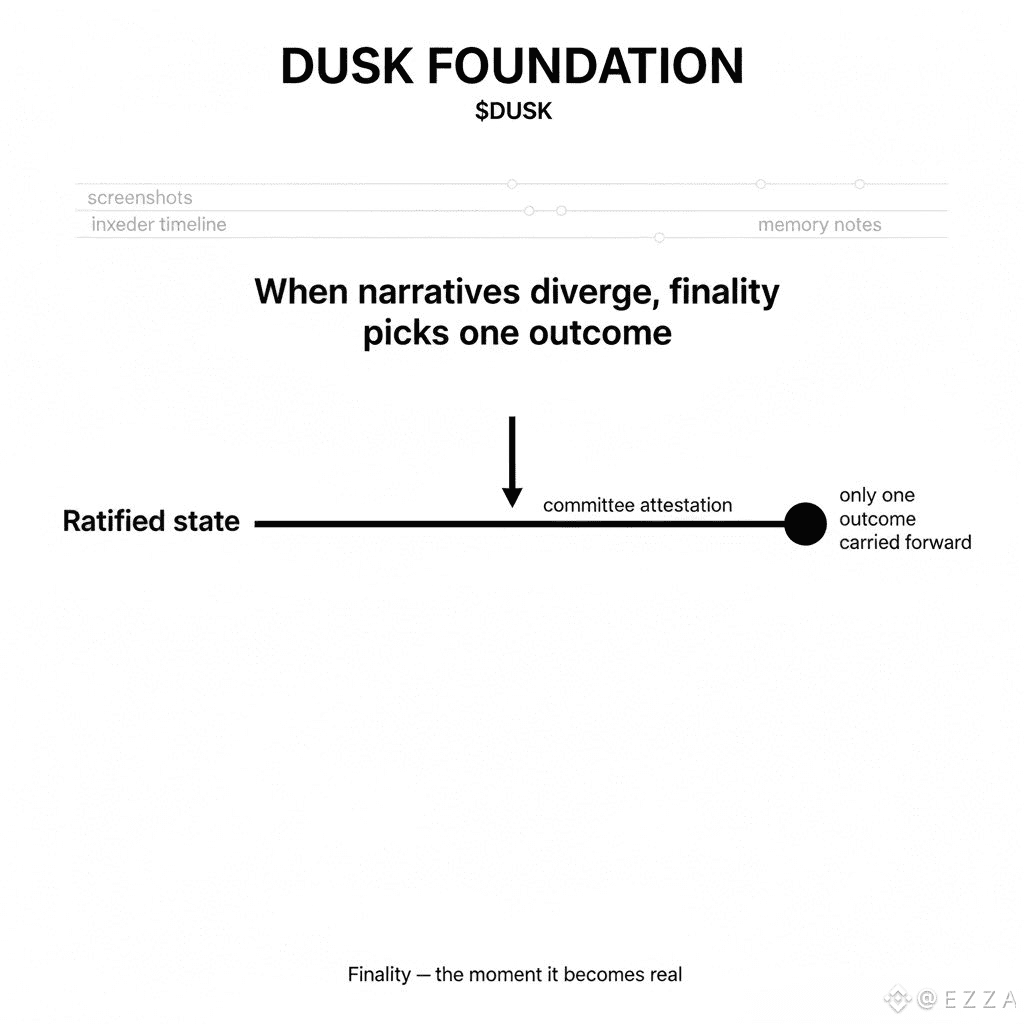
Dusk uses a proof-of-stake system with committee-based consensus and deterministic finality. Once a block is finalized, it stays final. No user-visible reorganizations. No guessing whether a transaction might reverse.
For markets, this matters deeply. Uncertain settlement creates hesitation. Predictable finality builds confidence.
Two Transaction Models, One Network
Dusk supports two transaction types, designed for different needs:
Moonlight
Transparent, account-based transactions for compliance-heavy workflows, reporting, and high-throughput use cases.
Phoenix
Privacy-preserving, UTXO-based transactions where balances and transfers remain confidential.
The important part is not just that both exist — it’s that users can convert between them safely and atomically. You can move value from private to transparent when regulation requires it, and back to private when confidentiality matters again.
This flexibility is rare, and it is exactly what real financial workflows need.
Privacy That Is Engineered, Not Promised
Phoenix transactions use zero-knowledge proofs to ensure:
Value is conserved
Double-spending is impossible
Transaction details remain private
The system tracks cryptographic commitments, not public balances. Privacy is enforced by math, not trust.
At the same time, gas fees and economic limits exist to protect the network from abuse. Privacy does not mean chaos — it still needs rules and incentives.
Built with Serious Cryptography
Dusk uses modern zero-knowledge systems based on PLONK and BLS12-381, implemented in Rust. The team is open about audits, limitations, and the need for continued testing. That transparency is a strength, not a weakness.
In high-value systems, honesty about risk is part of security.
Networking That Respects Fairness
Behind the scenes, Dusk uses Kadcast, a structured network protocol designed for reliable and fair message propagation. In financial systems, slow or uneven propagation can create unfair advantages. Dusk treats networking as a security layer, not an afterthought.
Familiar Tools, Strong Foundations
With DuskEVM, developers can use standard Ethereum tools while settling on Dusk’s secure base layer. Today, there are trade-offs like delayed finality inherited from existing stacks, but the roadmap is clear: tighter integration and faster finality over time.
The goal is simple: make adoption easy without compromising long-term market integrity.
Risks Are Acknowledged, Not Ignored
Dusk openly recognizes:
Cryptographic risk
Implementation complexity
Economic and governance challenges
Regulatory change
This is important. Infrastructure fails when risks are hidden. It survives when risks are named and managed.
Where Dusk Is Heading
Dusk is evolving toward a fully modular, three-layer architecture where:
Settlement remains rock-solid
Execution is flexible and developer-friendly
Privacy is native and composable
All powered by a single DUSK token and native bridges, without custodians or wrapped assets.
The Bigger Picture
Dusk is not trying to make finance louder.
It is trying to make finance calmer.
A system where:
Users don’t feel exposed
Institutions don’t feel unsafe
Rules can be proven without oversharing
Privacy feels normal, not suspicious
If Dusk succeeds, its real achievement won’t be another blockchain. It will be showing that privacy and regulation do not have to fight each other — they can coexist by design.
And when finance stops feeling like a spotlight and starts feeling like a foundation, more people are willing to build on it.
