

When businesses evaluate new payment rails, they are rarely asking whether the technology is innovative. They are asking what could break. Most payment decisions are shaped less by upside and more by downside. Late settlements, unpredictable fees, reconciliation issues, or compliance headaches can erase the benefit of faster or cheaper payments almost instantly.
This perspective explains why crypto payments, despite years of development, have struggled to move beyond niche usage. The problem was never speed or global reach. It was operational risk.
The support of Confirmo for Plasma is important because it directly addresses how businesses think about risk rather than how crypto communities talk about adoption.
Confirmo serves enterprises across e-commerce, trading, forex, and payroll, processing more than eighty million dollars each month. These businesses already accept crypto, but they do so cautiously. They treat it as an option, not a core rail, because traditional blockchain settlement introduces too many unknowns at the edges.
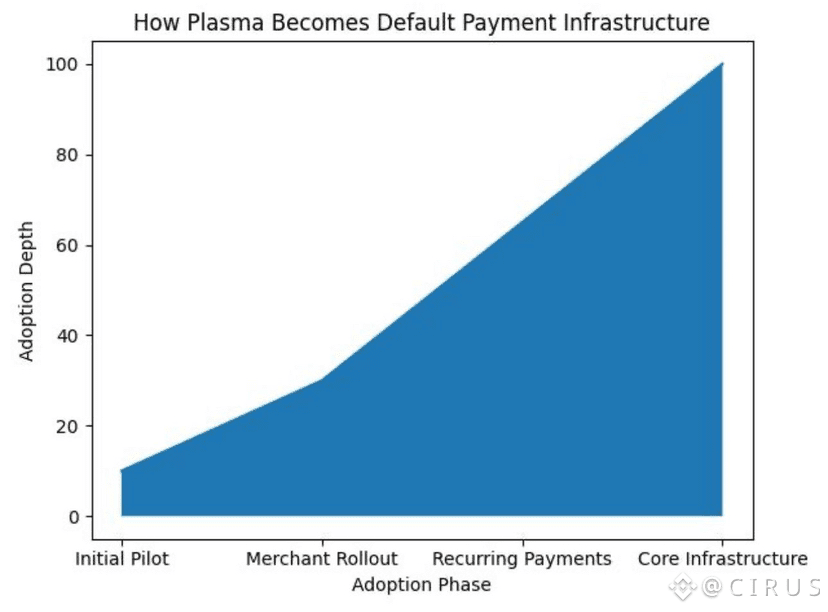
The biggest unknown is not whether a transaction will settle. It usually does. The real concern is whether settlement behaves consistently across time and volume. In business operations, inconsistency is more dangerous than inefficiency.
Plasma changes this equation by removing one of the most volatile variables in blockchain payments: gas fees. Zero gas on USD₮ transactions is not about being cheaper. It is about being predictable. When a merchant knows that every payment costs exactly what it says on the invoice, accounting becomes simpler. Risk models become cleaner. Customer disputes become easier to resolve.
This predictability changes internal conversations. Instead of asking whether crypto payments are worth the operational overhead, teams begin asking why they should not route stablecoin payments through Plasma by default. That shift is subtle, but it is how infrastructure adoption actually happens.
Another angle often missed is how payment processors themselves evaluate networks. Confirmo’s role is not to experiment. Its role is to provide reliability to clients who depend on it. Supporting Plasma signals that Plasma meets a threshold where failures are unlikely, not just theoretically preventable.
Plasma’s design reduces the number of failure modes a payment processor must manage. There is no need to dynamically estimate fees, no need to warn users about congestion, and no need to absorb unexpected settlement costs. Each removed variable lowers operational stress.
This matters especially for payroll and recurring payments. Businesses running payroll cannot tolerate uncertainty. A system that works ninety nine percent of the time is not acceptable if the remaining one percent creates delays or discrepancies. Plasma’s settlement model aligns with this reality by making stablecoin transfers behave more like traditional digital payments.
There is also a psychological layer. Businesses adopt what feels boring. The moment a payment rail stops requiring explanation, training, or special handling, it becomes acceptable. Plasma does not ask merchants to understand blockchain mechanics. It asks them to accept a digital dollar that settles cleanly.
Confirmo acts as a translator here. Merchants continue using existing dashboards, APIs, and reporting tools. Plasma operates underneath, absorbing complexity without exposing it. This separation is essential for mainstream usage. Businesses do not want to become infrastructure experts.
From a broader ecosystem perspective, this integration reframes what success looks like for Plasma. Instead of measuring adoption by transaction count alone, success can now be measured by how much business activity flows through it invisibly. That kind of usage is quieter, but it compounds.
As more merchants process stablecoin payments through Plasma, liquidity patterns stabilize. Usage becomes recurring rather than speculative. The network’s value becomes tied to real economic flows instead of market cycles. This is a different growth trajectory than hype-driven adoption.
There is also an important implication for regulators and compliance teams. Stablecoin payments with predictable settlement and clear reporting are easier to audit than fragmented onchain activity across volatile fee environments. Plasma’s structure aligns better with existing compliance workflows, even without being explicitly regulatory-focused.
Over time, this alignment reduces friction not just for merchants, but for institutions evaluating crypto infrastructure. Payment rails that resemble existing systems in behavior, even if they differ in architecture, face less resistance.
My take is that this integration matters less because of who announced it and more because of what it normalizes. It makes it reasonable for businesses to treat stablecoin payments as routine rather than exceptional. Plasma does not try to change how businesses think. It adapts to how they already operate.
That is often the difference between technology that stays experimental and infrastructure that quietly becomes indispensable.

