
Most people analyze blockchains as if they’re consumer products. Faster UX, louder narratives, bigger communities. That lens completely misses what Dusk is trying to do.
Dusk doesn’t compete in the same category as retail-focused Layer 1s. It competes with legacy financial infrastructure — systems that prioritize correctness, auditability, and legal defensibility over speed or excitement.
Once you frame it that way, many of Dusk’s design choices stop looking conservative and start looking intentional.
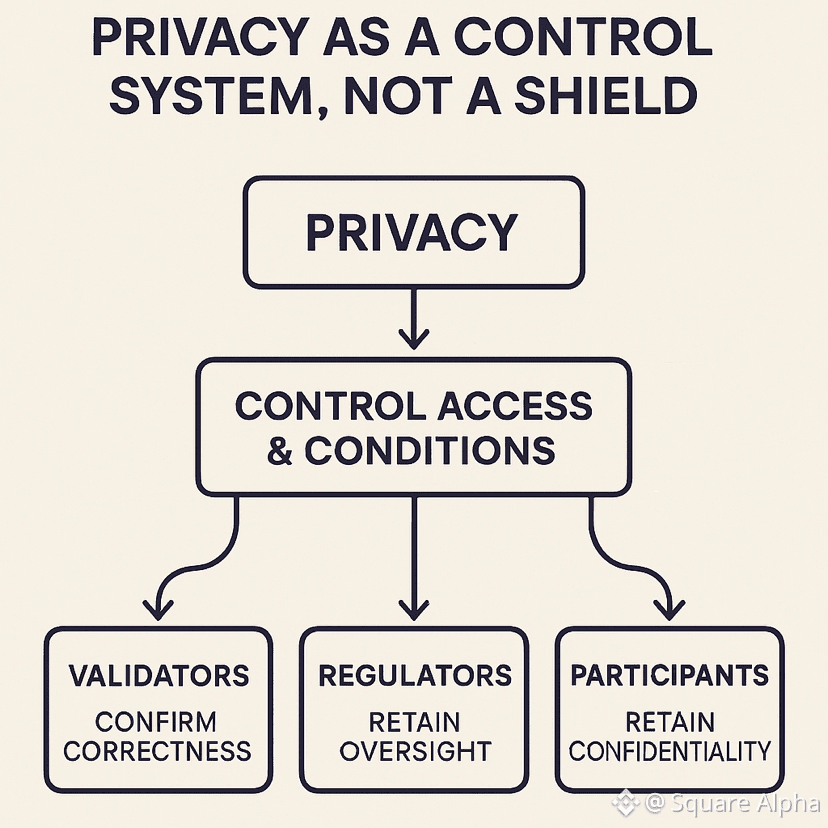
Privacy as a Control System, Not a Shield
The biggest mistake people make when evaluating Dusk is assuming its privacy model exists to hide information. It doesn’t.
Dusk’s privacy exists to control who can see what, and under which conditions. That’s a governance problem, not a cryptography flex.
Through components like Hedger, transaction validity can be proven without broadcasting sensitive details across the network. Validators confirm correctness. Regulators retain oversight paths. Participants retain confidentiality.
This is fundamentally different from chains that bolt privacy on after execution. On Dusk, privacy is part of the execution logic itself, which makes enforcement predictable rather than discretionary.
In regulated finance, predictability is everything.
Why DuskEVM Is About Institutions, Not Composability
EVM compatibility is often marketed as a growth hack. On Dusk, it’s a risk-mitigation strategy.
Institutions don’t ask whether a blockchain is innovative. They ask whether it’s familiar enough to audit, explain, and insure.
By settling Solidity-based contracts directly on Dusk’s Layer 1, DuskEVM allows regulated entities to deploy applications without rewriting their internal playbooks. Tooling stays familiar. Audit processes remain intact. Legal exposure is reduced.
This doesn’t maximize developer experimentation — it maximizes institutional comfort. That tradeoff is deliberate.
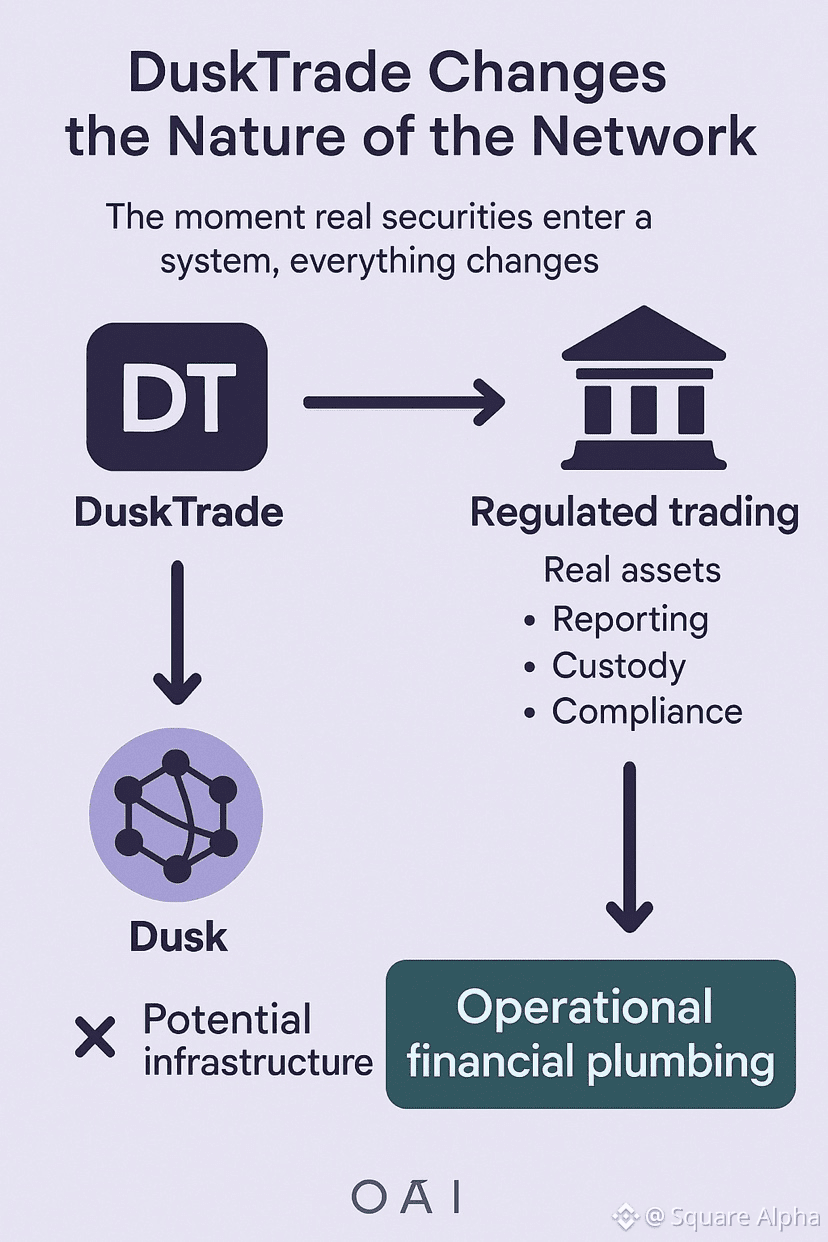
DuskTrade Changes the Nature of the Network
The moment real securities enter a system, everything changes.
With DuskTrade, Dusk is preparing to host regulated trading activity tied to real assets, not synthetic representations. The involvement of a licensed European exchange means reporting standards, custody rules, and compliance checks are non-negotiable.
This is where many blockchains fail — not because the tech breaks, but because governance does.
If DuskTrade functions as intended, Dusk stops being evaluated as “potential infrastructure” and starts being judged as operational financial plumbing. That’s a higher bar, but it’s also where long-term relevance is earned.
The Economic Reality of DUSK
$DUSK isn’t designed to reward attention. It’s designed to reward usage.
Transaction settlement, staking, validator participation, and regulated application activity all rely on the token. That ties value accrual to network behavior, not marketing cycles.
This model is uncomfortable for speculators and attractive to system designers. It implies slow beginnings, uneven liquidity, and delayed recognition — but also resilience once usage arrives.
If Dusk works, demand emerges naturally. If it doesn’t, no amount of narrative will compensate. That clarity is rare.
Why Dusk Is Easy to Ignore — and Hard to Replace
Dusk doesn’t optimize for headlines. It optimizes for survivability inside regulated environments.
That makes it easy to overlook in fast markets and hard to replicate in slow ones. Few teams have the patience, legal alignment, or architectural discipline to build at this intersection.
Whether Dusk succeeds or not will depend on execution and adoption — not sentiment. But structurally, it’s one of the few projects clearly built for the world regulators are creating, not the one crypto wishes existed.
And that’s why it remains relevant, even when it’s quiet.
