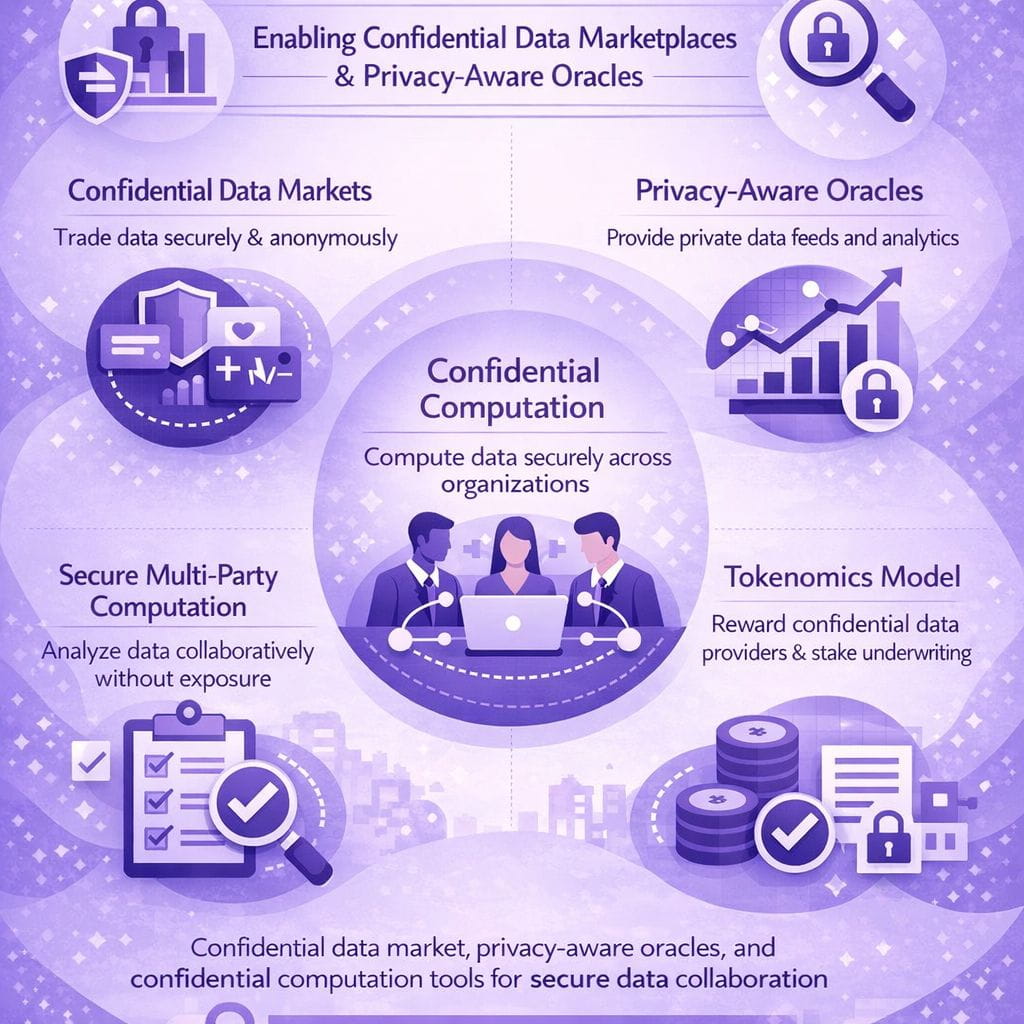
DUSK has a unique opportunity to support a new generation of data marketplaces where sensitive datasets—such as credit histories, health-related statistics, or proprietary supply-chain telemetry—can be monetized without exposing the underlying inputs. Through its ability to deploy confidential smart contracts using selective disclosure protocols, DUSK enables data providers to monetize verifiable, privacy-preserving claims about their datasets (for example, “I can prove this portfolio has an aggregate risk level of X”).
This approach provides strong economic incentives for holders of otherwise inaccessible datasets to participate in marketplaces, as it mitigates the risks associated with releasing raw or sensitive data.
A key counterpart to this capability is the concept of privacy-friendly oracles. Traditionally, oracles either publicly broadcast data feeds or rely on trusted third-party intermediaries. In contrast, DUSK oracles can present cryptographic attestations of off-chain events to confidentiality-preserving smart contracts without revealing the underlying data. For example, a price oracle may generate a compact proof that an index crossed a specific threshold required to trigger a payout, while the proprietary methodologies and source data remain private to the oracle operator.
Furthermore, the confidential computation model enabled by the DUSK codebase facilitates composable privacy. This allows multiple parties to contribute private inputs to a joint computation—such as credit-risk aggregation for a consortium loan—without any participant being able to access another participant’s data. This capability is particularly relevant for consortium-based use cases, such as shared banking solutions, where aggregated insights can be produced for mutual benefit while preserving individual data confidentiality.
Another significant differentiator is DUSK’s approach to regulatory sandbox friendliness. Through cryptographic proofs that enable selective disclosure and temporary auditor access, DUSK allows specific visibility to be granted to regulators when required—without placing consumer data in the public domain. This model supports regulatory compliance, accelerates institutional acceptance, and facilitates smoother entry into regulated markets.
From a developer and product perspective, DUSK research highlights the advantages of modular privacy primitives for market participants. These include privacy-preserving listing contracts, settlement channels, and licensing proofs for data consumers. Market operators can implement diverse monetization models such as on-chain proof verification fees, selective disclosure subscriptions, and attestation-based query pricing. This creates sustainable revenue opportunities for data custodians while preventing exposure of raw personally identifiable information (PII).
Operational risk within these systems can be mitigated through cryptographic mechanisms embedded directly into dispute resolution processes. The use of escrowed cryptographic proofs enables the development of commercially viable, trust-minimized oracle solutions.
In summary, DUSK extends the functionality of private systems beyond transaction confidentiality to enable entirely new business primitives: private data marketplaces, privacy-preserving oracles, and confidential consortium computations. These innovations unlock revenue-generating and collaborative opportunities while maintaining strong data privacy guarantees. As a result, DUSK’s potential market extends far beyond tokenization and data commerce alone.