

Walrus is simple on purpose.
Many systems become complex over time. New features are added. Shortcuts appear. Storage is pushed into the background and treated as someone else’s problem. Data is assumed to be available forever, without strong guarantees.
Walrus does not rely on assumptions.
It treats data availability as something that must be enforced, not hoped for. Once data is published, it becomes part of history. History cannot be recreated later if it is lost.
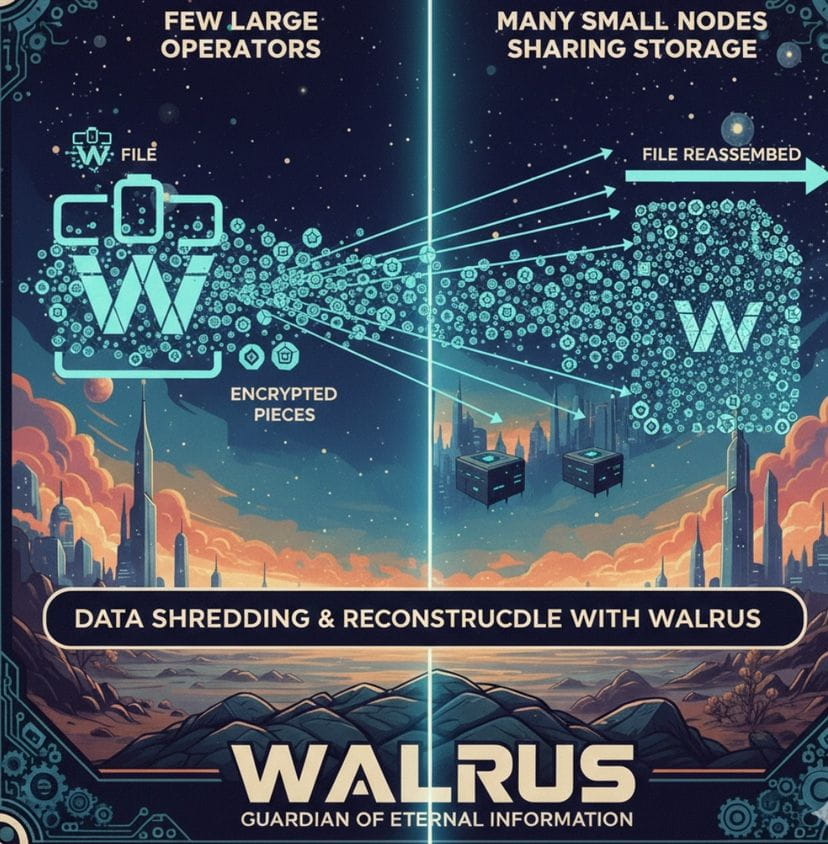
Walrus encrypts data before storing it. Storage nodes do not know what the data contains. They only know they are responsible for keeping their assigned pieces online. This protects users and reduces risk. No node can read or control the data it holds.
Instead of full copies, Walrus uses fragments. This lowers costs and makes long-term storage realistic. The system is designed so the data can always be rebuilt, even if some nodes fail or disappear.
This matters because storage pressure grows quietly. As data gets older, fewer people want to keep it. Systems that rely on full replication slowly become harder to maintain. Participation shrinks. Control concentrates.
Walrus avoids this by design.
$WAL connects real work to real rewards. Nodes are paid for doing their job correctly over time. Availability becomes a measurable action, not a promise.
Walrus does not compete with applications. It sits underneath them. Apps can change. Platforms can evolve. Walrus stays focused on keeping data accessible.
This focus gives Walrus strength. It does not chase trends. It does not need to reinvent itself. It does one job and keeps doing it.
That is what long-term infrastructure looks like.