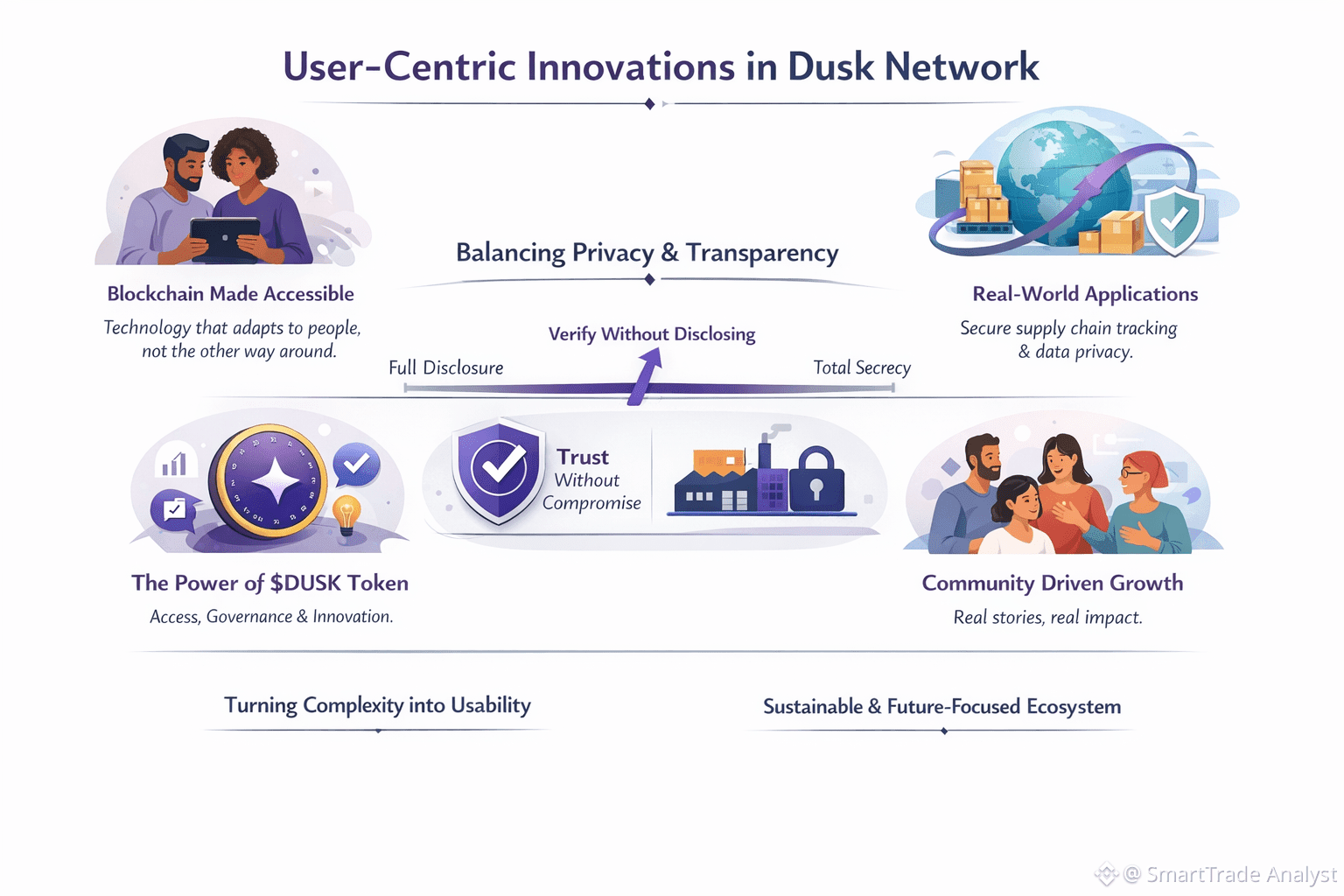
Blockchain technology has long aimed to deliver efficiency, transparency, and decentralization. However, for a vast majority of people, blockchain has remained an abstract and inaccessible concept. Complex interfaces and highly technical terminology have created a disconnect between blockchain’s promised use cases and the actual user experience. Dusk Network begins with a simple but powerful assumption: technology should adapt to humans, not force humans to adapt to technology.
Within Dusk, privacy is treated as a practical necessity rather than a theoretical ideal. Many modern blockchain architectures attempt to solve trust by exposing everything, often overlooking the equally important need for confidentiality. Dusk introduces a more balanced approach by prioritizing verification over disclosure. While this distinction may appear subtle, it is a defining characteristic of the network. It enables trust to exist without compromise.
The approach Dusk takes toward privacy can best be described as functional rather than philosophical. Whereas many blockchain platforms operate under the belief that “complete transparency is essential,” Dusk adopts a more nuanced position. Its ability to “verify without disclosing” allows transparency and confidentiality to coexist. For users, this translates into something highly valuable: trust that does not require sacrificing sensitive information.
The real-world implications of this approach become clear when viewed through practical environments such as supply chains. Tracking a product from origin to destination is not merely about visibility; it is about control over information. With Dusk, participants can confirm authenticity and integrity without exposing proprietary data or intellectual property. Rather than disrupting existing operations to force blockchain adoption, Dusk integrates seamlessly into established workflows.
This philosophy is further reflected in the human-centered design of the $DUSK token. Instead of functioning as a speculative centerpiece, the token serves as an access mechanism for participation. Users can create and interact with applications, take part in governance, and influence network decisions. This fosters a sense of shared responsibility, where users are not passive consumers but active contributors shaping the system they rely on. In this context, value emerges from participation rather than volatility.
The role of the $DUSK token continues to reinforce this user-oriented approach. By enabling application usage and voting rights, the token strengthens the feeling of ownership within the network. Users engage as participants rather than observers, and the value they derive is tied to their involvement rather than market speculation.
When it comes to sustainability, Dusk takes a grounded and realistic approach. Unlike projects that view growth as limitless expansion, Dusk emphasizes alignment with real-world requirements. There is a clear awareness of compliance, governance, and regulatory considerations, all of which play a crucial role in long-term sustainability. As a result, users can feel confident that the network is designed to endure rather than chase short-term momentum.
Ultimately, at the core of Dusk Network lies a shift in how blockchain itself is experienced. Decentralization becomes a source of choice rather than disorder. Privacy acts as an enabler, not a barrier. Innovation is no longer measured by added complexity but by the removal of unnecessary friction. Technology fades into the background as purpose moves to the forefront.
User-centric innovation does not mean oversimplifying ideas until they lose their meaning. Instead, Dusk Network focuses on building powerful systems that are accessible, practical, and aware of real-world limitations. In doing so, Dusk presents a vision of a future where blockchain is not something users must conform to, but something designed to accommodate them.