


The $VANRY token, native to the Vanar ecosystem, introduces a distinctive and ambitious economic model: an AI subscription burn mechanism designed to create sustained deflationary pressure. This comprehensive analysis examines whether this mechanism can deliver meaningful long-term deflation, how it operates in practice, its comparative advantages, and its likely impact on VANRY's price behavior through the next anticipated cryptocurrency bull cycle. The core hypothesis is that while token burns alone are not a panacea, Vanar's model—which ties token destruction directly to a real, recurring, and scalable revenue stream from AI services—represents one of the most structurally sound deflationary designs in the crypto-asset space, potentially positioning VANRY for unique price resilience and appreciation.
Before analyzing the burn, one must understand the ecosystem it fuels. Vanar is not merely another Layer-1 blockchain; it is a purpose-built platform designed to be a premier destination for entertainment, gaming, and AI applications. Built as a legal entity in Dubai and leveraging a modified Layer-1 protocol originally derived from Polygon Edge, Vanar prioritizes high throughput, low latency, and compliance-friendly features. This design makes it particularly attractive to mainstream brands, gaming studios, and AI developers who require performance, scalability, and a clear regulatory pathway.
Vanar’s mainstream-first strategy differentiates it from many Web3-native projects. Partnerships such as its collaboration with Lionsgate for immersive entertainment experiences demonstrate a focus on bridging Web2 intellectual property and audiences into Web3. This onboarding of mainstream users is critical for generating the ecosystem activity that feeds the burn mechanism.
Within this ecosystem, VANRY serves as the central utility token. Its primary functions include network fees for transactions and gas, governance participation through voting rights, access to Vanar’s AI services such as AI-powered NPCs, content generation tools, and data analytics, and staking for network security and validator rewards. It is this role as the exclusive payment currency for AI services that powers the deflationary mechanism.
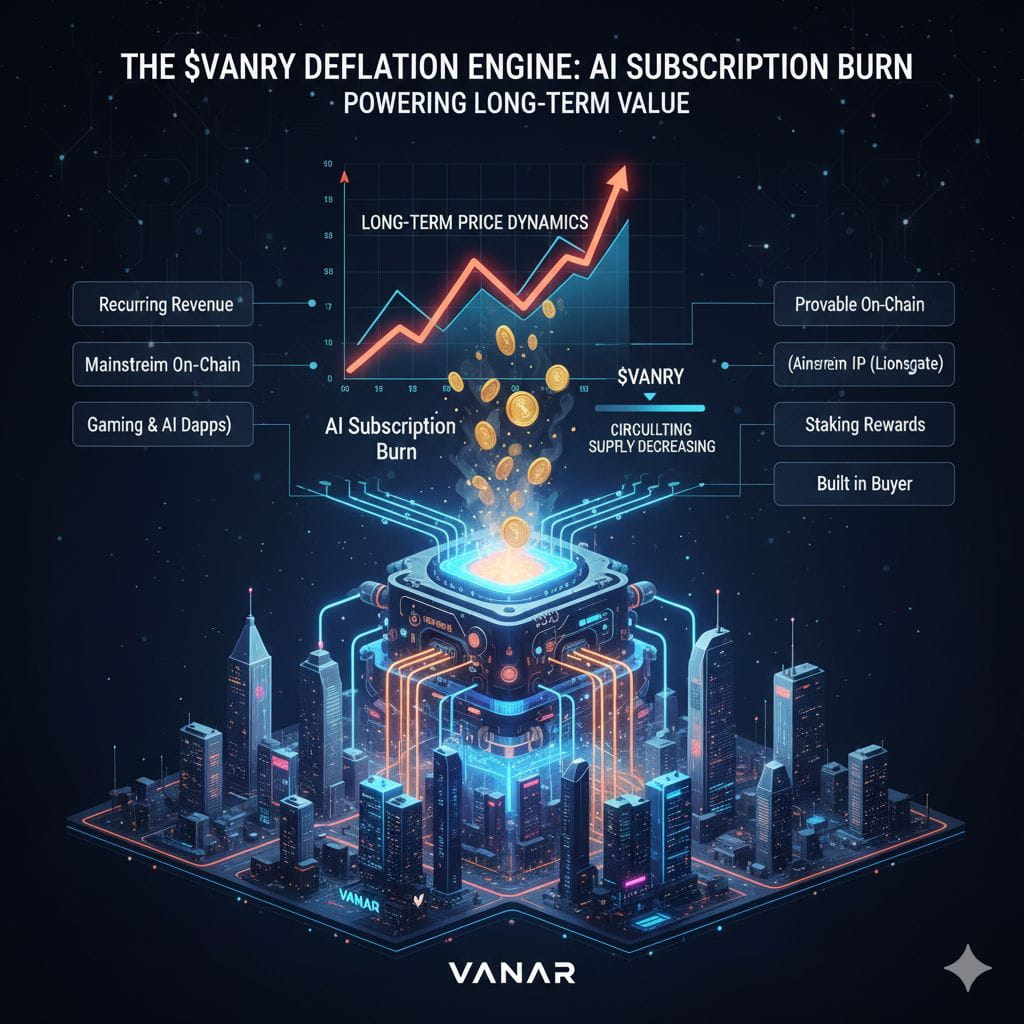
The burn mechanism follows a direct and transparent process. Developers, studios, or companies subscribe to Vanar’s AI services and pay exclusively in $VANRY tokens. This creates immediate utility-driven demand as users must acquire tokens from the open market. A significant portion of this subscription revenue is allocated to a buy-and-burn fund, which regularly purchases VANRY tokens from the market and permanently removes them from circulation by sending them to a burn address.
This structure has several key strengths. Because the model is based on subscriptions, it produces recurring and predictable burn activity similar to corporate stock buybacks. It is tied to real economic activity rather than speculative treasury actions, and all burns are publicly verifiable on-chain, increasing transparency and trust.
The mathematical impact of the burn depends on the burn allocation percentage, AI service adoption rates, average revenue per user, token price, and circulating supply. If AI revenue grows faster than the token price, the number of tokens burned can increase even in rising markets. This can create a positive feedback loop where increased usage leads to more burning, greater scarcity, and potential price appreciation.
The model’s strength lies in growth-driven deflation. As Vanar’s ecosystem expands, subscription revenue rises. If this growth exceeds new token issuance from staking rewards or unlock schedules, circulating supply declines. A decreasing supply paired with rising utility enhances scarcity and perceived value. Psychologically, an automated burn acts as a built-in buyer in the market and signals long-term commitment to tokenholder value. In a crypto landscape dominated by inflationary assets, a credibly deflationary token can stand out as a store-of-value within its niche.
However, this model is not without challenges. Its success depends on sustained adoption of Vanar’s AI services. These tools must remain competitive and attractive to developers and enterprises. Revenue will fluctuate with token price volatility, meaning that higher prices could reduce the number of tokens burned for the same dollar revenue. Staking emissions and token unlocks must also be outweighed by burn volume to achieve net deflation. Additionally, investors are increasingly skeptical of burn narratives without strong product adoption to support them.
The burn mechanism has meaningful implications across different phases of a bull market cycle. During early accumulation and awareness phases, the AI-linked deflation narrative can attract long-term investors and support steady appreciation. In mania phases, the combination of reduced supply and speculative demand could drive parabolic price movement. During market contractions, the burn may act as a stabilizing force because lower prices allow more tokens to be burned with the same revenue, potentially strengthening price floors.
Compared to many tokens, VANRY benefits from narrative synergy between AI innovation and tokenomics. Its constant buy pressure reduces sell-side pressure and offers a structure that resembles corporate share buybacks, making it easier for institutional investors to understand. However, risks remain, including overvaluation from hype, macroeconomic market downturns, and increasing competition in the AI blockchain sector.
Deflation alone is not enough to sustain long-term value. Ecosystem growth from partnerships and applications drives primary demand. Staking incentives reduce circulating supply further. Leadership execution and roadmap delivery are critical. Market sentiment toward AI crypto assets will heavily influence price action regardless of internal mechanics.
The VANRY AI subscription burn mechanism represents one of the most structurally aligned tokenomics models in crypto today. It directly links platform success to token scarcity using external, recurring revenue rather than inflationary funding. For the next bull cycle, this provides a strong fundamentals-based narrative during growth, powerful momentum during speculative phases, and potential stability during downturns.
Ultimately, the burn mechanism is a powerful engine, but its performance depends on the strength of the ecosystem driving it. If Vanar achieves meaningful adoption in entertainment, gaming, and AI services, the deflationary design could position VANRY as a standout example of next-generation, utility-driven cryptocurrency economics.
Disclaimer: This analysis is for informational purposes only and does not constitute financial advice. Cryptocurrency investments are highly volatile and risky. Always conduct your own research and consider your financial situation before making investment decisions.
@Vanarchain #Vanar $VANRY #Vanar
