
Ether compatibility is now a two sided sword in blockchain infrastructure. On the one hand, it will reduce the entry barrier of developers through the provision of familiar tooling and execution models. On the other, it regularly brings in assumptions which are thoroughly inconsistent with regulated finance - most notably, unconditional public execution and observability by the global state. This trade-off can hardly be tolerated in case of institutions. Being compatible cannot be done at the expense of exposure.
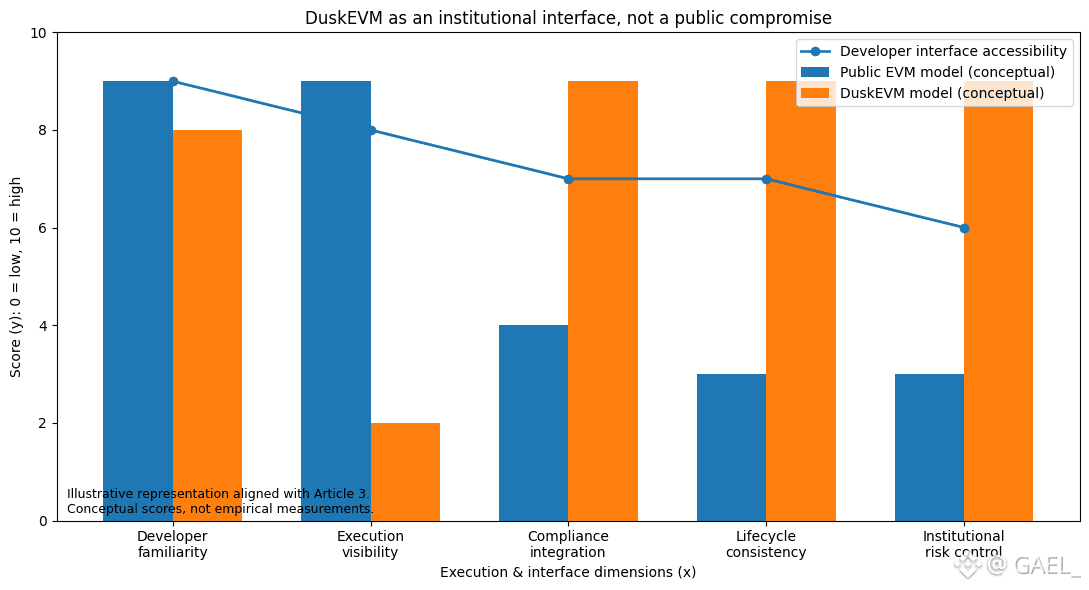
Here @Dusk Foundation distinctly draws an architectural line. DuskEVM is not an effort to model its convenience on publicly available blockchains. It is intended as a institutional interface: a means of builders to get into the EVMigmatized development without assuming the upfront transparency of the case constitutive of a public network.
The majority of EVM settings presuppose that the execution of smart contracts should be publicized by default. The inputs, logic and the resulting changes of the state are freely available to any node runners or chain indexer. This transparency facilitates the practice of permissionless experimentation, but is in direct opposition to the practicalities of managed assets. Institutions cannot reveal pricing logic, settlement mechanics or contractual conditions just to have programmability.
DuskEVM re-defines this issue by separating the interface with the developer with the execution visibility model. As a developer, the environment is known. Known paradigms are used in writing the contracts, tooling is easily available, and the learning curve is also low. However, under that interface, it is executed in the confidential protocol layer of @Dusk . EVM is not operated on transparency-first ledger; it is operated within the framework of a selective disclosure system.
This is not the cosmetic difference. It is an alteration of what is practically constructible. With @Dusk EVM developers are able to run smart contracts, managing regulated workflows, such as issuance conditions, transfer restrictions, corporate actions, without showing the logic to the whole network. The protocol confirms the correctness and still maintains confidentiality of the execution specifics. This does not mean hiding the behavior under supervision, it is to ensure the unnecessary broadcasting of proprietary information does not take place.
Notably, DuskEVM does not outsource compliance. A significant proportion of what are known as institutional EVM solutions is based on gateways being allowed, off-chain verification or on-top legal contracts over public execution. These strategies divide the responsibility and augment risk of operations. @Dusk , as an alternative, enables compliance logic to coexist with application logic, which is imposed on execution instead of retrospective. The interface is the same, however, the guarantees are completely different.
Institutionally speaking, this is more important than raw performance or composability accounts. Risk containment, auditability, and predictability are factors that lead to the adoption of financial infrastructure. @Dusk EVM also complies with these priorities as the developers do not have to redesign systems just to keep them out of the limelight. The environment does not compel institutions to decide between programmability and confidentiality.
Lifecycle consistency is another very important factor. On numerous platforms, although issuance or execution is initially done in a private setting, assets ultimately come to a publicly settled layer where exposure comes back. DuskEVM works under a protocol that ensures the secrecy of the asset lifecycle. Issue, execution and settlement is done under the same privacy and compliance assumptions. It is this coherence that enables @Dusk to be used as infrastructure as opposed to being an experiment.
It is also notable what DuskEVM fails to be. It is not a multi-purpose open DeFi public execution environment. That is a deliberate choice. Narrowing down its focus to institutional and regulated usage cases allows Dusk to compromise less than would be the case when it serves both incompatible audiences on the same execution layer.
Finally, @Dusk EVM reveals that the compatibility of EVM does not necessarily imply the openness. The fact that the EVM is viewed as an interface, as opposed to a philosophy, makes Dusk accessible to the developers and redefines execution guarantees. In the case of institutions, it is the distinction between tuning in on the blockchain technology to financial reality and strapping financial systems to technical limitations to which they do not belong.
In that way, it is less compatible as an end-to-end requirement but rather about control, which is the control over visibility, compliance, and execution integrity. And that is what institutional infrastructure needs.
