
The majority of blockchains consider tokens as a product of activity. After execution, fee is collected, after validation, rewards are given out and settlement is made when the computation has already been carried out. This sequencing is effective with simple transaction systems, but it does not work when infrastructure is supposed to handle persistent and autonomous AI workloads.
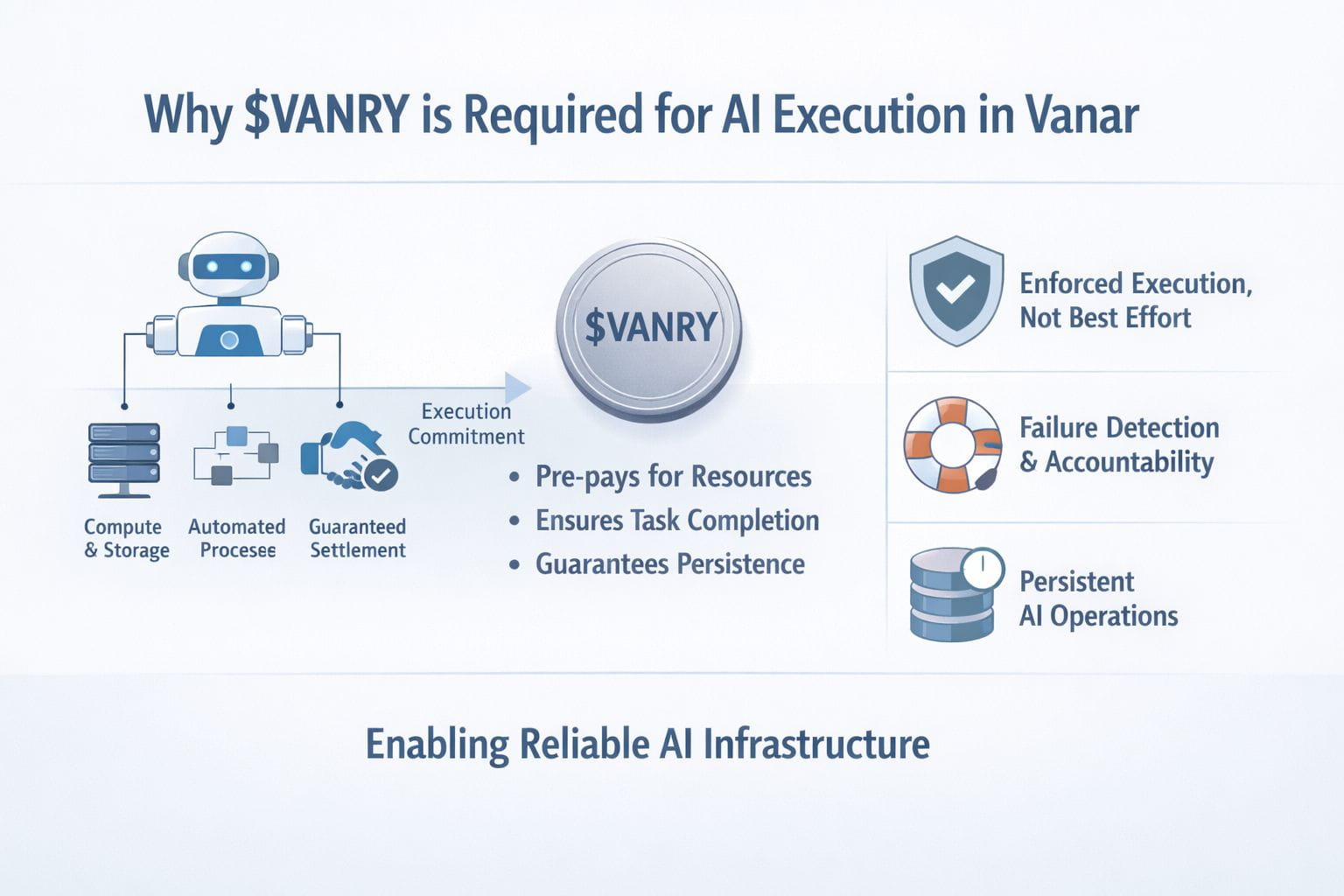
@Vanarchain takes a different standpoint to the problem. In an AI first world, implementation has to be ensured beforehand. The settlement, automation, computation, and memory persistence cannot be based on best-effort incentives. They require enforcement. This is where $VANRY will reside, as not a token of transactional fee, but as an execution requirement that Vanar has built directly into its infrastructure layer.
AI systems do not act in the same way as normal persons. One-off transactions are not presented by them. They are stateful, invoke repetitive actions, service-to-service interaction and rely on confidence in completeness. When the execution of the operation can be postponed, reverted, or abandoned because of a lack of incentives, the system fails. Vanar responds to this by conditioning its execution on initial economic commitment. VANRY is that commitment.
Within @Vanarchain , the use of $VANRY is not linked to narrative use, but operational flow. Resources are needed to be allocated before an AI task, automation sequence or persistent process can be run. Storage, compute, coordination and settlement capacity are not taken to be unlimited and free. $VANRY is the mechanism that links resource allocation to enforceable payment making execution economically guaranteed instead of probabilistic.
Such a design decision is important since AI architecture cannot be based on post-hoc settlement. An AI agent that coordinates actions in the time, either through memory maintenance, workflow, or communicating with user services, cannot stop halfway when the fees change or are congested. VANRY being an execution input will mean that, once a process starts, Vanar will guarantee that the infrastructure will fulfill it in stipulated parameters.
More importantly, it also transforms the way of managing failure. Failed execution in most networks is ambiguous: is it network, pipe or even user error? The model by @Vanarchain eliminates this ambiguity. In case of a $VANRY, the implementation is transferred to the infrastructure. A failed process can be detected, held responsible and financially contained. It is a precondition to construct systems that the institutions and consumer-related products can rely on.
The other implication is persistence. AI systems are not ephemeral. They need permanent memory, a steady state access, and availability. The infrastructure of Vanar is not built on a throughput basis, but on persistence. VANRY supports this by investing not only in transaction, but in continuity. Implementation is not a one-time event, it is a life cycle and VANRY puts the life cycle to an economic anchor.
This methodology also makes blockchain complexity unseen by end users. Consumers who will have to deal with AI-driven applications do not have to be aware of gas properties or network properties. Economic logic is processed at the infrastructure level. Developers establish reliability on predictable execution assurances, AI agents are continuously running, and customers enjoy reliability in their services. VANRY silently ensures this reliability in the background.
Noteworthy, it is not abstract design. Vanar uses this execution-first model in building their real products and tooling. The token does not await future utility, it is already entrenched in the point of execution coordination and settlement. That is why one should take VANRY as operation fuel and not a narrative asset.
The infrastructure to enable AI on scale will not be measured by throughput metrics or the theoretical decentralization in the long run. It will be scored on whether execution actually occurs, whether systems are maintained and failure is managed in a predictable manner. @Vanarchain @undefined satisfies the requirements in a structural, as opposed to a promotional, manner. $VANRY exists because AI infrastructure cannot operate without forced execution- and Vanar is built around that fact.
