
The modular architecture was a clever approach to compliance changing with the evolving rules when I first looked at the structure of @Dusk to deal with regulated finance. In contrast to rigid chains, the layers of Dusk, namely the settlement, execution, and data availability, are meant to have flexibility without destabilizing the core to facilitate long-term utility in settings such as MiCA where regulations change over time. The core of this is the Rusk protocol, the state transition functionality of the network that brings it all together to do compliant, private operations.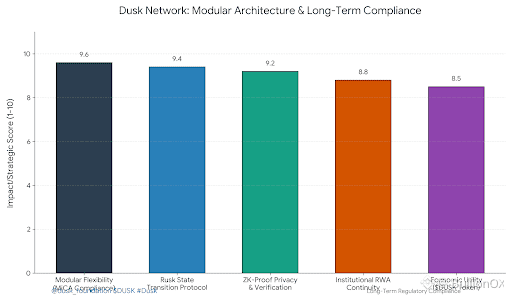
Rusk deals with change of states in transactions, therefore, being modular by imposing a separation of concerns. The consensus and finality in Proof of Stake is facilitated by the settlement layer (DuskDS), which guarantees that the states are irreversible to guarantee regulatory assurance. Rusk aligns this with the execution layer, enabling updates to contract logic or parameters through governance without hard forks, necessary to comply with changing laws, such as by implementing new KYC requirements.
Long term compliance is made possible by this modularity, which supports proxy patterns in smart contracts. Institutions can make rules governing tokenized assets (e.g. investor prohibitions) more modern (e.g. by treating an address as constant) and rely on Rusk to execute deterministically. The ZK integration of Rusk allows these changes to occur in the background and demonstrates that the new state is not in contravention without violating data and balances privacy with verification requirements.
In practical implementation, the architecture by Rusk is brilliant to RWAs. It enables the insertion of regulatory hooks so as when the rules are changed, Rusk cryptographically verifies the transitions, which include changes in the involved modules. This minimizes migration risks on the part of institutions where continuity is central to legal requirements such as reporting.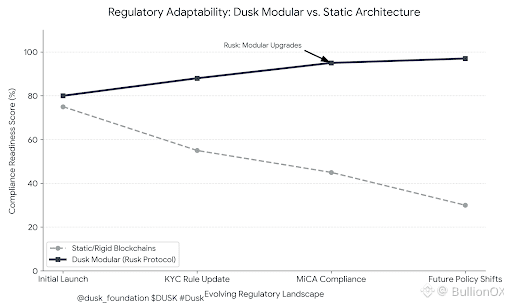
$DUSK token will be the economic layer and enable Rusk to be easily modular, with state transitions powered by gas and secure upgrades powered by staking, in line with compliant evolution.
In my opinion, Rusk allows Dusk to be designed in a modular way which ensures long term regulatory compliance, adopting stability over anarchy which can be ideal to the institutional trends of Web3.
What is your experience with compliant modular chains?
