
The year 2026 has brought a long-awaited realization: institutions don’t actually want "crypto." They want the efficiency of the blockchain without the vulnerability of a public ledger.
For years, the "Privacy vs. Compliance" debate felt like a zero-sum game. You either had a transparent chain like Ethereum where every competitor could see your trade size, or a dark pool where regulators couldn't verify AML (Anti-Money Laundering) rules. Enter Dusk Network—the protocol that effectively ended this stalemate by becoming the first Layer-1 to treat privacy not as a mask, but as a compliance tool.
The Citadel & The Shield: Redefining Digital Trust
Most people view privacy as a way to hide. In the institutional world, privacy is security. If a bank tokenizes €100M in bonds, they can’t have that data sitting on a public explorer for front-runners to exploit.
Dusk’s secret weapon is Citadel. Think of it as a digital "Self-Sovereign Identity" (SSI) vault. It allows an institution to prove they are KYC-compliant without broadcasting the underlying personal data to the entire world.
How it works in a real-life scenario:
Imagine DuskTrade, the 2026 flagship platform. A European broker wants to list €300M in tokenized securities.
• The Problem: EU MiFID II regulations require strict reporting, but the broker's clients demand trade confidentiality.
• The Dusk Solution: Using Zero-Knowledge Proofs (ZKP), the broker "proves" to the regulator that the buyer is authorized and the funds are clean. To the public, the transaction looks like a shielded event. The regulator sees the "truth," while the market sees only the "validity."
Technical Moats: Piecrust and Phoenix
To achieve this, Dusk didn't just fork an existing chain; they built a custom stack from the ground up.
1. Piecrust VM: This is the world’s first ZK-native virtual machine. While other chains struggle to add privacy as a "plugin," Piecrust makes private smart contracts the default setting. It’s fast, lean, and written in Rust, catering to the "hard-tech" standards institutions demand.
2. Phoenix Model: This is Dusk’s unique transaction structure. It combines the privacy of a UTXO model (like Bitcoin/Zcash) with the smart contract flexibility of an account-based model (like Ethereum). This "dual-engine" allows for complex DeFi maneuvers while keeping the balances hidden.
Visualizing the Flow: The Institutional "On-Demand" Visibility
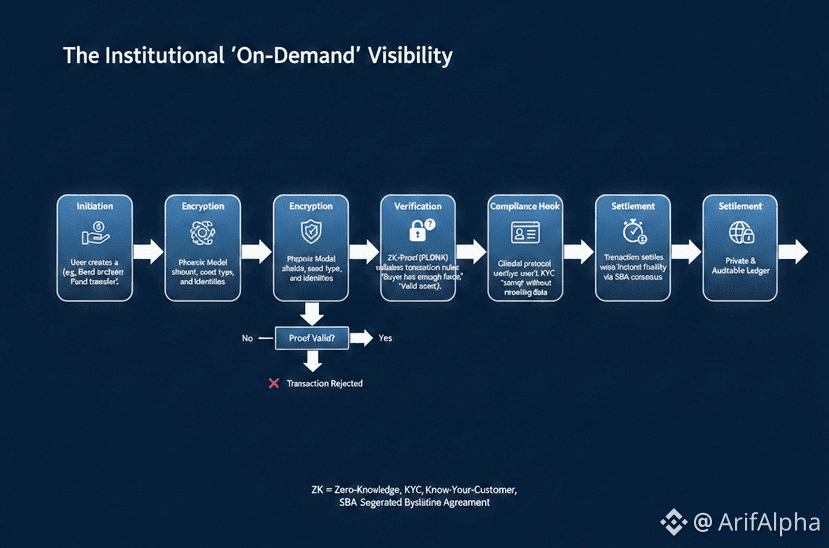
Step 1: Initiation → User creates a transaction (Bond purchase).
Step 2: Encryption → Phoenix Model shields the amount and identities.
Step 3: Verification → ZK-Proof (PLONK) validates the transaction rules (e.g., "Buyer has enough funds") without revealing the balance.
Step 4: Compliance Hook → Citadel protocol verifies the user's KYC "stamp" is valid.
Step 5: Settlement → Transaction settles with near-instant finality via the SBA (Segregated Byzantine Agreement) consensus.
Why 2026 is the "Dusk Era" for RWAs
We’ve moved past the "RWA Hype." Real-world asset tokenization is now about infrastructure. Dusk is no longer just a tech experiment; it's a licensed environment. By partnering with entities like NPEX (a regulated Dutch exchange), Dusk has bridged the gap between code and law.
The tokenization of a building or a private equity fund isn't just about putting a "digital sticker" on it. It’s about ensuring that the asset follows its legal lifecycle—dividends, voting, and transfers—automatically and privately. Dusk’s Confidential Security Contract (XCS) standard is essentially the "ERC-20 for the banking world."
The Strategic Shift: From "Hiding" to "Selective Disclosure"
The beauty of Dusk is that it doesn't fight the system; it upgrades it. Institutions are migrating to Dusk because they can finally stop choosing between being "on-chain" and being "legal." They get the speed of DeFi, the privacy of a private bank, and the auditability of a public ledger—all in one.
As institutional holdings in the ecosystem are projected to climb from 45% toward 70%, the question is no longer about which chain has the most memes, but which chain has the most utility.
If you were a fund manager, would you prioritize the transparency of a public ledger or the "hide-by-default" security of a protocol like Dusk? Let’s discuss in the comments.
