
Hi everyone! Have you ever wondered what happens to your files when you upload them to the cloud? Most of us just trust that they will be there when we need them. But today I want to talk to you about a much smarter and safer way to store information using something called Walrus. Specifically we are going to look at a system called Asynchronous Complete Data Storage or ACDS. It sounds like a mouthful but I promise to break it down so it makes perfect sense.
What Exactly is Walrus and This New Storage Idea
When we talk about Walrus we are talking about a giant decentralized storage locker. Unlike a normal company that keeps your files on their own private servers Walrus spreads your data across many different computers. To make this work smoothly we use ACDS. This is basically a set of rules that makes sure your data is always reachable even if some of those computers break or try to act sneaky.
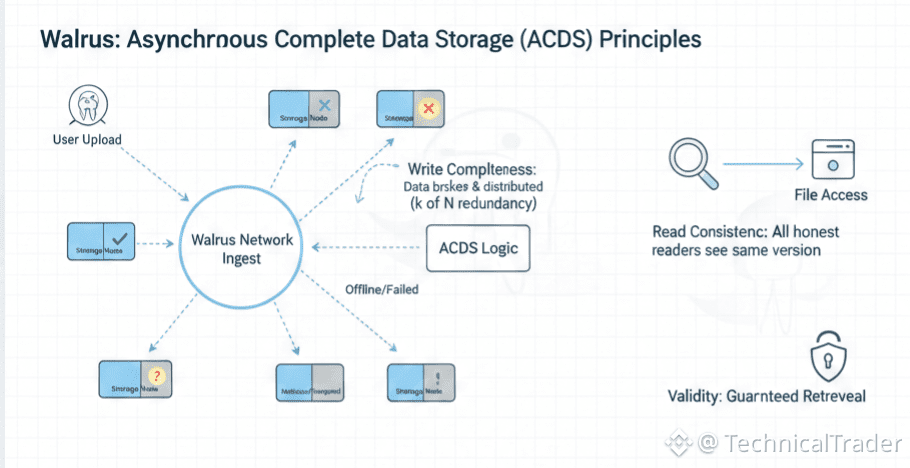
In a big network we have to assume that not everyone is going to be honest. Some nodes might fail or try to delete your data. Walrus is built to handle this by using math to ensure that as long as most of the network is doing its job your files stay perfectly safe. It is all about creating a system that does not have a single point of failure.
Making Sure Your Uploads are Successful in Walrus
The first thing we care about is something called Write Completeness. Think of it this way. When you save a photo to Walrus you want to know for sure that it is actually saved. Write Completeness is a guarantee that if you are acting honestly the network will take your file and break it into little pieces. These pieces are then sent to different storage nodes.
Even if some nodes go offline later Walrus only needs a few of those pieces to put your whole photo back together. It is like tearing a postcard into ten pieces and realizing you only need any four of them to read the whole message. This makes the system incredibly tough and reliable for you as a user.
Why Everyone Sees the Same Thing in Walrus
Have you ever looked at a website while a friend saw something totally different on their screen? That is a big problem in data storage. In Walrus we use a rule called Read Consistency to stop that from happening. This rule ensures that if two different people try to read the same file they will both get the exact same version of that file.
This is super important because it prevents confusion and errors. Whether you are checking a document today or your friend is checking it tomorrow the network ensures the result is identical. We want the system to be predictable so you never have to guess if the information you are seeing is the most current or correct version.
Ensuring Your Data is Always Valid in Walrus
Another big piece of the puzzle is called Validity. If you successfully save something to the Walrus network you should always be able to get it back. Validity is the promise that the network wont just lose your file in the shuffle. If the system tells you that your data is stored it must be able to prove it and show it to any honest reader.
This creates a high level of trust. You are not just throwing your files into a black hole. You are placing them in a system that is legally bound by its own code to give them back to you. This makes Walrus a very strong candidate for storing really important things like legal documents or precious memories that you cannot afford to lose.
How Walrus Stays Fast Even When the Internet is Slow
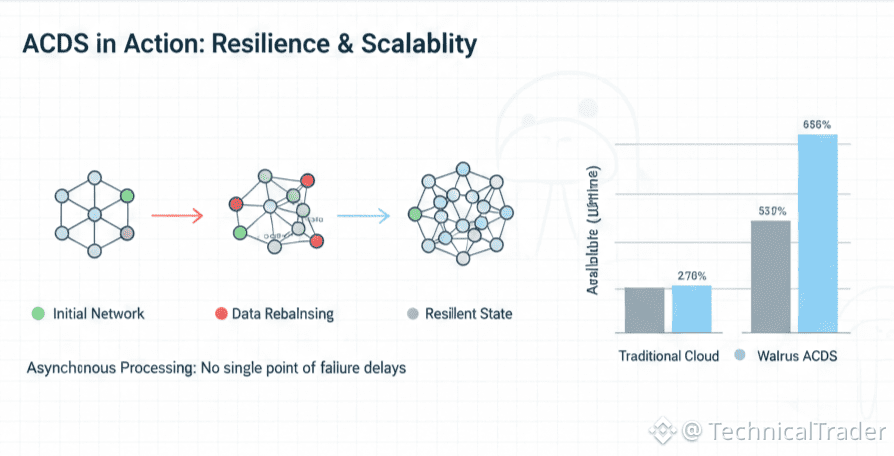
The word asynchronous in ACDS is actually really cool. It means that the system does not wait around for every single computer to answer at the same time. We all know the internet can be laggy or slow depending on where you are. Walrus is designed to keep moving forward even if some parts of the network are taking their sweet time to respond.
Because of this Walrus stays fast and efficient. It does not get stuck waiting for one slow server in another country. This flexibility allows the network to stay alive and healthy 24/7. It is a bit like a team of people working on a project where the work keeps going even if one person takes a slightly longer lunch break.
Handling Changes and New Nodes in Walrus
Networks are always changing. New computers join the Walrus system and old ones might leave to do something else. This is what we call churn. A good storage system needs to handle this without losing any data. Walrus is built to be dynamic meaning it can move data around and update its list of storage providers without you ever noticing a glitch.
We use committees of nodes to manage the work. As these committees change the rules of ACDS stay in place to protect your files. This means Walrus can grow from a small network to a massive global one while keeping your data just as safe as it was on day one. It is built for the long haul.
Why We Should Care About Decentralized Storage
At the end of the day we all want to feel like we own our digital lives.
Using a system like Walrus means you are not relying on one big corporation to be the gatekeeper of your information.
By using the smart rules of ACDS we are building a library for the world that no one can shut down or change. It is a very human way of looking at technology.
I think it is amazing how these complex ideas can be used to make our lives simpler and more secure.
When we use Walrus we are participating in a new kind of internet that is fair and open. It is a big step forward for everyone who uses a computer or a phone.
We are finally getting the tools we need to keep our data safe forever.
what you think about this? don't forget to comment 💭
Follow for more content 🙂

