

In crypto, we often talk about speed, throughput, and features as if they are the final destination. New chains launch promising faster execution, lower fees, and cleaner developer tooling, and for a while, that is enough to attract attention. But when you step outside crypto-native use cases and look at payments businesses, card issuers, fintech platforms, and real money flows, a different priority emerges. What matters most is not raw performance. What matters is liquidity, specifically deep, reliable stablecoin liquidity that works under pressure, at scale, and without surprises.
This is the context in which Plasma’s recent emphasis on stablecoin depth and Fluid’s performance on the network becomes meaningful. Not as an announcement or a milestone graphic, but as evidence that Plasma is aligning itself with how real financial infrastructure actually behaves.
Payments systems do not fail because transactions are slow. They fail because liquidity dries up, spreads widen, settlement becomes uncertain, and confidence breaks. Plasma’s design choices are clearly aimed at preventing those failure modes before they appear.
To understand why this matters, it helps to step back and look at how payments infrastructure really works in the traditional world.
Every payments business, whether it is a card network, a neobank, or a payroll processor, is ultimately a liquidity management business. Users see a swipe, a tap, or a transfer. Behind the scenes, there are pools of capital that must always be available to honor redemptions, clear transactions, and settle balances. The best systems are invisible precisely because this liquidity layer never shows strain.
Crypto has historically struggled here. Many chains can process transactions cheaply, but liquidity is fragmented across protocols, incentives, and bridges. Liquidity often appears deep on dashboards but proves shallow when size or stress enters the picture. This is why large fintechs have been cautious about building directly onchain.
Plasma is taking a different approach. Rather than treating liquidity as something applications figure out later, it is positioning stablecoin depth as a foundational property of the network itself.
This is where Fluid’s architecture becomes important.
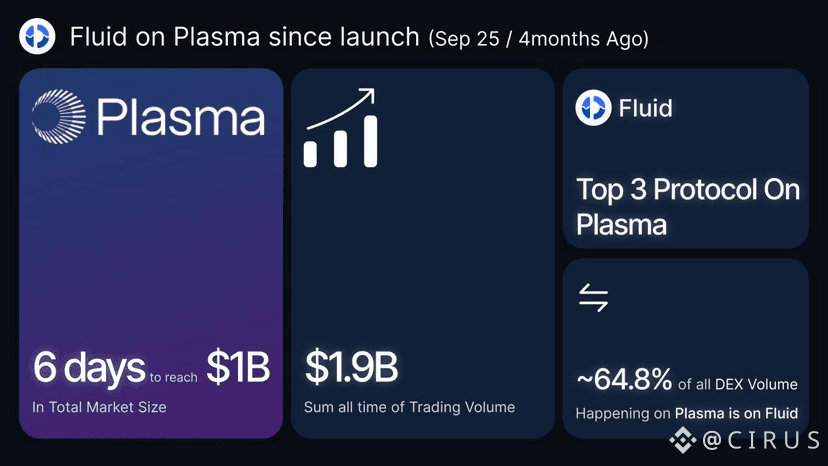
Fluid did not become a top protocol on Plasma by accident or by chasing short-term incentives. Its growth reflects a structural alignment with Plasma’s goals. Reaching one billion dollars in total market size within days and accumulating close to two billion dollars in all-time trading volume is not just a vanity metric. It signals that meaningful capital feels comfortable staying active on the network.
More importantly, the fact that roughly two thirds of all DEX volume on Plasma flows through Fluid suggests consolidation rather than fragmentation. In payments and finance, consolidation around reliable liquidity venues is not a weakness. It is a strength. It reduces slippage, improves pricing, and builds predictability.
For builders, this changes the equation entirely.
On many chains, launching a payments product means first solving a liquidity puzzle. You need to bootstrap pools, manage incentives, and constantly worry about whether your users can move size without adverse price impact. On Plasma, the presence of deep stablecoin liquidity means builders can focus on product logic, compliance, user experience, and distribution, rather than financial engineering.
This is what Plasma means when it talks about Fluid enabling efficient bootstrapping at scale. It is not about making launches easier in a marketing sense. It is about removing an entire category of operational risk that has historically made onchain payments fragile.
The implications extend far beyond DeFi dashboards.
Consider a card issuer exploring stablecoin settlement. What they need is not yield or governance tokens. They need the ability to convert, settle, and rebalance large stablecoin positions continuously, without moving the market or exposing themselves to volatility. If a network cannot support this natively, it will never be used for real payments, regardless of how fast blocks are produced.
Plasma’s focus on stablecoin liquidity speaks directly to this requirement. By ensuring that deep pools exist and that trading volume is concentrated rather than scattered, the network begins to resemble the liquidity topology of traditional financial rails, but with onchain transparency and programmability.
Another overlooked aspect is confidence over time.
Liquidity that appears overnight due to incentives can disappear just as quickly. Liquidity that grows steadily, is actively used, and supports real volume tends to be more durable. Fluid’s four-month trajectory on Plasma suggests the latter. This kind of organic growth builds trust not only among users, but among institutions that evaluate infrastructure over multi-year horizons.
There is also a feedback loop at work. As liquidity deepens, pricing improves. As pricing improves, larger players feel comfortable executing size. As larger players enter, volume increases further, reinforcing liquidity. Plasma’s architecture appears designed to encourage this compounding effect rather than fighting fragmentation.
This is particularly relevant for stablecoins, which are often treated as boring infrastructure rather than strategic assets. In reality, stablecoins are the bloodstream of onchain finance. They connect crypto to commerce, payroll, remittances, and everyday spending. A chain that optimizes for stablecoin performance is implicitly optimizing for adoption beyond crypto-native users.
Fluid’s dominance in Plasma’s DEX volume suggests that this optimization is working.
It also highlights a subtle but important shift in how Plasma positions itself. Rather than competing as a general-purpose chain trying to do everything, Plasma is increasingly defining itself as a settlement and liquidity layer for stablecoin-driven activity. This focus makes tradeoffs clearer and execution sharper.
From a builder’s perspective, this clarity matters. When you know what a chain is optimized for, you can design accordingly. If your product relies on predictable stablecoin flows, Plasma offers an environment where those flows are already dense and active.
From a market perspective, this kind of specialization often wins in the long run. Financial infrastructure rarely succeeds by being generic. It succeeds by being exceptionally good at a narrow set of critical functions.
The numbers shared by Fluid and Plasma are therefore less about celebrating growth and more about demonstrating fit. Fit between architecture and use case. Fit between liquidity and payments. Fit between onchain systems and real-world financial expectations.
What is especially telling is how little noise surrounds this progress. There is no dramatic narrative, no promise of instant transformation. Instead, there is steady evidence that capital is moving, settling, and trading where Plasma intended it to.
That quiet confidence is usually a good sign.
As more fintechs, card issuers, and payment processors explore stablecoins, they will look for chains that behave like infrastructure, not experiments. They will look for liquidity that absorbs volume rather than amplifies risk. They will look for ecosystems where the hardest problems have already been solved at the base layer.
Plasma’s emphasis on deep stablecoin liquidity, supported by Fluid’s architecture and usage, suggests it is preparing for that future deliberately.
My take is simple. Many chains chase attention by adding features. Plasma is building credibility by solving constraints. In finance, constraints are where systems break. Liquidity is one of the hardest constraints to get right, and one of the easiest to underestimate.
By making stablecoin liquidity central rather than incidental, Plasma is not just supporting today’s DeFi activity. It is laying groundwork for payments infrastructure that can actually scale into the real economy.
If that trajectory continues, the most important Plasma milestones in the future may not be flashy announcements, but moments when large, ordinary financial systems start using it without fanfare, because it simply works.

