


The economic design of plasma is grounded with a simple and uncharacteristic assumption in crypto that the greatest share of long-term value will be derived through real usage, and not through ongoing speculation. Plasma does not create token mechanics based on hype cycles or trading volume, instead it uses economics as an aid whereby money moves consistently over time.
This implies that the token does not feature in the middle of the scene. Plasma does not attempt to compel users to be concerned with XPL whenever they access the network. Rather, it aims at ensuring the smooth functioning of the system initially, and allows the token to quietly reconcile incentives in the background.
Integrity Between Usage and Speculation in Plasma Separates.
A lot of blockchains are closely intertwined with the usage and their native token. All transactions, interactions, and execution of contracts expose them to a volatile asset. Plasma intentionally does not design it in this way as it causes friction and is not designed to be used in the real world.
On Plasma, everyday balancing of the exposure to the stablecoins is not required by users moving the stablecoins. This division reduces the impediments to common-day applications like payments, transfers, and settlements. Meanwhile, the network continues to use the infrastructure level of the coordination of security and governance based on the use of XPL.
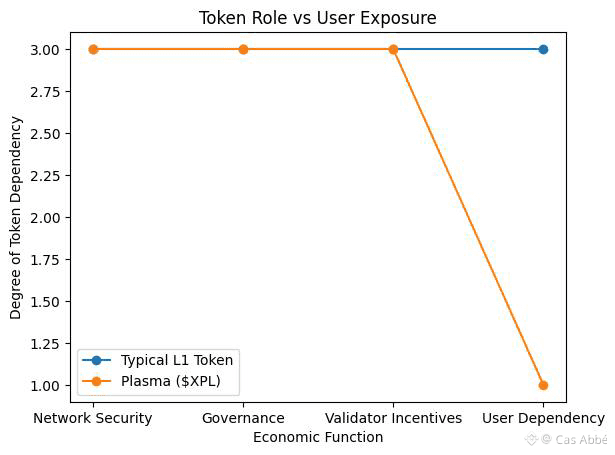 With the usage and the speculation being separated, Plasma minimizes artificial demand spikes and shuns the volatility that can frequently introduce a token-based activity.
What XPL Was Built to Do in the First Place.
The reason why XPL is in place is to ensure and organize the network, but not to harvest value out of every activity of the users. It mainly focuses on making sure that validators act in good faith, ensure the network is stable and make decisions that are responsible in the long term.
It is applied to obtain consensus by staking and pairing the validators with the health of the network as well as to facilitate governance on a protocol level. It is also a kind of economic anchor, it clears the risk and it instills discipline in the system.
Due to this design, it is possible that the XPL will not be noticeable to an average user but when it comes to the infrastructure level, the reliability is the most important.
 Staking: Promoting a Long-Term Investment.
The staking model of plasma is constructed on a belief that network security becomes better when the actors have long-term thinking. The validators put money on XPL to get rewards and these rewards are directly proportional to honest engagement and stable performance.
In the event of a dishonest act of validators, off-line, and system manipulation, they are punished by slashing mechanisms. This discourages dangerous operation and drives validators to set uptime and correctness rather than aggressive optimization.
The outcome is economically sound validator set, which is not about short-term profitability.
Inflation: It is More of a Maintenance than a Growth Trick
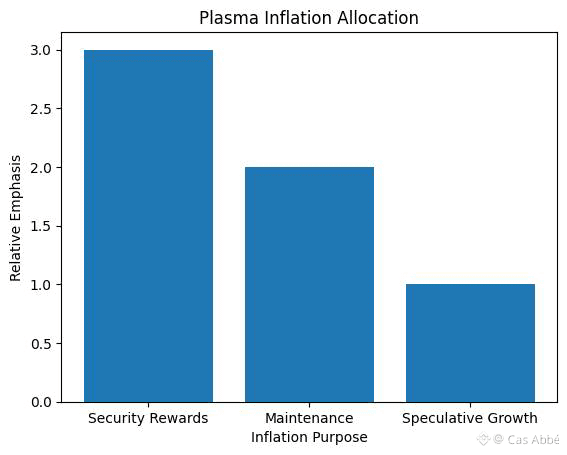
Plasma Inflation is considered as a necessary maintenance expenditure as opposed to a marketing instrument. There is its existence in order to reward the validators, maintain the security of the network and ensure operations in the long run.
Predictability is what is most important. Inflation of plasma is supposed to be predictable and easy to comprehend such that actors can act in accordance. There should be no sudden changes or issues issued aggressively as it creates uncertainty and will destroy trust.
Plasma has applied inflation to maintain the system safe and operational long-term as an alternative to artificially improving the system by inflation.
Custom Gas Tokens: Making it Easier on the Users.
Gas abstraction is one of the most useful economic characteristics of Plasma. In $XPL, transaction fees are not always necessary to users and applications. In most instances, they can be paid in the form of stablecoins or even sponsored by the applications themselves.
This design eliminates one of the barriers of adoptions. Users do not have to buy or hold a volatile asset only to transfer money. Companies can attract users without describing token economics and wallets and gas policies.
Under the hood, XPL serves to hold the economic system in place, yet the users are provided with a simpler and more intuitive flow.
The Reason Why This Economic Design Should be adopted.
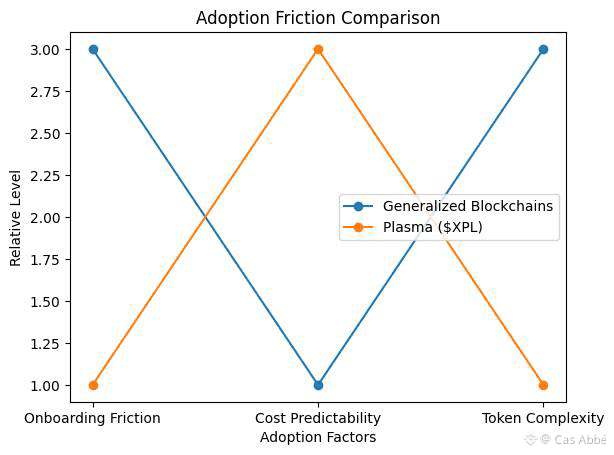 Reduced friction results in the regularity of use. The economic model of plasma enables businesses to make predictions on costs, users to trade without anxiety and developers to create applications without caring about the management of user tokens.
This is particularly relevant in environments where the stablecoin is a heavy workload, where reliability and simplicity are of greater importance than expressiveness or experimentation. This fact determines the economics of plasma.
Ecosystem Incentives: Focused and Punitive.
Plasma does not have to use extensive incentive programs to produce activity. Rather, incentives are aimed at those areas that reinforce the network, including liquidity stability, core infrastructure, and long-term contributors.
This prevents a short-term increase in usage which is then followed by a steep decrease after the rewards are removed. Plasma favors organic growth which is based on real demand as opposed to the temporary incentive exchanges.
Advantages to the Economic Design of Plasma.
The solution undertaken by plasma results in a decreased friction among users, less volatility due to speculation and more predictable network behavior. Validators suit long-term health more, and businesses can more easily integrate the network with the real world.
These advantages help the larger mission of Plasma of becoming a long-lasting financial infrastructure and not a gambling grounds
Risks and Trade-Offs
There is also the price of the economic model of plasma. The growth rate is potentially slower than that of hype-based chains, potential speculative traders have less immediate opportunities. The incentive loops are also smaller and more controlled.
Also, the fact that Plasma targets stablecoins implies that its success is partially connected to regulatory and market-related conditions of stable assets. Such dependencies bring in external risks, which Plasma should manoeuvre through.
The reason behind why Plasma trades in such trade-offs.
Plasma presupposes the long-term relevance to be more important than the short-term attention. It does not depend on aggressive token-based mechanics and, conversely, makes it less fragile and builds trust over time.
This causes the network to be less noisy, yet more resilient. Plasma is built in a manner that it works in cycles and not only takes advantage of it.
Plasma looks on economics as a supporting service, rather than the star of the show. The token is made to maintain the system stable, honest and predictable but not to control the experience of the users.
The upside is resilience.
The downside is slower hype.
Plasma is not created to have tokens exciting.
It is constructed in such a way that money moves.

