

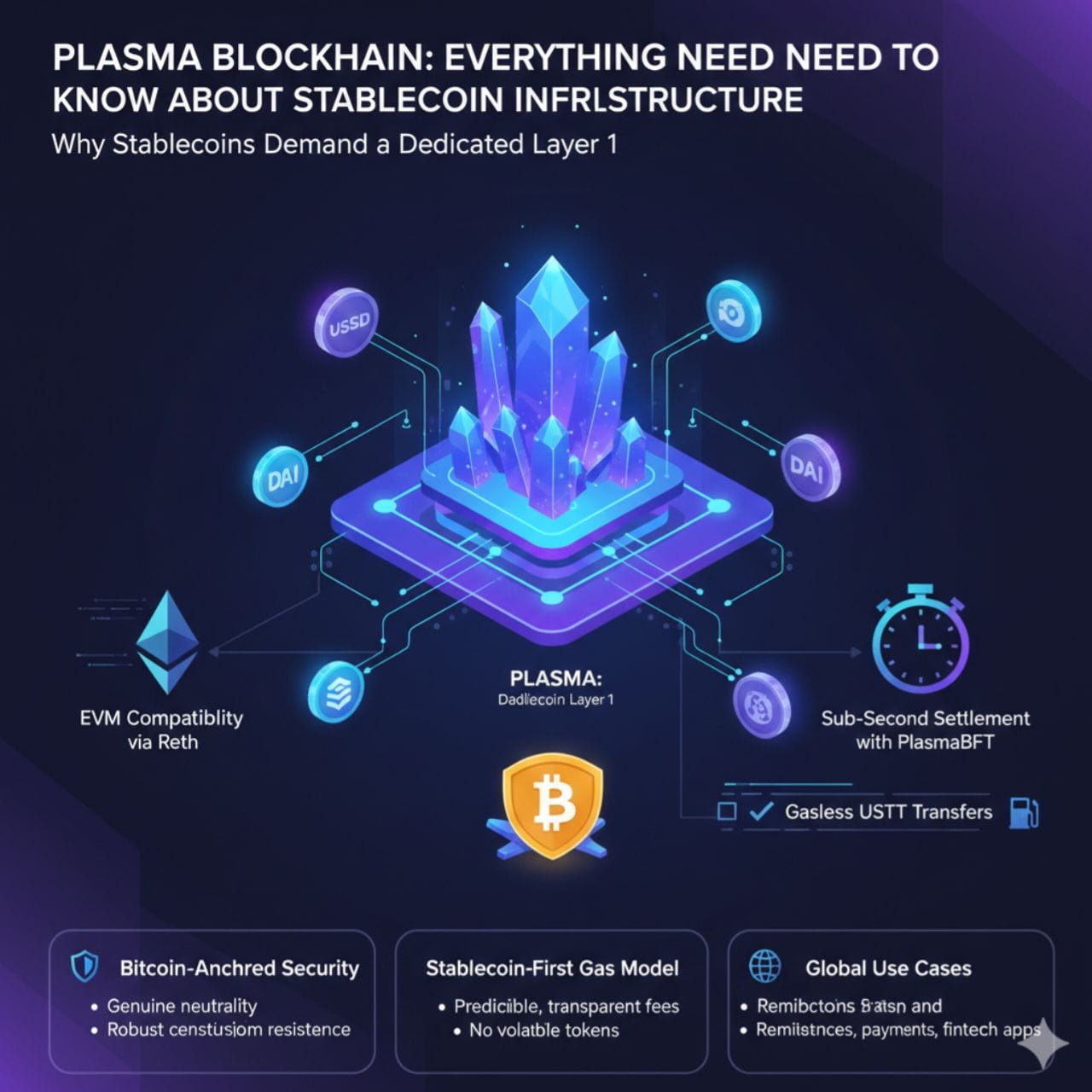
Why Stablecoins Demand a Dedicated Layer 1
Let’s revisit the fundamentals. Stablecoins aren’t a fringe experiment in the crypto world—they’ve become its foundation. Every single day, billions of dollars flow through USDT and other stablecoins, not for speculation, but for real, practical purposes: settling trades, making purchases, sending funds across borders, and facilitating all sorts of everyday financial operations.
The issue is, most blockchains weren’t architected with this in mind. They treat stablecoins as just another kind of token among many, resulting in high transaction fees, sluggish speeds, and complex gas fee mechanics that frustrate everyone from casual users to professional traders.
Plasma Blockchain takes an entirely different approach. Rather than being a generic solution, it’s a purpose-built Layer 1 chain for stablecoins, putting speed, reliability, and simplicity at the forefront—eschewing hype for pragmatic features that matter in the real world.
But what exactly is Plasma? How does it function, and why is it so significant for the evolution of stablecoins? Let’s explore the details.
What Sets Plasma Apart?
Plasma isn’t aiming to be a jack-of-all-trades. Instead, it’s laser-focused as a Layer 1 specifically optimized for stablecoin movement and settlement—delivering transactions that are fast, secure, and low-cost.
Here’s how Plasma distinguishes itself:
- Full Ethereum compatibility, enabled by Reth, so developers can leverage familiar tools and smart contracts.
- Sub-second settlement times, made possible by the PlasmaBFT consensus mechanism—transactions are confirmed almost instantly.
- USDT transfers incur zero gas fees, eliminating one of the biggest pain points for users.
- Gas fees, when necessary, are paid in stablecoins rather than volatile native tokens, ensuring cost predictability.
- Security is anchored to Bitcoin, providing genuine neutrality and robust censorship resistance.
By focusing entirely on stablecoin use cases, Plasma sidesteps many of the persistent issues that plague general-purpose blockchains.
Why Build Specialized Infrastructure?
Most Layer 1 blockchains are designed to be multipurpose, supporting everything from smart contracts and DeFi protocols to NFT marketplaces. But stablecoins serve a fundamentally different role—they’re not speculative assets, they’re the core infrastructure for financial operations.
Stablecoin users have specific priorities:
- Consistently low and predictable fees, so costs don’t fluctuate unpredictably.
- Fast, dependable settlement to ensure payments and transfers go through without delays.
- User-friendly interfaces that don’t require technical expertise or constant gas fee calculations.
- Robust neutrality and censorship resistance, providing confidence and security.
On crowded, general-purpose blockchains, users often experience the opposite: volatile fees, slow or failed transactions, and unnecessary complexity. Plasma is engineered from the ground up to resolve these pain points, making stablecoin use as seamless as possible.
Now, let’s dive into the technology underpinning Plasma’s unique capabilities.
The Technology Behind Plasma
1. EVM Compatibility via Reth
Plasma operates using Reth, allowing full compatibility with the Ethereum Virtual Machine. This means developers can use existing Ethereum tools, libraries, and smart contracts without modification. Migrating stablecoin apps to Plasma is straightforward—there’s no need to rewrite or reinvent code, greatly reducing the friction of adoption.
2. Sub-Second Settlement with PlasmaBFT
At the heart of Plasma’s performance is PlasmaBFT, its proprietary consensus mechanism. This engine delivers transaction confirmations in under a second, making stablecoin payments nearly instant. For merchants, traders, and everyday users, this transforms the payment experience—eliminating waiting times and unlocking new possibilities for real-time commerce.
3. Gasless USDT Transfers
A major innovation of Plasma is its support for gasless USDT transfers. Users can send USDT without needing to hold or manage a separate fee token, removing a critical user experience barrier. This is especially impactful for remittances, retail transactions, or in regions where stablecoins are essential for economic participation but acquiring gas tokens is impractical.
4. Stablecoin-First Gas Model
On Plasma, any fees that are charged are paid directly in stablecoins, not in a volatile native cryptocurrency. This means businesses and users can forecast their costs and don’t need to worry about fluctuating fee token prices. Predictability and transparency are built in, making stablecoins more functional for real-world financial applications.
Bitcoin-Anchored Security
Security isn’t just a checkbox for Plasma—it’s central to its design. By anchoring its security to Bitcoin, Plasma achieves a higher level of resistance to censorship and centralized interference. This approach brings the trust and resilience of the world’s most secure blockchain to stablecoin infrastructure, which is crucial when dealing with assets that underpin real economic activity and cross-border value transfers.
Who Benefits from Plasma?
Plasma is designed for two primary audiences:
1. Everyday Users in High-Adoption Markets
- Enjoy rapid, cost-effective stablecoin transfers.
- No need to worry about confusing gas fee mechanics or running out of tokens for fees.
- Dependable for daily payments, savings, and remittances, especially in regions where traditional banking is limited.
2. Institutions and Payment Service Providers
- Benefit from predictable, stable transaction fees that make business planning easier.
- Integrate Plasma seamlessly into existing payment infrastructure, leveraging Ethereum compatibility.
- Rely on Bitcoin-level security for peace of mind and regulatory confidence.
Ultimately, Plasma is about translating the promise of stablecoins into a practical, everyday reality.
Whether you’re sending funds to family abroad, running a business that depends on fast and affordable payments, or building the next generation of fintech apps, Plasma delivers the infrastructure stablecoins have always needed—making digital dollars work for everyone, everywhere.


Disclaimer: Not Financial Advice