
I was on a call a while back, watching a dev move a small app from Ethereum to “an EVM chain.” It was meant to be easy. Same code. Same tools. Same vibe. And at first… it was. Then the weird stuff showed up. Fees that spiked for no clear reason. A wallet flow that felt fine in a test run, then failed when it mattered. Finality that was “fast” on paper, but not calm in real life.
That’s when I stopped treating “EVM compatible” like a gold star. It’s more like… a door handle. Useful, sure. But it doesn’t tell you if the door opens into a solid building or a room made of thin wood.
Plasma (XPL) is interesting to me because it tries to make that door lead somewhere different. Not “another fork.” More like a stablecoin rail that happens to speak Ethereum. That’s a big shift in mindset. Plasma frames itself as a Layer 1 built for stablecoins, with things like zero-fee USD₮ transfers and a gas model meant to feel closer to payments than to “crypto chores.”
And if you care about EVM Compat 2.0, that’s the point. The goal is not just to run Solidity. The goal is to make the whole stack behave like money infra. Boring. Smooth. Predictable. When I read Plasma’s pitch, I don’t hear “come farm, come gamble.” I hear “please don’t break when people actually use it.”
Now, the tech part… but in plain words.
Plasma splits the job into two big pieces. One part runs the EVM logic. The other part decides order and finality. For the EVM side, Plasma uses Reth, which is an Ethereum client built in Rust. Think of Reth like the engine that processes blocks and state. Rust is known for being strict, which can help cut whole classes of bugs. Not magic. Just fewer sharp edges.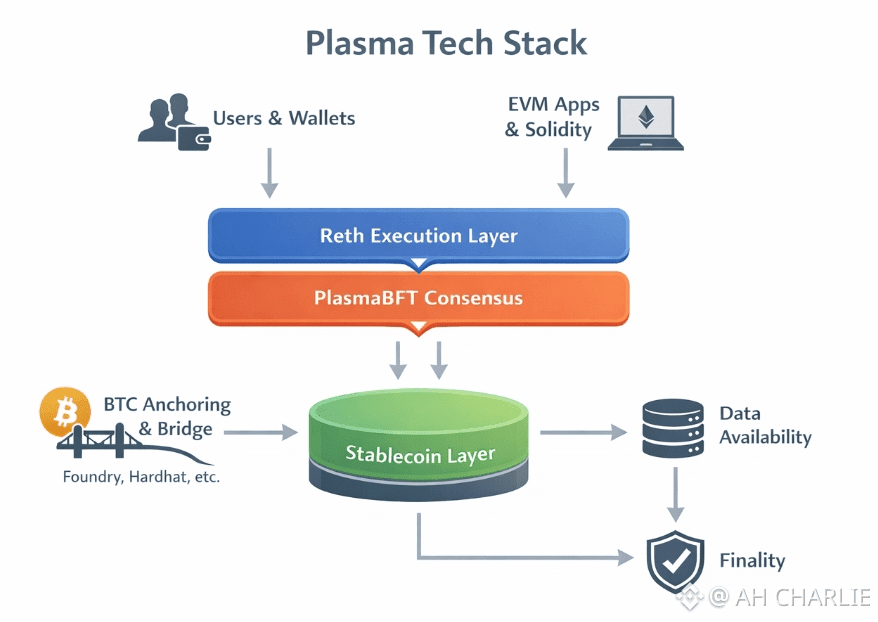
This matters because “EVM compatible” can mean a lot of things. Some chains feel compatible until you push them. Until the mempool gets noisy. Until nodes lag. Until the chain starts acting like it’s tired. Using a modern Ethereum client design as the execution core is one way Plasma tries to make compatibility feel real, not performative. Same EVM rules, but with a build choice that leans toward speed and safety, not just quick copying.
Then there’s the part people skip when they talk about forks: the consensus layer. Plasma points to PlasmaBFT as the system that manages sequencing and finality. In simple terms, it’s the “agreement machine.” It’s how the network says, “yes, this is the order,” and, “yes, it’s locked in.” If execution is the engine, consensus is the traffic control. When traffic control is clean, you feel it. Things settle fast. Less waiting. Less guessing.
And the dev-facing side is meant to stay familiar. Plasma’s docs lean hard into “use what you already use.” Foundry. Hardhat. MetaMask. Same flows, less retraining. That’s the good side of EVM. You don’t force people to learn a new world just to ship.
So where does “Compat 2.0” actually show up?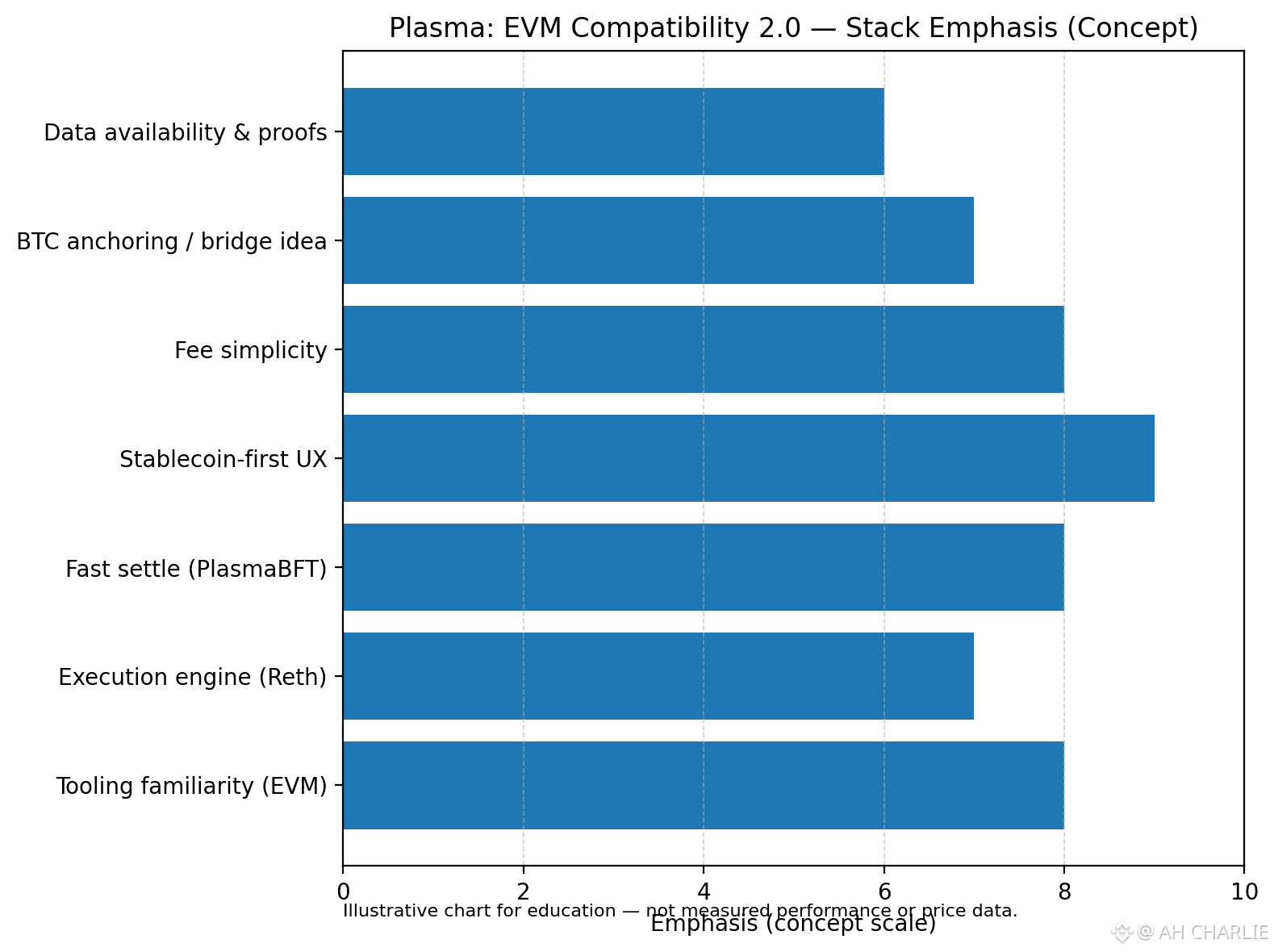
It shows up when the chain treats stablecoins as the main event, not a side quest. Plasma’s public materials describe zero-fee USD₮ transfers (in specific cases / supported flows) and a “stablecoin-first” approach to fees, where the experience is pushed toward payment-like behavior instead of constant token juggling. That’s not a small UI detail. That’s a design choice that changes who can use the chain without feeling lost.
Because here’s the truth I’ve seen: most people don’t want to “manage gas.” They want to send value, get a receipt, and move on with their day. If Plasma can make parts of that feel closer to normal money apps hile still keeping the EVM world intact that’s not “just another fork.” That’s a different product category wearing an EVM jacket.
There’s also the security angle Plasma keeps circling back to: Bitcoin anchoring and a more trust-minimized BTC bridge concept, so BTC can move into an EVM space without the usual “just trust the custodian” vibe. It’s trying to borrow Bitcoin’s weight while keeping Ethereum’s programmability. If you’re building stablecoin rails, that’s a very specific kind of ambition. Not louder. Heavier.
But I think, don’t care if a chain is exciting. I care if it’s dependable when nobody is cheering. EVM Compat 1.0 was about getting apps to deploy. Compat 2.0 is about the full experience: fees, finality, tooling, and the “did it work like money” test.
Plasma is basically saying: keep the EVM language, replace the nervous system. If they execute on that, the win isn’t that it’s Ethereum-like. The win is that it’s payment-like… without asking developers to give up the tools they already trust.

