
The Ethereum Foundation has announced post-quantum security (PQ) as one of its main strategic priorities and has formed a specialized team of developers.
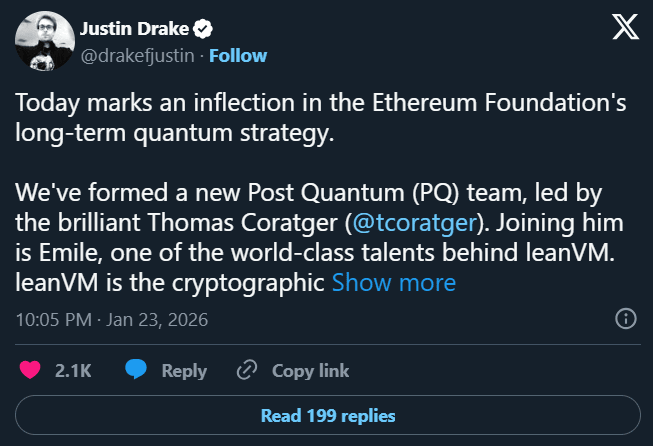
The group will be led by cryptographic engineer EF Thomas Koratger with support from a specialist from the leanVM team known as Emile, researcher Justin Drake reported.
"Our journey began in 2019 with the presentation of Eth3.0 Quantum Security at StarkWare Sessions. From 2024, PQ will take center stage in the leanEthereum concept. The pace of engineering breakthroughs in PQ has been simply phenomenal since then. But now it’s 2026, and the deadlines are accelerating," he wrote.
Drake called leanVM the "cornerstone" of Ethereum's post-quantum cryptography strategy. The virtual machine is optimized for the use of zero-knowledge proofs and quantum-resistant signatures based on hashing.
The transition is accelerating
In November 2025, Ethereum co-founder Vitalik Buterin warned that the underlying elliptic cryptography of cryptocurrency could become vulnerable by 2028.
According to Drake, the task of the blockchain project is to transition to quantum-resistant technologies as soon as possible without downtime and loss of funds. He discussed a number of steps planned or already implemented in this direction:
The Lighthouse and Grandine consensus client teams have already implemented post-quantum networks for developers. A similar solution is expected from Prysm soon;
EF is launching a $1 million prize for improving the reliability of the hash function. An equivalent amount is allocated for rewards in another PQ initiative called the Proximity Prize;
Next month, weekly PQ sessions for developers will begin under the guidance of Antonio Sanso. The sections will focus on user-oriented security, including account abstraction and signature aggregation using leanVM.
In October, EF will hold a three-day thematic seminar in Cambridge, and at the end of March, a separate session before the EthCC conference in Cannes.
And what about Bitcoin?
In the community of the first cryptocurrency, the quantum risk for the blockchain is recognized. However, the time forecasts vary greatly.
Famous cypherpunk and CEO of Blockstream Adam Back is confident that the risk of hacking will not become real for at least another 20-40 years. A number of experts, such as analyst Willy Woo and the Quantum Doomsday Clock project team, are less optimistic. They suggest a range of 2028-2030.
Castle Island Ventures partner Nick Carter criticized Bitcoin developers for ignoring the threat of quantum computing. In his opinion, the risk is already negatively affecting the dynamics of digital gold prices. This statement was contested by Checkonchain founder and leading analyst James Chek.
According to Back, developers are conducting relevant research. However, Chek believes that the main problem will not be the creation but the implementation of the protection mechanism — the Bitcoin community is extremely slow to reach a consensus on changes to the protocol.
Commercial Director of Naoris Protocol Youssef El Maddarasi reminded in a column for Cointelegraph that even a "minor" update like Taproot required lengthy discussions and agreements.
He also identified another important issue: the potential transition to quantum-resistant technologies, which will require fundamental modernization of the signature mechanisms in the protocol. According to researchers from Kent University, such a significant upgrade will cost 75-300 days of downtime. For a global financial asset with a capitalization of over $1 trillion, this seems unacceptable, emphasized El Maddarasi.
Recall that in December, Cardano founder Charles Hoskinson pointed to the risk of blockchain performance decreasing by tens of times when migrating to quantum-resistant solutions.

