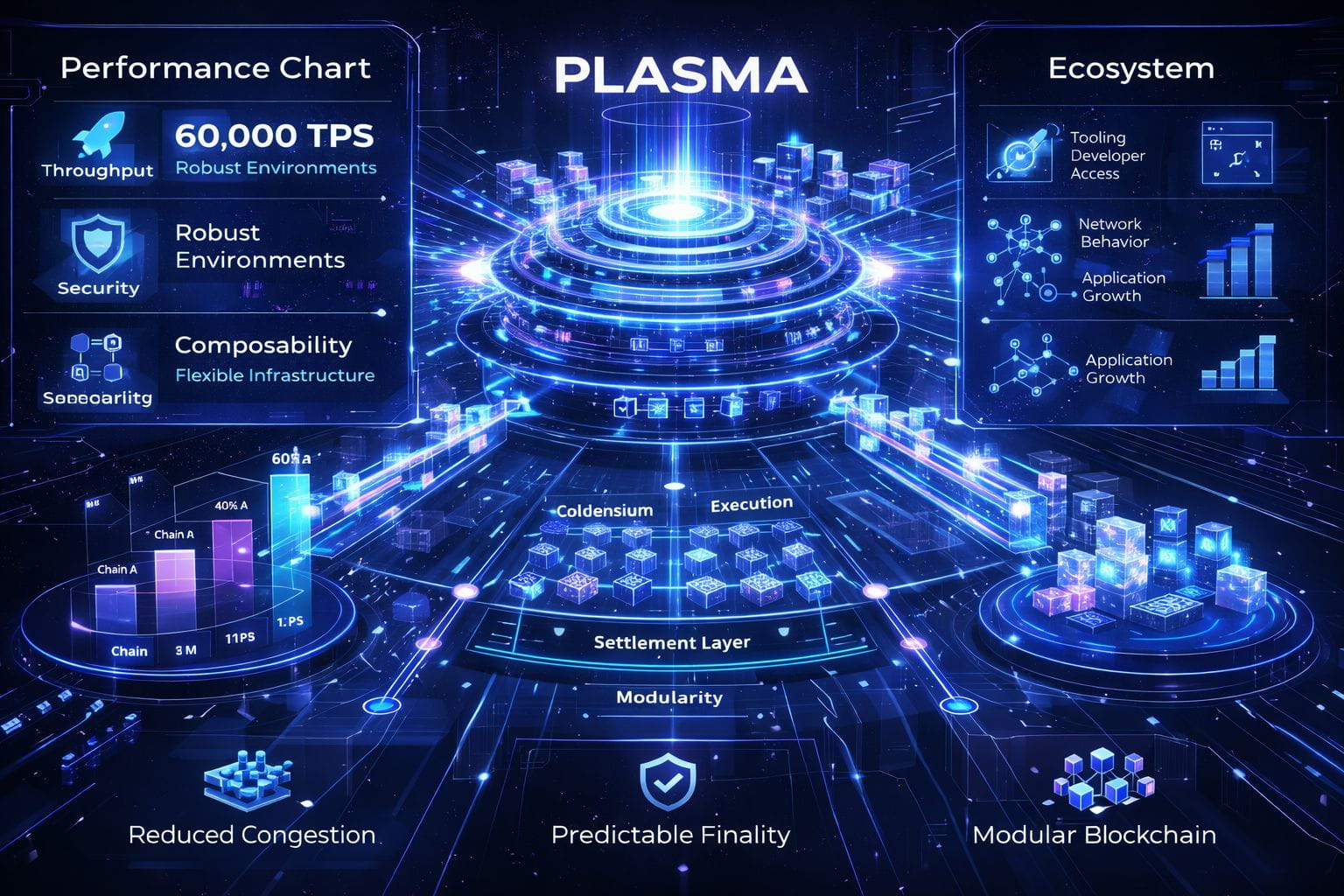
Plasma’s recent trajectory makes one thing clear: this is not a chain optimizing for narrative cycles, but for operational reality. Instead of chasing abstract promises around speed or decentralization, Plasma is shaping itself around a more difficult goal—becoming an execution environment that remains stable as usage compounds. That distinction matters, because most blockchains perform well in isolation and struggle the moment real demand arrives. Plasma’s design choices suggest an awareness of that failure mode and an intent to avoid it at the protocol level.
At the core of Plasma’s approach is a disciplined view of performance. Throughput is not treated as a marketing number, but as a system-wide property influenced by execution flow, settlement logic, and congestion management. Plasma’s architecture focuses on maintaining predictable behavior under load, which is far more valuable than peak performance in ideal conditions. For applications, this translates into reliability: transactions settle when expected, fees remain intelligible, and users are not exposed to sudden degradation during periods of activity.
Security in Plasma is framed as an operational guarantee rather than a theoretical construct. The network’s structure emphasizes consistency and resilience, ensuring that scaling does not introduce new attack surfaces or brittle dependencies. This is especially relevant as applications move beyond experimentation and begin handling assets, state, and user behavior that cannot tolerate ambiguity. Plasma’s alignment between execution and settlement reduces the need for compensating mechanisms at the application layer, allowing developers to focus on product logic rather than protocol risk.
Composability is another area where Plasma avoids shortcuts. Rather than forcing applications to adapt to fragmented layers or incompatible standards, the network is engineered to support interaction without friction. This matters because ecosystems do not grow through isolated successes; they grow through integration. Plasma’s environment encourages applications to interoperate without inheriting systemic complexity, which lowers long-term maintenance costs and reduces failure points as the ecosystem expands.
What reinforces Plasma’s credibility is how tooling and developer access are evolving alongside the core network. Instead of prioritizing surface-level adoption metrics, the emphasis is on making the chain usable in practice. Developer workflows, network behavior, and infrastructure maturity are being refined together, which signals an understanding that sustainable growth is cumulative. Each improvement compounds the next, rather than masking unresolved constraints.
Plasma also distinguishes itself by treating finality as a first-order concern. Predictable settlement is foundational for any system that expects repeated, high-value interactions. By engineering finality into the network’s behavior rather than layering it on as an afterthought, Plasma reduces uncertainty for applications and users alike. This is a subtle but critical shift from chains that rely on probabilistic assurances while advertising deterministic outcomes.
Taken together, these decisions position Plasma as infrastructure designed to persist. It is not attempting to redefine blockchain concepts, nor is it leaning on speculative differentiation. Instead, it is assembling a system where performance, security, and composability reinforce one another under real conditions. If adoption follows—as it typically does when reliability becomes evident—Plasma stands to be judged not by claims, but by how well it holds up when the network is actually used.