


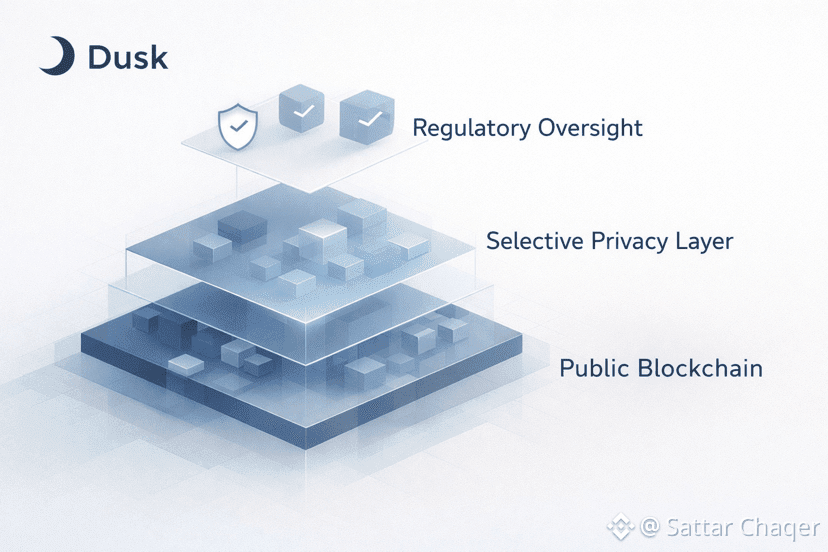
In most blockchain narratives, privacy is treated as rebellion. Something radical. Something that exists in opposition to institutions, regulators, and legacy finance. This framing has shaped an entire generation of privacy-focused projects and, quietly, limited how far they can go.
Dusk took a different path.
From the beginning, Dusk Foundation did not attempt to weaponize privacy against regulation. Instead, it treated privacy as a structural requirement of real financial markets — something that must coexist with compliance, auditability, and legal accountability. This choice explains why Dusk has never fit neatly into retail narratives, and why it continues to attract attention from institutional circles that typically ignore public blockchains altogether.
This article is not about hype cycles or token price movements. It is about design intent Dusk foundation and why Dusk’s architecture makes sense only if you understand who it was built for.
Privacy in finance is not optional. In traditional financial markets, privacy is not a feature; it is assumed. Trade sizes, counterparty identities, settlement details, and ownership structures are rarely broadcast publicly. They are selectively disclosed to auditors, regulators, and legal authorities, but not to the market at large. This is not secrecy. It is market hygiene.
Public blockchains inverted this model. Radical transparency became a virtue. Every transaction, wallet balance, and interaction is visible by default. While this openness enabled innovation, it also created an environment fundamentally incompatible with regulated finance.
Institutions cannot operate where every action exposes strategy, inventory, and risk posture. They cannot tokenize securities on rails where compliance must be retrofitted after deployment. And they cannot accept privacy models that rely on obscurity rather than cryptographic guarantees.
Dusk starts from this reality, not from ideology.
Retail discourse often places Dusk in the same conceptual bucket as privacy coins. This is a mistake. Privacy coins typically aim for maximum anonymity. Transactions are hidden from everyone. Compliance is treated as an external concern, if it is considered at all. This approach may serve individual users, but it collapses under institutional scrutiny.
Dusk does not pursue anonymity. It pursues selective disclosure.
Selective disclosure allows transactions to remain private by default, while still enabling verifiable proofs to authorized parties. Regulators can audit. Issuers can demonstrate compliance. Counterparties can transact without exposing sensitive data to the public.
This distinction matters. One model rejects oversight. The other integrates it cryptographically.
Institutions do not fear transparency. They fear uncontrolled transparency. In regulated environments, information asymmetry is managed deliberately. Too much visibility can distort markets, enable front-running, and compromise fiduciary obligations. Too little visibility creates systemic risk.
Dusk’s architecture recognizes this balance. Rather than exposing raw data on-chain, Dusk enables cryptographic proofs that assert compliance without revealing underlying details. This allows financial instruments to exist on a public blockchain without inheriting the surveillance properties that make most chains unusable for serious finance.
This is not a compromise. It is alignment with how financial systems already function.
Blockchains reveal their priorities through architecture. Chains optimized for DeFi speculation emphasize throughput, composability, and rapid deployment. Chains designed for institutional use emphasize determinism, auditability, and predictable execution environments.
Dusk’s modular design reflects its target audience. Components are built to support tokenized securities, compliant financial applications, and identity-aware interactions. Privacy is embedded at the protocol level rather than bolted on through smart-contract gymnastics.
This is why development appears slow to retail observers. Institutional infrastructure does not reward speed. It rewards correctness.
Founded in 2018, Dusk emerged during a period of maximal experimentation in crypto. Many projects chased narratives. Dusk chose patience. Instead of promising disruption, it focused on integration. Instead of marketing to users, it aligned with issuers, legal frameworks, and financial standards. This decision delayed visibility, but preserved relevance.
Institutional adoption rarely happens quickly. It happens when systems are boring enough to be trusted. Dusk’s trajectory makes sense only if viewed through this lens.
Retail markets reward immediacy. Infrastructure rewards restraint. Dusk does not produce viral metrics. It does not optimize for developer mindshare through incentives. It does not frame compliance as an enemy. As a result, it often sits outside mainstream crypto narratives.
Yet the very qualities that limit its retail appeal are what make it legible to institutions. This tension explains why Dusk is frequently underestimated — and why it continues to exist while louder projects fade.
Public blockchains blurred the line between infrastructure and spectacle. Dusk redraws it. By treating privacy as a prerequisite for regulated finance rather than a political statement, Dusk positions itself where tokenized real-world assets, compliant DeFi, and institutional-grade applications can realistically live.
This is not a promise of dominance. It is a claim of suitability. In markets governed by law, suitability matters more than excitement.
Dusk was never designed to win attention. It was designed to survive scrutiny. Its approach to privacy reflects an understanding that financial systems are social, legal, and technical constructs at the same time. Ignoring any one of these dimensions breaks the whole.
In a space obsessed with speed, Dusk chose alignment. In a market addicted to visibility, it chose discretion. And in an industry that often confuses rebellion with innovation, it chose architecture.
Whether that choice pays off is not decided by retail sentiment, but by whether regulated finance ever fully moves on-chain.