

When people first talked about blockchain, it sounded like a rebellion against the entire financial system. No rules, full transparency, and total decentralization. That idea attracted attention, but it ignored one simple truth: real financial institutions cannot work without rules, privacy, and legal structure. This is where DUSK takes a very different and much more realistic approach.
DUSK is built with the understanding that banks, funds, and regulated markets do not operate in a vacuum. They follow laws, compliance requirements, and strict operational standards. Instead of fighting this reality, DUSK is designed to work within it. Its goal is not to replace traditional finance overnight, but to connect it with blockchain technology in a way that actually makes sense.
Most public blockchains assume that transparency creates trust. In practice, this can be dangerous for institutions. Financial transactions often contain sensitive information. Trading positions, settlement details, and portfolio movements are not meant to be visible to everyone. Exposing them can create legal issues, competitive risks, and even security threats. DUSK treats privacy as a basic requirement, not an optional feature. Transactions are verified using cryptography, so the system can confirm correctness without revealing confidential data.
Compliance is another major challenge in tokenized finance. Many blockchain platforms struggle to support real-world assets like bonds or equities because legal rules are difficult to enforce on chain. DUSK solves this by embedding compliance directly into the system. Ownership rules, transfer conditions, and settlement logic are built into the protocol itself. This allows regulated assets to operate on chain while still respecting existing legal frameworks.
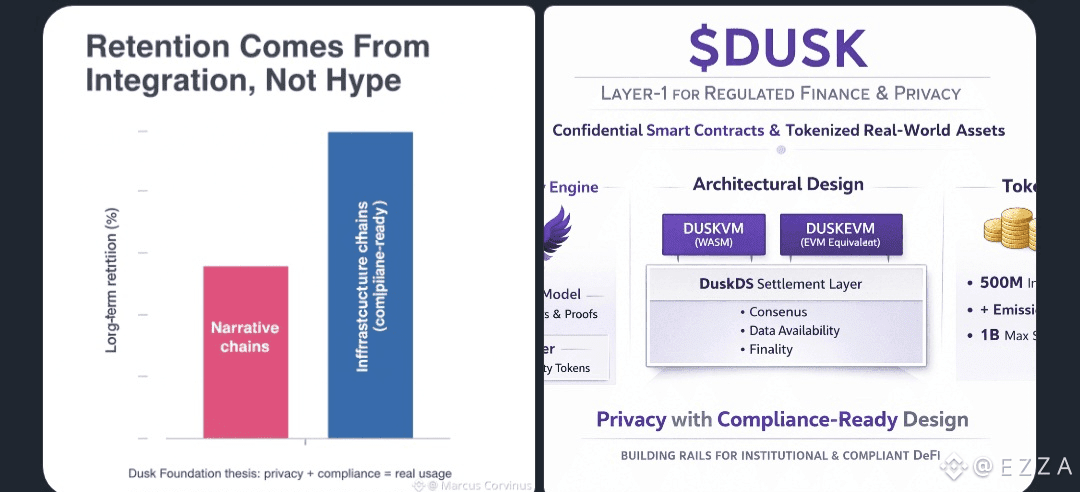
DUSK also borrows an important lesson from traditional financial infrastructure: stability matters more than hype. The network is designed in a modular way, separating privacy, execution, and settlement. This means upgrades and integrations can happen smoothly without breaking the system. Financial markets grow through careful evolution, not sudden experiments. DUSK reflects this mindset by prioritizing reliability and long-term usability.
Identity is handled with the same level of care. Instead of forcing users to reveal everything, DUSK uses selective disclosure. Participants can prove they meet certain requirements—such as compliance or eligibility—without exposing unnecessary personal information. This approach aligns well with global privacy laws and reduces risk for institutions and users alike.
Seen from a professional perspective, DUSK is not about quick profits or loud marketing. It is about building infrastructure that real markets can actually use. Its focus on privacy, compliance, and thoughtful design makes it especially attractive to serious financial players who value trust, discretion, and operational stability.
DUSK shows that blockchain does not have to choose between innovation and regulation. By respecting how finance truly works, it offers a practical path forward—one where technology supports institutions instead of clashing with them.
@DuskDUSK: Where Real Finance Meets Real Blockchain Use
When people first talked about blockchain, it sounded like a rebellion against the entire financial system. No rules, full transparency, and total decentralization. That idea attracted attention, but it ignored one simple truth: real financial institutions cannot work without rules, privacy, and legal structure. This is where DUSK takes a very different and much more realistic approach.
DUSK is built with the understanding that banks, funds, and regulated markets do not operate in a vacuum. They follow laws, compliance requirements, and strict operational standards. Instead of fighting this reality, DUSK is designed to work within it. Its goal is not to replace traditional finance overnight, but to connect it with blockchain technology in a way that actually makes sense.
Most public blockchains assume that transparency creates trust. In practice, this can be dangerous for institutions. Financial transactions often contain sensitive information. Trading positions, settlement details, and portfolio movements are not meant to be visible to everyone. Exposing them can create legal issues, competitive risks, and even security threats. DUSK treats privacy as a basic requirement, not an optional feature. Transactions are verified using cryptography, so the system can confirm correctness without revealing confidential data.
Compliance is another major challenge in tokenized finance. Many blockchain platforms struggle to support real-world assets like bonds or equities because legal rules are difficult to enforce on chain. DUSK solves this by embedding compliance directly into the system. Ownership rules, transfer conditions, and settlement logic are built into the protocol itself. This allows regulated assets to operate on chain while still respecting existing legal frameworks.
DUSK also borrows an important lesson from traditional financial infrastructure: stability matters more than hype. The network is designed in a modular way, separating privacy, execution, and settlement. This means upgrades and integrations can happen smoothly without breaking the system. Financial markets grow through careful evolution, not sudden experiments. DUSK reflects this mindset by prioritizing reliability and long-term usability.
Identity is handled with the same level of care. Instead of forcing users to reveal everything, DUSK uses selective disclosure. Participants can prove they meet certain requirements—such as compliance or eligibility—without exposing unnecessary personal information. This approach aligns well with global privacy laws and reduces risk for institutions and users alike.
Seen from a professional perspective, DUSK is not about quick profits or loud marketing. It is about building infrastructure that real markets can actually use. Its focus on privacy, compliance, and thoughtful design makes it especially attractive to serious financial players who value trust, discretion, and operational stability.
DUSK shows that blockchain does not have to choose between innovation and regulation. By respecting how finance truly works, it offers a practical path forward—one where technology supports institutions instead of clashing with them.