
@Dusk The first time I came across Dusk, it didn’t announce itself with the usual noise. There was no loud promise of reinventing everything or tearing down the old world overnight. Instead, it felt like a project that had arrived quietly, almost cautiously, as if it knew exactly which rooms it wanted to enter and which ones it was willing to ignore. After watching several crypto cycles rise and fall, that restraint immediately stood out. Most systems want to be everything at once. Dusk seemed content with being something specific.
To understand why that matters, it helps to remember the environment Dusk stepped into. By 2018, the industry was already divided between two extremes. On one side were open systems built for speed and experimentation, often careless about privacy or regulation. On the other were closed financial structures that prized compliance and trust but moved slowly and excluded innovation by default. Many projects claimed they would somehow merge these worlds, but few truly adjusted their behavior to fit the reality of regulated finance. Dusk entered this gap not with a dramatic solution, but with a patient observation: institutions do not behave like retail users, and pretending otherwise only creates friction.
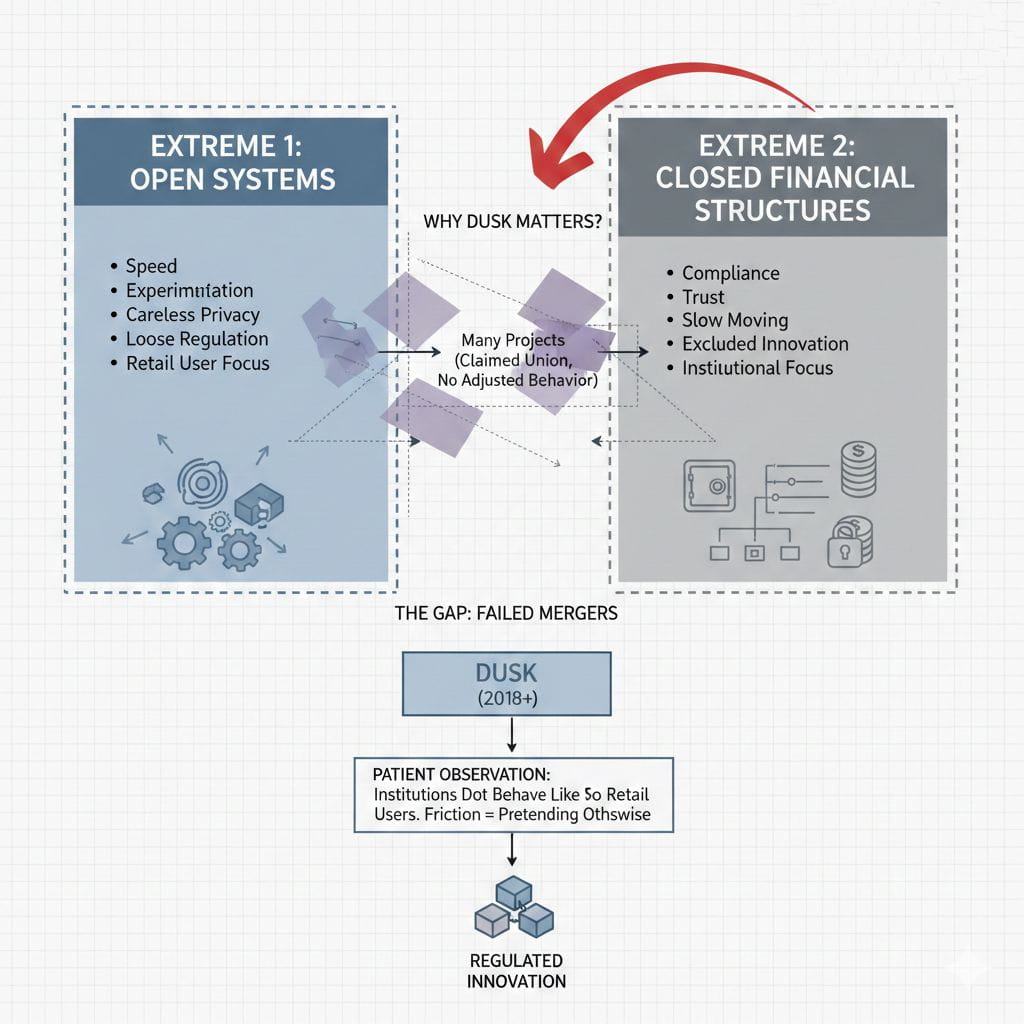
What Dusk seems to have noticed early is that financial systems are not just about moving value. They are about accountability, selective visibility, and long-term reliability. In real markets, privacy does not mean secrecy for its own sake. It means revealing the right information to the right parties at the right time. Existing blockchain solutions often treat privacy as an all-or-nothing feature, which works in theory but feels awkward in practice. Regulators need clarity. Institutions need audit trails. Users need discretion. Dusk’s approach appears shaped by this uncomfortable triangle, rather than by ideology.
Because of that, the project makes some choices that feel almost unfashionable. Instead of chasing maximal openness or radical anonymity, it accepts that some constraints are non-negotiable if the goal is real-world finance. This is a conscious trade-off. By narrowing its focus to regulated use cases, Dusk gives up the explosive experimentation seen elsewhere. It does not try to attract every developer with endless flexibility. Instead, it builds an environment where certain rules are assumed from the start. That limitation, paradoxically, becomes its defining strength.
What is kept simple is just as revealing as what is made complex. Dusk does not overload its narrative with grand abstractions. The system is framed around familiar financial ideas: assets that need structure, transactions that need discretion, and institutions that need confidence before they move. There is a sense that complexity exists under the surface, but it is not used as a selling point. This restraint suggests a design philosophy that values predictability over novelty, which is rare in a space addicted to constant reinvention.
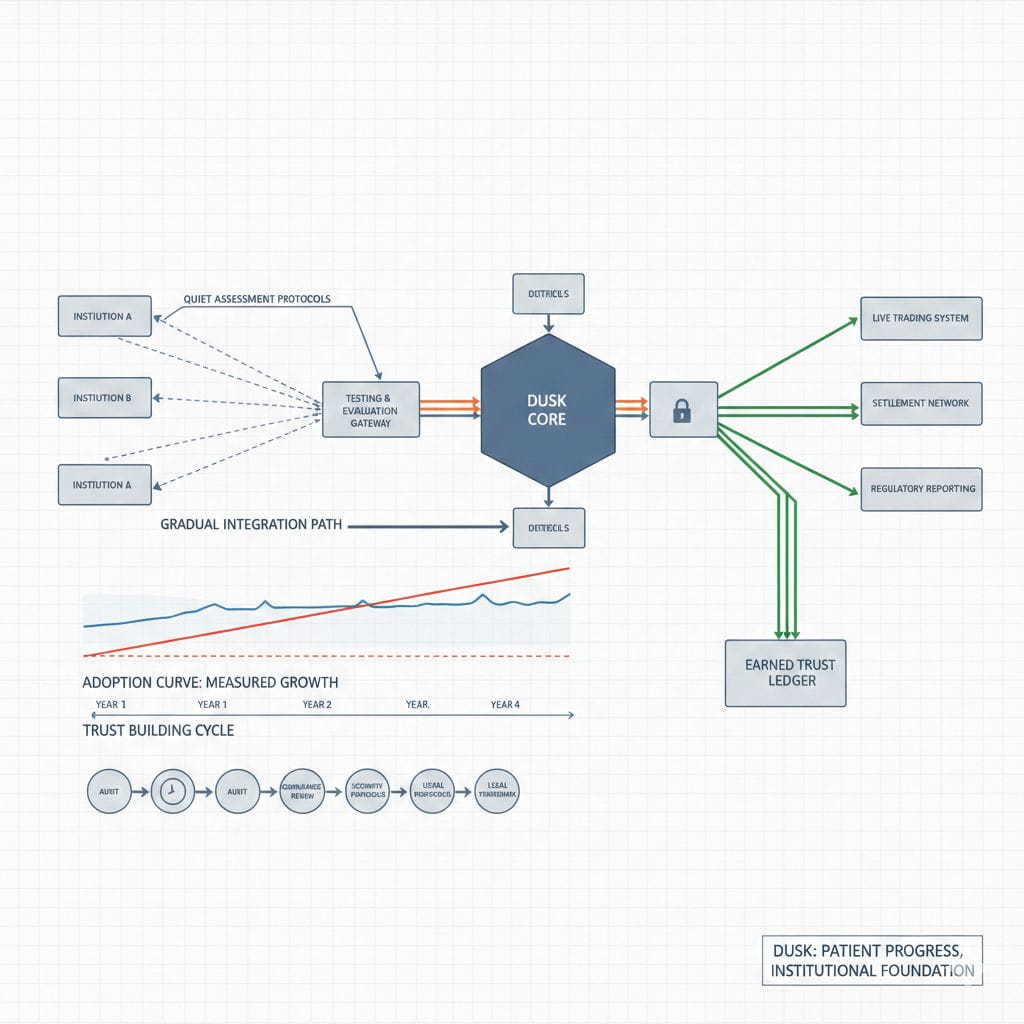
Growth, as a result, feels measured. Dusk has never looked like a project racing for headlines. Adoption seems to follow the slow rhythm of institutions testing, hesitating, and gradually integrating. This can be frustrating to observers who equate progress with visible metrics and sudden spikes. But anyone who has watched traditional finance up close knows that meaningful adoption often looks boring from the outside. Systems are evaluated quietly, over long periods, and only expanded once trust is earned. Dusk appears comfortable with that pace.
Of course, this approach raises real questions. By aligning itself so closely with regulated environments, Dusk risks being shaped by them. Rules change, jurisdictions disagree, and compliance today does not guarantee relevance tomorrow. There is also the challenge of balance: how much flexibility can be preserved without undermining the very structure institutions depend on? These are not problems with clean answers, and Dusk does not pretend otherwise. Its path feels less like a solved equation and more like an ongoing negotiation.
There is also the matter of visibility. Projects that stay quiet can be overlooked, especially in a market driven by narratives. Dusk’s relevance may be obvious to a narrow audience while remaining invisible to the broader crowd. That can limit community energy and slow organic experimentation. Whether this trade-off is sustainable depends on how well the project continues to align with real financial needs rather than market sentiment.
Still, after seeing countless platforms burn bright and fade just as quickly, there is something reassuring about a system that does not rush to impress. Dusk feels like it was built by people who expect the industry to mature, not explode. Its relevance does not come from being loud, but from being appropriately placed. It exists where regulation, privacy, and structure overlap, a space many avoid because it lacks easy victories.
Looking ahead, it is hard to predict outcomes, and perhaps that is the point. Dusk does not feel like a bet on a single future, but a careful positioning toward a direction where financial systems slowly adapt rather than abruptly transform. Whether it succeeds fully or partially, it represents a mindset that crypto rarely celebrates: progress through alignment instead of disruption. After multiple cycles, that quiet confidence feels less naive and more intentional, like a project that understands exactly how long the journey might be.
