

One of the most underestimated challenges in blockchain systems is not consensus or execution speed—it is state growth. As networks mature, state accumulates relentlessly: accounts, contracts, proofs, commitments, historical artifacts. Many protocols treat this as an unavoidable cost of success. Dusk Network does not. It treats state growth as something that must be designed, constrained, and governed, or the system will quietly centralize over time.
The problem is simple but brutal. If running a node requires storing an ever-growing amount of data indefinitely, participation becomes expensive. As costs rise, only large operators remain viable. Decentralization erodes, not through attack, but through attrition. Dusk’s architecture acknowledges this reality early and builds guardrails around it.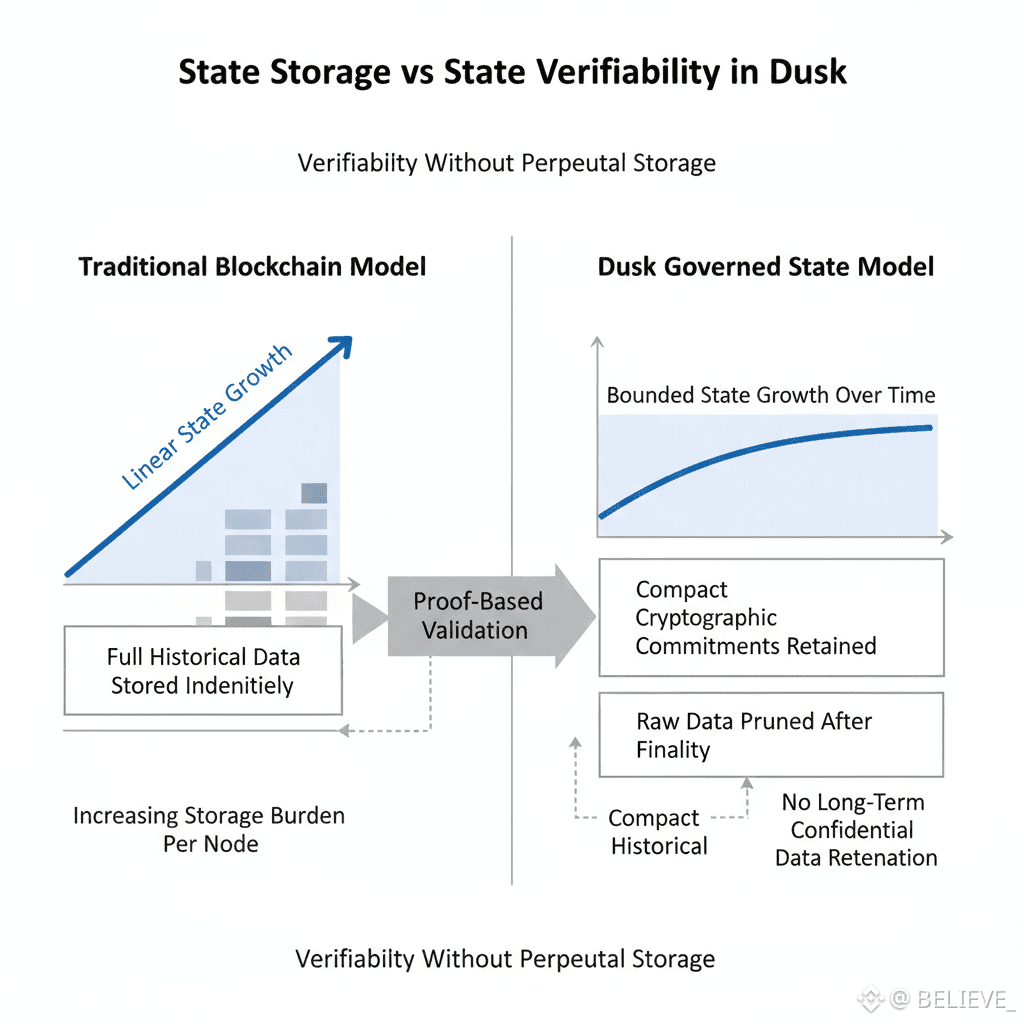
Instead of assuming that all historical data must live forever in an accessible form, Dusk separates what must remain provable from what must remain stored. This distinction is critical. Verifiability does not require hoarding raw data. It requires preserving cryptographic commitments that allow correctness to be demonstrated later.
Dusk leans heavily into this idea. State is structured so that historical actions can be validated through compact proofs rather than full replay. Once something is finalized and anchored cryptographically, its raw operational details no longer need to burden every node. The system remembers that something happened correctly, not every byte of how it happened.
This approach is especially important in a privacy-preserving environment. Storing sensitive data indefinitely is not just inefficient—it is risky. Dusk avoids turning the blockchain into a long-term archive of confidential material by ensuring that privacy-sensitive state can be validated without perpetual exposure or storage.
From a professional standpoint, this mirrors how serious systems manage data lifecycle. Financial institutions do not keep every internal message forever. They retain what is legally required, compress what is operationally useful, and discard what no longer serves a purpose. Dusk applies that discipline at the protocol level.
Predictability is another important factor. Operators and developers are able to reason about how states change over time. There are no hidden multipliers that cause the global state to unexpectedly expand due to a well-liked application. Explicit actions, bounded structures, and known limits are all necessary for growth.
This predictability matters for long-term planning. Infrastructure providers need to know what resources will be required months or years ahead. Dusk’s approach makes node operation something that can be budgeted and maintained, not constantly chased.
A fairness component is also present. Early adopters gain disproportionately from unchecked state growth. They sign up when storage is inexpensive, and participants pay the price later. Dusk avoids permanently locking in those advantages by creating mechanisms that prevent unbounded accumulation.
The DUSK token interacts with this philosophy indirectly but meaningfully. Because execution and participation costs are linked to protocol-defined limits, economic incentives discourage wasteful state creation. There is no free lunch where applications can externalize their storage costs onto the network indefinitely.
Importantly, this does not mean Dusk discourages rich applications. It encourages efficient ones. Developers are incentivized to design logic that proves what needs to be proven and discards what does not. Over time, this creates an ecosystem where elegance is rewarded and excess is costly.
There is also an operational resilience benefit. Smaller state means faster synchronization, easier recovery, and lower barriers for new nodes to join. This strengthens decentralization not by rhetoric, but by making participation practically accessible.
What makes Dusk’s stance notable is that it does not rely on future fixes or optimistic assumptions. It does not say “we’ll solve state growth later.” It treats it as a first-order design constraint from the start.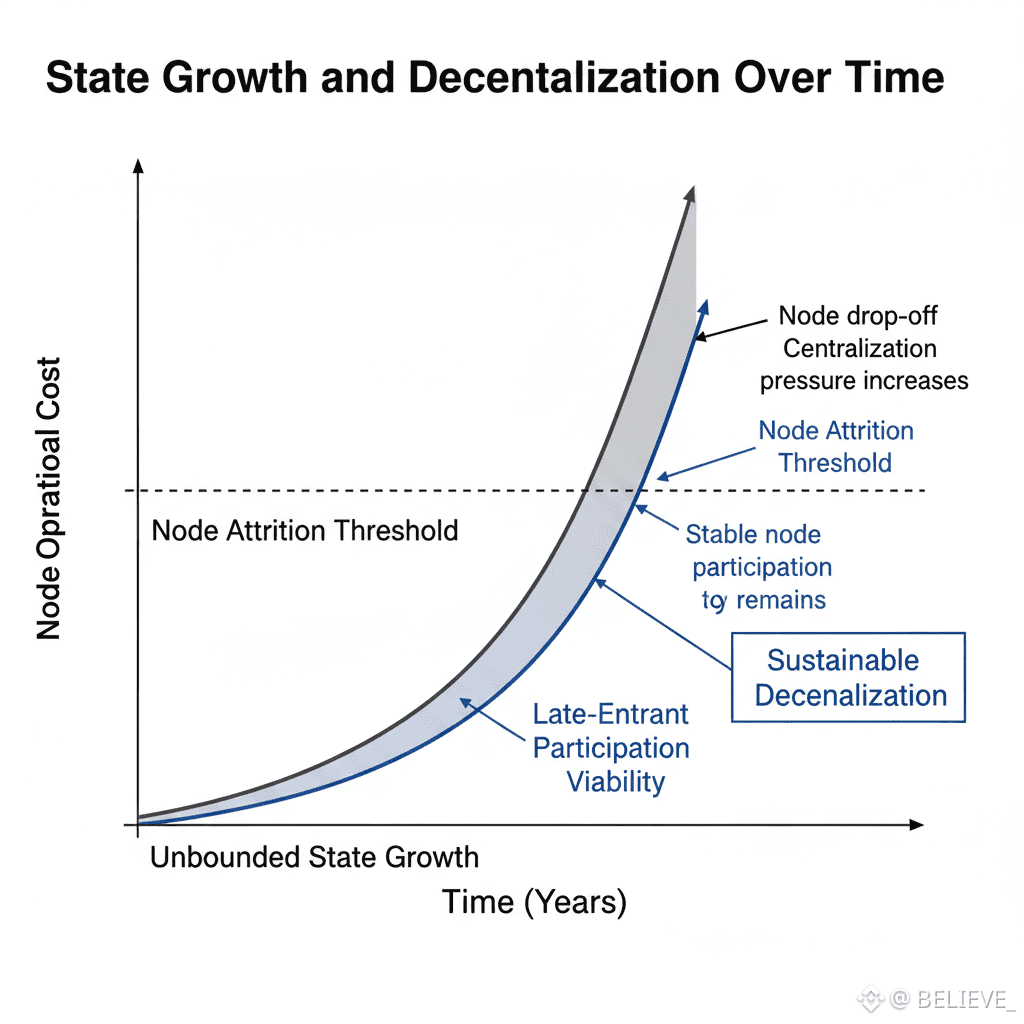
In many blockchains, state bloat is the hidden tax that arrives years after launch. By then, it is politically and technically difficult to reverse. Dusk avoids that trap by never letting state growth become invisible. Every design choice asks the same question: does this need to live forever?
That question is rare in a space obsessed with adding features. But it is essential for systems that aim to last decades, not hype cycles.
In conclusion, Dusk’s handling of state is not about minimalism for its own sake. It is about preserving decentralization through practicality. By governing how state accumulates, what must be retained, and what can be safely discarded, the protocol ensures that growth does not silently undermine participation.
Blockchains do not fail only when they are attacked.
They also fail when they become too heavy to carry.
Dusk’s architecture shows a clear understanding of that risk—and a willingness to design against it before it becomes irreversible.
