

There’s a category of data that most decentralized systems handle badly: information that must exist now, but should not be public yet.
Think of security research under embargo, governance drafts awaiting formal release, market disclosures tied to future events, or datasets that must be preserved intact before publication. Today, teams solve this with private servers, legal agreements, or “trust us” workflows.
Those solutions don’t scale—and they aren’t truly decentralized.
Walrus introduces a different approach: time-locked transparency, where data can be committed early, preserved honestly, and revealed later without relying on secrecy or custodians.
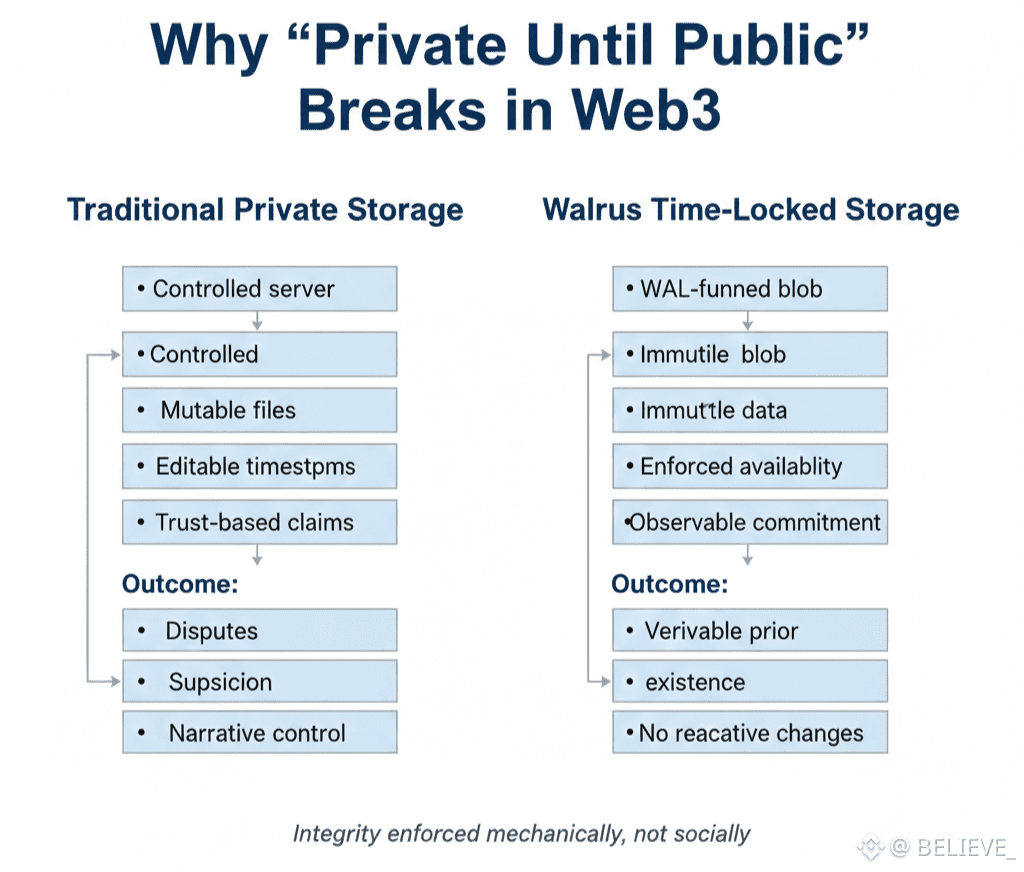
The Problem With “Private Until Public”
In Web3, “private” usually means “someone controls the server.”
That’s risky. Private storage can be altered. Files can be swapped. Dates can be rewritten. When disclosure finally happens, outsiders have no reliable way to verify that the data truly existed in its original form at the claimed time.
This is why embargoed data often turns into disputes.
Did the report exist before the vote?
Was the research finished before the announcement?
Were changes made quietly after the fact?
Walrus eliminates that ambiguity.
---
Committing Early Without Revealing Early
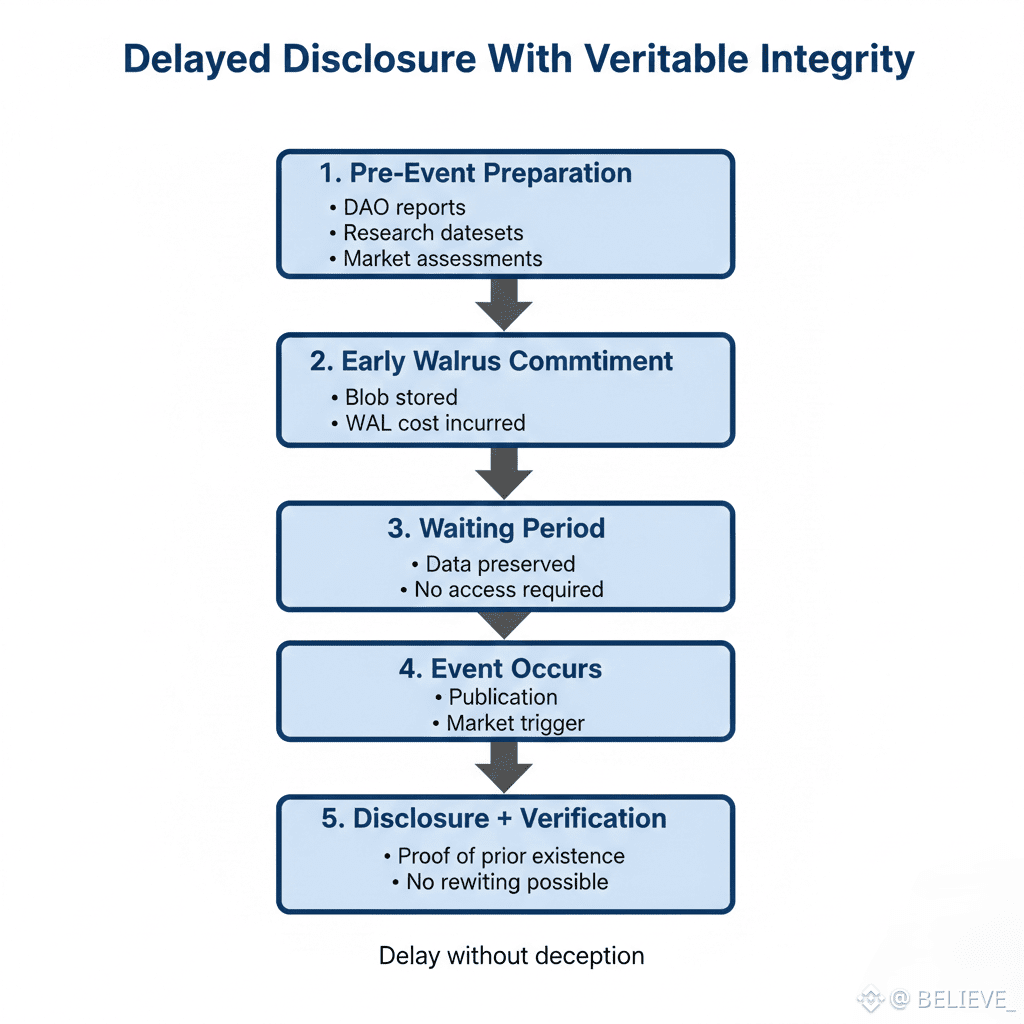
On Walrus, data can be stored and economically committed long before it is meant to be consumed.
The key difference is that existence and availability are separated from interpretation and exposure. A dataset can be stored, its presence verifiable, and its integrity enforced—without requiring applications or communities to read it immediately.
That creates a cryptographic timestamp without a publicity requirement.
When the moment for disclosure arrives, there’s no need to convince anyone that the data wasn’t altered. The network already enforced its availability and integrity during the entire embargo period.
Why This Matters for Governance
Governance is one of the most sensitive areas for delayed disclosure.
Draft proposals, research reports, and risk assessments are often prepared well in advance but released strategically. In centralized systems, this creates suspicion. Opponents can always claim manipulation.
Walrus allows governance processes to be provably honest without being prematurely transparent.
A DAO can commit a report before a vote window opens, keep it unread during deliberation, and then release it afterward—knowing anyone can verify it wasn’t rewritten mid-process. This preserves fairness without sacrificing strategic timing.
---
Research Without Fear of Being Scooped
Researchers face a similar tension.
Publishing early invites copying. Publishing late invites accusations. Walrus offers a middle ground: proof of prior existence without disclosure.
A research group can commit datasets, methodologies, or findings at a known point in time, then continue working privately. When publication happens, the community can verify that the work existed earlier—even if no one saw it.
This reduces reliance on journals, notaries, or institutional trust. Priority becomes a property of infrastructure, not reputation.
---
Time-Locked Accountability in Markets
Markets also benefit from delayed disclosure.
Audits, risk assessments, or internal metrics often need to be prepared ahead of events but revealed only when conditions are met. Without trustless infrastructure, markets rely on attestations and auditors.
Walrus lets organizations commit to information before outcomes are known, reducing incentives to rewrite history after the fact. The data doesn’t need to be public to be binding—it just needs to exist under enforceable conditions.
This strengthens credibility without forcing constant transparency.
---
WAL Makes Delay Economically Honest
Delayed disclosure only works if data remains intact during the waiting period.
WAL ensures that.
Because storage is economically enforced, a team can’t quietly let embargoed data lapse and re-upload a modified version later. Maintaining the commitment costs something. That cost signals seriousness.
If the data matters enough to be revealed later, it matters enough to keep alive now.
This turns delayed disclosure into a credible act, not a narrative claim.
---
Avoiding the “Dead Man’s Switch” Problem
Traditional time-lock systems rely on automated release triggers. If something fails, data may be lost or leaked unintentionally.
Walrus avoids brittle automation.
Disclosure timing remains a human or application decision. The network’s role is simply to guarantee that the data existed unchanged up to that point. No forced reveals. No accidental leaks.
This makes the system adaptable to real-world complexity.
Why This Is a Big Deal for Decentralization
Decentralization often pushes toward radical transparency. While admirable, that doesn’t match how many systems actually function. Strategic timing matters. Privacy matters. Preparation matters.
Walrus doesn’t force openness.
It supports honesty even when openness is delayed.
That’s a more realistic model for institutions, communities, and markets that operate over time.
Final Thought
Trustless systems usually struggle with patience.
They’re good at instant verification and bad at delayed truth. Walrus flips that script.
By allowing data to be committed early, preserved faithfully, and revealed on human timelines, it introduces a missing primitive: time-aware integrity.
You don’t have to show everything immediately to be honest.
You just need a system that remembers when it mattered.
Walrus does that quietly—
and that quiet reliability is exactly what delayed truth requires.

