

Most decentralized systems are built to start.
Very few are built to be handed over.
Teams change. Maintainers step back. DAOs rotate contributors. Companies wind down products. What usually follows is a quiet mess: data no one fully understands, storage bills no one wants to pay, and responsibilities that dissolve without clarity.
Walrus addresses this uncomfortable reality by making data handoff explicit, verifiable, and survivable.
The Problem No One Designs For
In Web3, responsibility often lives in people’s heads.
Who pays for storage?
Who maintains historical data?
Who is allowed to walk away?
When a team transitions, these questions surface too late. Data either gets abandoned accidentally or clung to unnecessarily. In both cases, the system suffers.
Walrus introduces structure where handoffs usually rely on trust and memory.
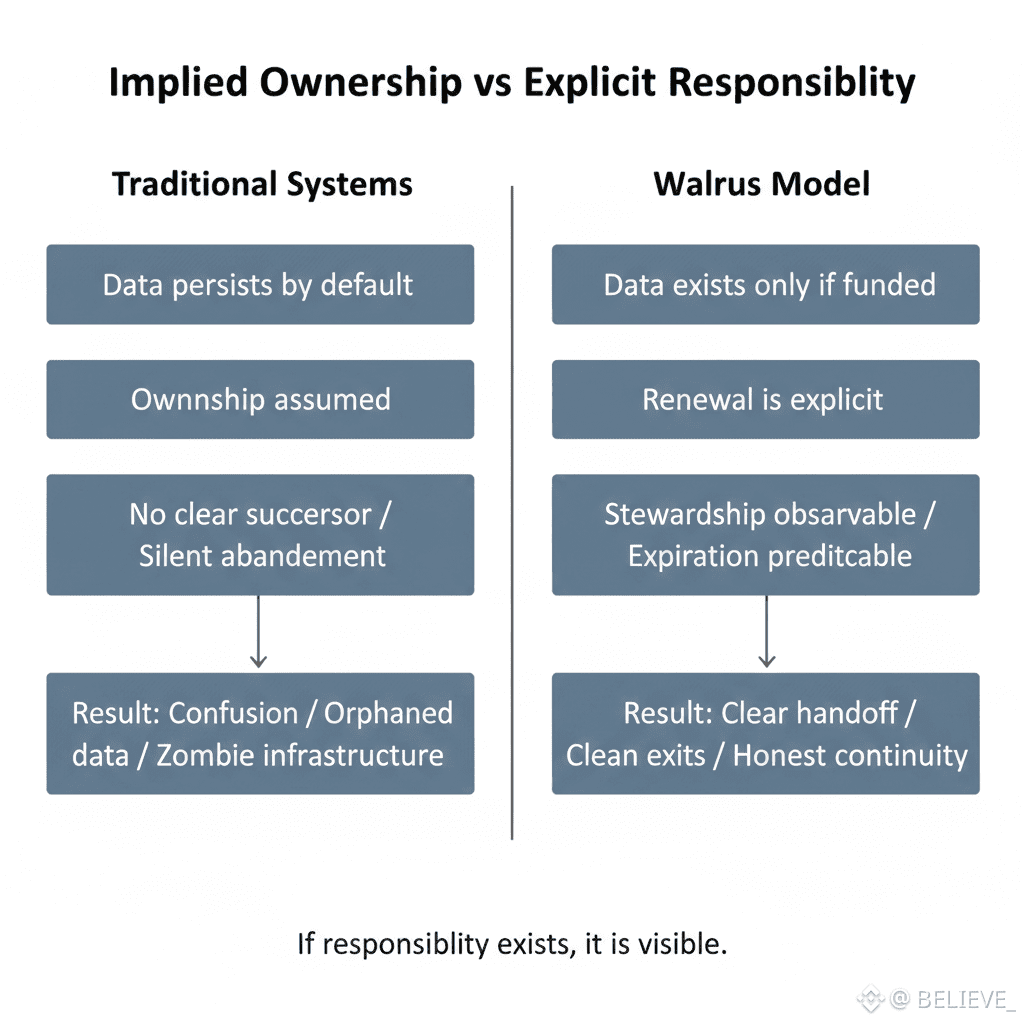
Storage Responsibility Is Visible, Not Implied
On Walrus, data doesn’t exist “in the background.”
It exists because someone funded it.
That simple rule changes how transitions work. When a maintainer steps away, the network doesn’t guess who’s responsible next. If the data is renewed, someone chose to take over. If it expires, the handoff didn’t happen.
There’s no ambiguity. Responsibility is legible on-chain.
This is a quiet but powerful improvement over traditional systems where data outlives accountability.
---
Clean Exits Without Breaking History
One of the hardest things to do in decentralized systems is to exit responsibly. Leaving often means either deleting too much or leaving behind a mess others must clean up.
Walrus allows maintainers to leave without destroying context.
Data can remain available for a defined transition period. New stewards can step in and extend it. If no one does, expiration is predictable and honest. There’s no sudden loss and no silent neglect.
Exits become events, not accidents.
---
Succession Without Private Agreements
In many projects, handoffs rely on private conversations, shared credentials, or informal agreements. These don’t scale and they don’t age well.
Walrus removes the need for backstage coordination.
Anyone who values the data can assume responsibility simply by renewing it. There’s no permission request. No approval flow. No gatekeeper. Succession happens through action, not paperwork.
That’s especially important for open systems where contributors are fluid and authority is distributed.
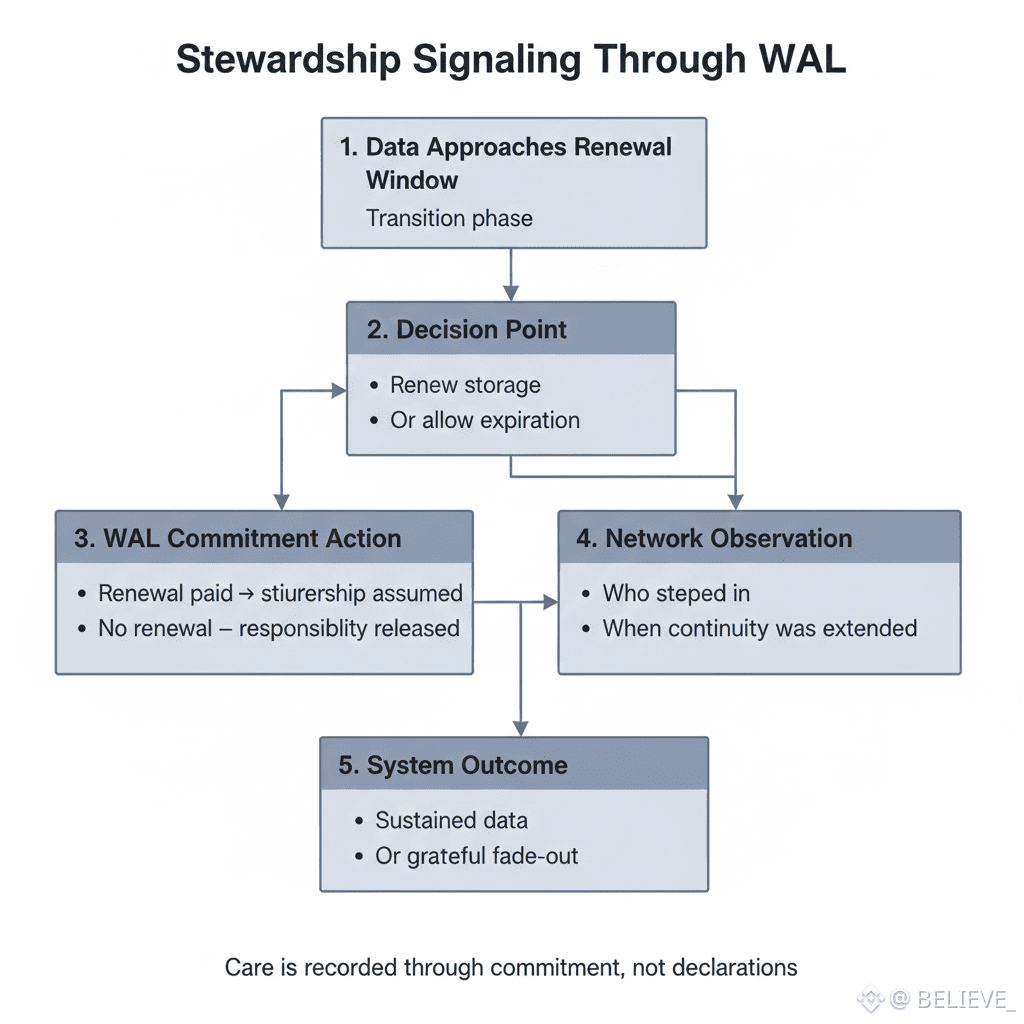
WAL as a Signal of Stewardship
WAL plays a subtle but crucial role here.
Renewing data is not just a technical act — it’s a signal of stewardship. Paying to keep data alive communicates intent. Over time, observers can see who stepped up, when, and for how long.
This creates a natural record of care. Not a reputation system, but a factual trail of responsibility.
Projects don’t need to announce maintainers.
The network shows who is acting like one.
---
Avoiding Zombie Infrastructure
One of the worst outcomes in decentralized systems is zombie infrastructure: data that persists indefinitely with no active users, no maintainers, and no reason to exist — but still consuming resources and confusing newcomers.
Walrus prevents this by default.
If no one is willing to take responsibility, data fades. The system doesn’t preserve artifacts out of politeness. It preserves them out of demonstrated value.
This keeps ecosystems healthier and easier to navigate.
---
Handoffs Without Central Control
Traditional infrastructure solves handoff through central ownership. Someone always has the master key. That works — until it doesn’t.
Walrus distributes the ability to care, not control.
No one can seize data unilaterally. No one is forced to maintain it forever. Responsibility emerges through participation, not authority.
That balance is rare, and it’s essential for systems meant to outlive their creators.
---
Why This Matters as Web3 Matures
Early-stage projects assume momentum. Mature systems must assume turnover.
As Web3 infrastructure ages, handoffs will become the norm, not the exception. Systems that don’t support clean transitions will fragment or ossify.
Walrus is one of the few storage layers that treats succession as a first-class reality.
A Different Philosophy of Permanence
Walrus doesn’t promise eternal data.
It promises honest continuity.
If data survives, it’s because someone chose to carry it forward. If it disappears, it’s because no one did. Both outcomes are valid, visible, and fair.
That philosophy respects both history and change.
---
Final Thought
Every system is eventually inherited by someone else — or no one.
Walrus doesn’t force inheritance, and it doesn’t fear abandonment. It simply makes both outcomes explicit.
In doing so, it turns one of the most fragile moments in infrastructure — the handoff — into something calm, observable, and intentional.
That’s not just good storage design.
It’s how systems grow up.

