

When a project begins to talk about 'cross-chain', the market's first reaction is often traffic, expansion, and ecological narrative. Frankly, this reaction is not surprising, because for a long time, cross-chain has been more of a growth strategy rather than an architectural necessity. But if you put Vanar into the premise discussed repeatedly in the previous articles—that AI is becoming one of the main users—then the question 'why cross-chain' will have a completely different answer.
For AI, isolated infrastructure has almost no value.
Humans can form communities, emotions, and a sense of identity within a chain, but AI cannot. The way AI works is inherently cross-system; it calls APIs, switches environments, and combines resources. For it, a 'chain' is merely an execution environment, not a matter of identity. If an AI-first infrastructure can only exist on one chain, then it has already limited its usage radius from the start.
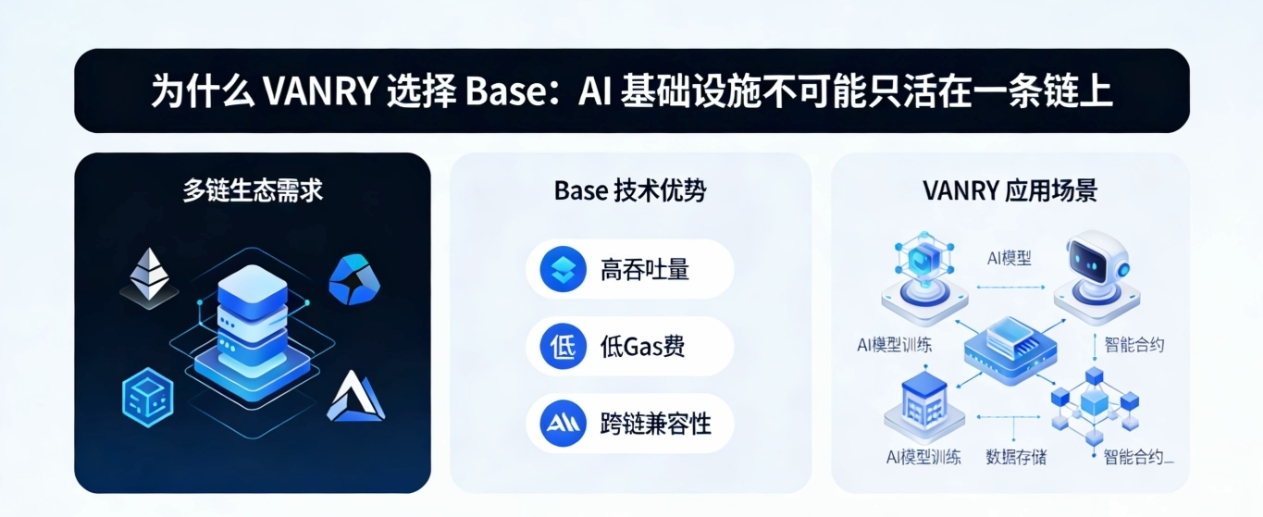
It is in this sense that I begin to understand why Vanar considers Base an important step, rather than putting all its energy into the narrative of 'growing one chain'.
Let's first place Base in a realistic context.
Base is not just another EVM chain; it is more like a high-density interface layer connecting real applications with Web3. A large number of applications aimed at ordinary users, payment scenarios, and developer tools are naturally growing on Base. This is already significant for the 'human-centered' narrative; for AI, its significance will be further amplified.
Because AI does not exist to 'participate in the ecosystem of a certain chain'; it exists to accomplish tasks. And tasks often occur where there are the most users, the most applications, and the smoothest settlements. What Base provides is precisely such an environment.
If you acknowledge that AI's activity radius will inevitably cover multiple ecosystems, then you must also admit: AI-first infrastructure cannot encapsulate itself as an island.

Cross-chain is not for storytelling, but for survival.
From this perspective, VANRY's positioning has also undergone a very critical change.
In a single-chain narrative, VANRY can easily be understood as 'Gas on the Vanar chain'. But once you shift your perspective to a cross-chain environment, it resembles a value anchor that maintains consistent rules of behavior across different execution environments.
No matter where AI executes tasks, is the settlement logic consistent?
Are costs predictable?
Can behaviors be measured by the same set of rules?
These questions cannot be established without a value scale that is usable across environments.
Vanar chooses to start from Base, rather than waiting until 'everything matures', essentially pre-validating a hypothesis: the use of AI will not be locked to a certain chain.
If this assumption is correct, then the significance of VANRY will not be limited to Vanar's own network.
Many people underestimate the changes brought about by this.
In traditional public chain competition, cross-chain more often means 'moving assets over';
In the AI scenario, cross-chain means transferring intelligent behaviors.
These two are completely different. Assets are static, behaviors are dynamic.
Once behaviors can occur across chains, then settlement, constraints, memory, and reasoning must also coordinate across environments. Otherwise, the system will fracture at the boundaries.
It is also for this reason that I believe Vanar's choice of cross-chain is more like a self-verification at the architectural level, rather than a simple ecological expansion. It is not validating 'is there anyone using it', but rather 'can this design maintain consistency in different environments'.
If you connect the logic of the previous articles, you will find a very clear clue:
Memory must persist.
Reasoning must be explainable.
Execution must be constrained.
Settlement must be predictable.
And all of this cannot just happen within a closed system.
What VANRY undertakes here is to maintain the same semantics of these capabilities in different environments. It's not about 'which chain to use', but rather 'regardless of where, are the same rules still applied?'.
This may not be an easily priced story for the short-term market. Because it does not create a sense of scarcity, nor does it emphasize 'uniqueness'. But for AI, consistency itself is a scarce resource. If a behavior needs to be reinterpreted or recalibrated in different environments, it cannot scale.
I increasingly feel that the competition for AI-first infrastructure is unlikely to be decided by 'which chain is the hottest', but rather by 'which set of rules can be easily replicated in different environments'. Vanar treats Base as an important stop, following this direction.
If you still view this step through the lens of 'ecological expansion', it is easy to underestimate its significance. But if you regard AI as one of the main users, you will realize: not being cross-chain is the real risk.