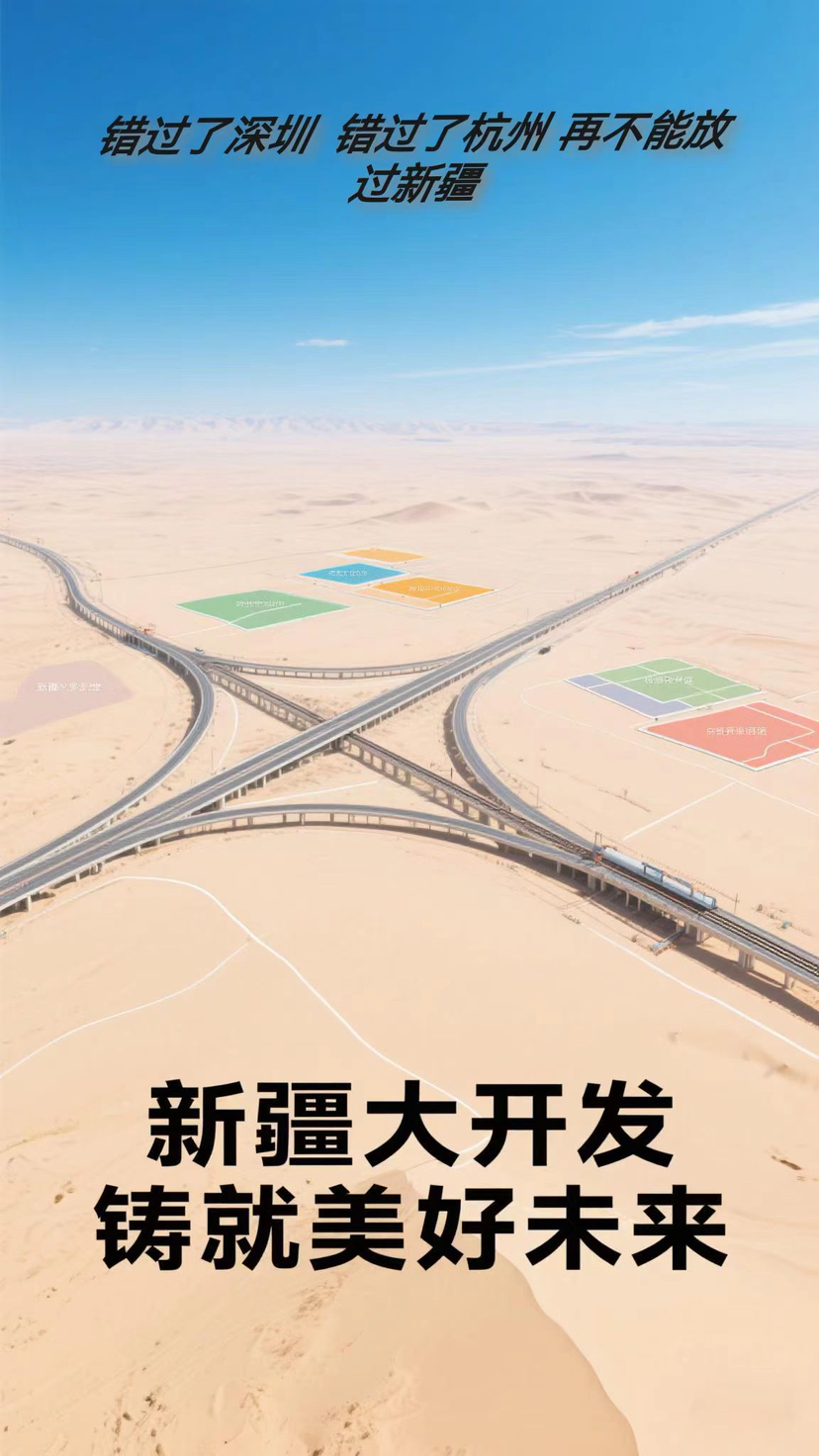
Why Xinjiang? 30 years ago, people in Shenzhen could easily buy a piece of land and make a hundredfold profit. Today, Xinjiang is replicating this miracle, and on a much larger scale. The country has just poured 3.47 trillion yuan into Xinjiang. What does this number mean? In 2008, China's economy only used 4 trillion yuan. Now, almost the same amount of money is being poured into one province. You're probably wondering, why Xinjiang? Let me tell you, there's a grand strategy behind it that keeps the US up at night. What is the US most afraid of now? They're most afraid that we'll stop using sea routes. For the past 30 years, goods to be sold to Europe had to pass through the Strait of Malacca. The US has deployed warships there, ready to cut off our economic lifeline at any time. It's like having a bully blocking your doorstep; you have to be mindful of their attitude when you go out to do business. But Xinjiang is different. It borders eight countries and is the geographical center of Asia. From Xinjiang, goods can be transported directly to Europe by land, completely bypassing the US maritime blockade. Goods from Chengdu, Chongqing, and Zhengzhou are now directly shipped from Xinjiang to Germany, the Netherlands, and the United States – no chance of even trying. Even more impressive is Xinjiang's abundance of resources: 30% of the nation's oil reserves, 28% of its natural gas reserves, and 40% of its coal reserves. If you open a factory in Guangdong, the cost of transporting energy from Xinjiang will be exorbitant. But if you build your factory directly in Xinjiang, energy is right at your doorstep, cutting costs in half. Electricity prices are even more outrageous: in Guangdong, electricity costs 1.2 yuan per kilowatt-hour during peak hours, while in Xinjiang it's only 0.6 yuan – more than half the price. This is why international giants like BASF from Germany and Toray Industries from Japan are flocking to Xinjiang. You might not know that the world is currently facing a severe power shortage: the power grids of the UK and Sweden are on the verge of collapse due to AI, and the US has warned that half of its regions will experience power shortages within the next 10 years. Xinjiang has abundant wind and solar power, and has already built 36 AI data centers. Huawei and China Mobile are positioning themselves for the AI era; whoever controls the power grid is king. Xinjiang is becoming the Saudi Arabia of the AI era. And there's something even more surprising: isn't Xinjiang a desert? Xinjiang's grain output has now surpassed that of Jiangxi Province, with an additional 2.02 million mu of arable land added in 2024 alone, and its sales growth ranking first in the country. Even more outrageous is that Xinjiang is now raising salmon and crayfish. The transformation of deserts into fertile fields and Gobi into granaries is not a myth, but a reality that is unfolding.With 3.47 trillion yuan invested and 500 key projects launched simultaneously, transportation, energy, and computing power—each sector presents a massive wealth opportunity. Xinjiang's foreign trade growth rate is currently 21.8%, exceeding 100 billion yuan annually for three consecutive years, a feat other provinces can't match. Let me ask a painful question: 30 years ago, Shenzhen's housing prices were only a few hundred yuan per square meter. Now? Starting at 100,000 yuan. Those who went to Shenzhen back then, even as laborers, would be millionaires now if they bought property. Today's Xinjiang is like Shenzhen 30 years ago, perhaps even with greater opportunities. Shenzhen is just a city; Xinjiang covers 1.66 million square kilometers, equivalent to 17 Zhejiang provinces. With such a vast area, abundant resources, and such massive investment, how many times will housing prices increase? How many more job opportunities will arise? How many entrepreneurial opportunities will emerge? You're still struggling in Beijing, Shanghai, and Guangzhou, earning a meager 10,000 or 20,000 yuan a month, barely enough to cover rent. Meanwhile, Xinjiang is undergoing a transformative change, with countless opportunities waiting for those with foresight to seize. I'm not telling you to buy a plane ticket to Xinjiang tomorrow; I'm telling you the tide has turned. The past was the age of the ocean; the future is the age of land. In the past, look to the coast; in the future, look to the west. The 3.47 trillion yuan is just the beginning; more funds and policies will follow. You can continue to be exploited in first-tier cities, or you can go to Xinjiang to be a pioneer—the choice is yours. But I must remind you, opportunity never waits for anyone. Those who missed out on Shenzhen 30 years ago are still regretting it; will you regret missing out on Xinjiang 10 years from now? $雪球