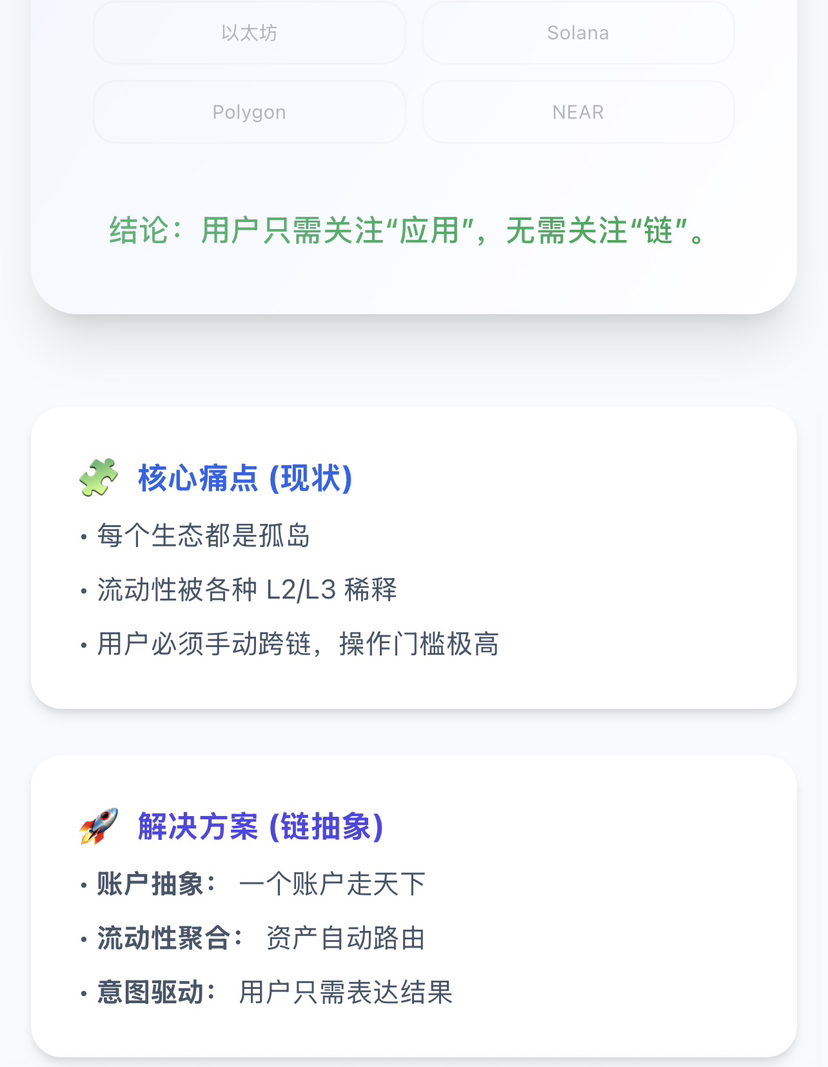
The core goal of Chain Abstraction is to make users 'unaware of the existence of chains.'
In the current Web3 world, the experience for beginners is poor and requires learning a lot of pitfalls knowledge. Chain abstraction aims to bundle all these underlying dirty tasks, allowing users to quickly apply different public chains.
What is Chain Abstraction?
Chain abstraction is a design paradigm that separates the underlying complexity of blockchain (such as different ledgers, consensus mechanisms, gas fees, and signature algorithms) from the application layer.
Its core elements typically include:
1. Unified Account: Users only need one account to be universally applicable across all chains.
2. Users can pay Gas with any token, even covered by the application party.
3. Funds are automatically scheduled across different chains, and you do not need to manually cross chains.
4. Regardless of whether the underlying is EVM or non-EVM, users only need to sign once, and the backend automatically handles multi-chain logic.
Representative project classification
1. Comprehensive solutions (The Pioneers)
• NEAR Protocol:$NEAR
One of the earliest public chains to clearly propose the concept of 'chain abstraction'. Through Account Aggregation, users can control addresses on all other chains (such as Ethereum, BNB) with a single NEAR account. Its vision is to make NEAR the entry point for all Web3 applications.
2. Aggregation layer within the ecosystem (The Ecosystem Aggregators)
Polygon (AggLayer): $POL
The aggregation layer launched by Polygon aims to connect all L2s built on CDK. Its goal is to enable atomic cross-chain transactions and unified liquidity among these chains, as if they were on a single chain.
• Optimism (Superchain):
Building a 'super chain' through OP Stack allows chains like Base, OP Mainnet, and Zora to interoperate at the underlying level, reducing the barrier for users to switch between these chains.
3. Wallets and entry points (The Wallets)
• Binance $BNB Wallet / Uniswap Wallet:
These wallets are achieving effective chain abstraction at the front end by integrating multi-chain and automatic cross-chain swaps, but they do not constitute direct mergers on public chains.
In summary, chain abstraction is not about eliminating different chains, but about removing the barrier of 'users must understand the chain'.