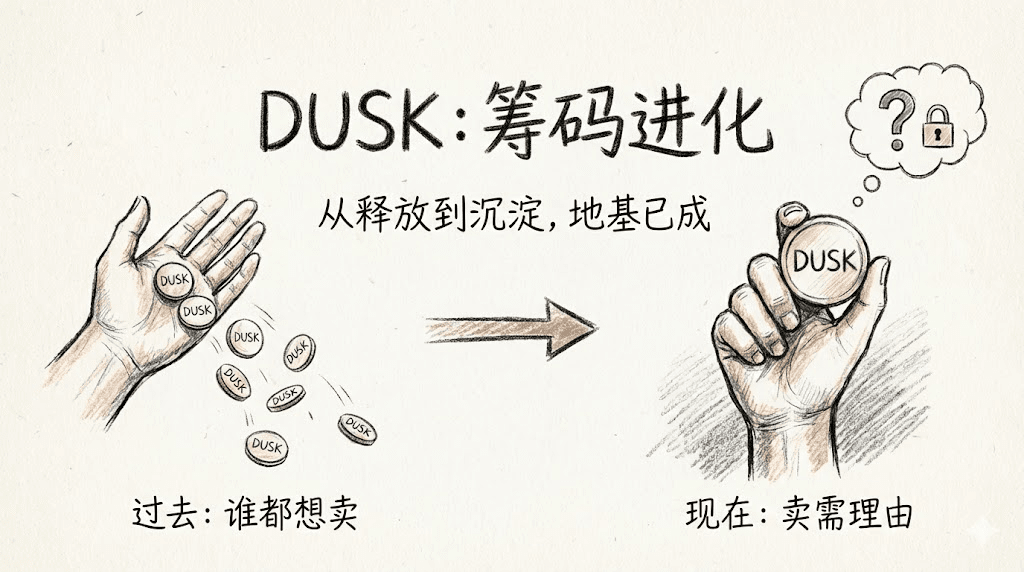
If you only focus on the K-line, it's easy to overlook a more important issue: the people trading DUSK now are not the same as those at the time of the TGE. Price is just the result; what truly determines the subsequent trend is actually the chip structure.
Let's go back to the early stage of the TGE. The typical characteristic of DUSK during that phase was just one — a high degree of liquidity in the chips. Whether it was airdrops, early participants, or funds entering for short-term fluctuations, the goal was very consistent: to find liquidity and realize expectations. The role of price in this phase was not 'pricing' but 'releasing'. What was released was the early uncertainty, also providing the market with an opportunity to redistribute the chips.
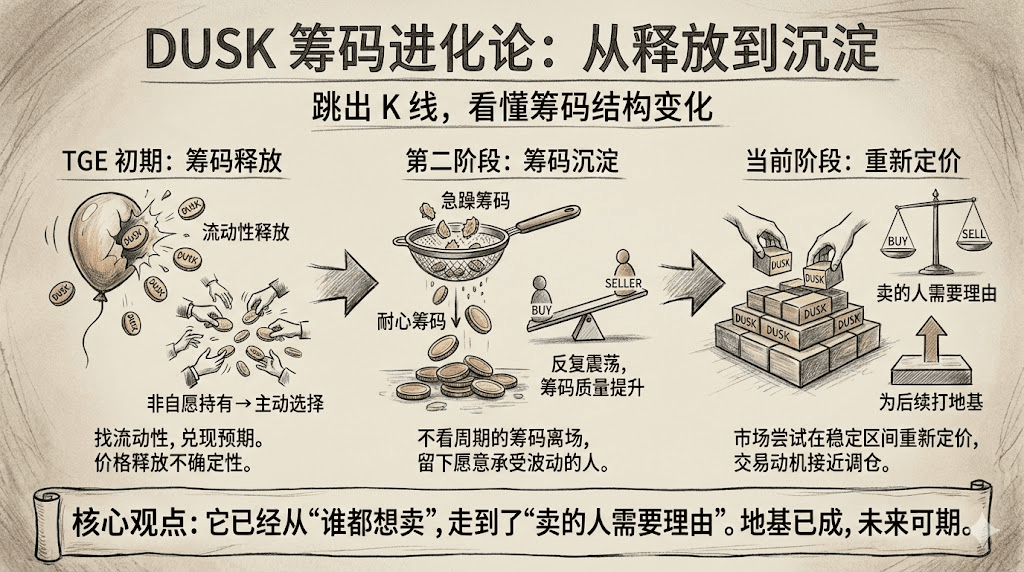
So you will see that after TGE, there was no one-sided trend. Rallies are interrupted by sell orders, and declines are supported. This does not indicate a weak project, but rather highlights a fact: the chips are shifting from 'involuntary holding' to 'active choice to hold.'
Next is the second stage, which is also the stage where many people are most likely to misjudge. As the first batch of eager-to-cash chips gradually clears out, trading does not disappear but begins to become dispersed. Prices are no longer driven by a single direction, but instead enter a phase of repeated fluctuations. Many people will conclude 'there is no market here,' but structurally, this is precisely a signal that the quality of chips is beginning to change.
Because chips that truly do not watch cycles or positions have often already left; what remains are at least those willing to endure volatility and have judgment about prices. These types of chips will not all sell out during every rally, nor will they panic and sell during every pullback. The price beginning to 'stick' is a direct result of the increased proportion of these chips.
Looking at the current stage, DUSK's trading still exists, but there are rarely instances of unilateral rapid sell-offs. When sell orders come out, there are buyers; when buy orders go up, there are sellers. It sounds very ordinary, but it signifies something very crucial: the market is starting to attempt to reprice DUSK within a more stable range.
At this time, imposing the standards of an 'emotion-driven coin' on its movements will instead create a misalignment. Because what governs the price now is no longer the chips that must be sold, but those that choose to remain. Their trading motivations are closer to 'rebalancing' and 'waiting for confirmation,' rather than 'fleeing.'
From a trading perspective, this type of chip structure is not suitable for pursuing immediate explosions. It is more like laying the foundation for subsequent trends. The foundation stage is not lively, but once completed, the price's response to external variables will become more direct and decisive.
So if we look at DUSK from the starting point of TGE, we will find a very clear change:
It has moved from 'everyone wants to sell' to 'sellers need a reason.'
This is not a conclusion, but a process. As long as this process is not disrupted, there is meaning in continuing the discussion about the subsequent market.
The above content is merely personal analysis and does not constitute any investment advice.