

In modern crypto markets, the most important work happens after a trade is made. Orders need to be matched, balances must be updated, and assets must settle from one party to another in a way that is final, accurate, and hard to dispute. This process is called settlement, and it is the same core function that runs traditional financial markets. On public blockchains this settlement happens on a shared ledger, but most blockchains were built for open and simple token transfers, not for the complex needs of regulated finance, private trading, or real-world assets. This gap between open crypto rails and the rules of real finance is where many projects struggle.
Dusk is a layer 1 blockchain that was created to operate in this space. Founded in 2018, it was designed from the start for regulated and privacy-focused financial infrastructure. Instead of trying to turn a general-purpose blockchain into something that banks, funds, and regulated platforms can use, Dusk was built with these requirements in mind. Its goal is not to hide activity, but to allow financial actions to be private where needed and still auditable when required. This balance is important for things like institutional trading, compliant DeFi, and tokenized real-world assets, where regulators, counterparties, and users all need different levels of visibility.
At the core of Dusk is its modular architecture. This means the system is not a single rigid design, but a set of layers and components that work together. One part handles consensus and security, another handles privacy, and others manage application logic and asset rules. This structure makes it easier to support financial products that need clear rules, compliance checks, and reliable settlement. It also means the network can support different types of financial activity without forcing everything into one simple transaction model.
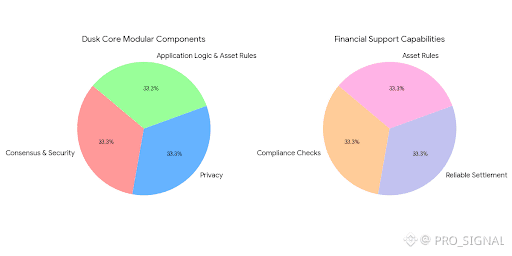
Dusk is designed to support institutional-grade financial applications. These are not small retail apps, but systems that handle large volumes, legal obligations, and risk management. In practice, this includes compliant DeFi platforms where trades, loans, or liquidity pools can follow rules set by regulators or by the issuer of an asset. It also includes tokenized real-world assets, such as securities or claims on physical assets, where ownership must be clear, private, and legally meaningful. Dusk provides the base layer where these assets can exist and move between users while keeping sensitive details protected.
Privacy on Dusk is not used to avoid oversight. It is used to protect trading positions, balances, and counterparties from being exposed to the whole market. In traditional finance, this information is not public, and for good reason. If large orders, holdings, or settlements were visible to everyone, markets could be manipulated and traders could be harmed. Dusk uses cryptographic methods to keep this data private on-chain, while still allowing the system to prove that rules are being followed. At the same time, auditability is built in. This means that regulators or authorized parties can verify activity when needed, without turning the whole network into a public data feed.
From a trading and money flow point of view, this makes Dusk a settlement layer rather than just a payment chain. Assets can be issued, traded, and settled on the same network. Positions can be updated without exposing them to the public. Compliance rules can be enforced at the protocol level instead of through manual checks. This creates a more predictable environment for financial activity, which is important for larger players who need legal and operational certainty.
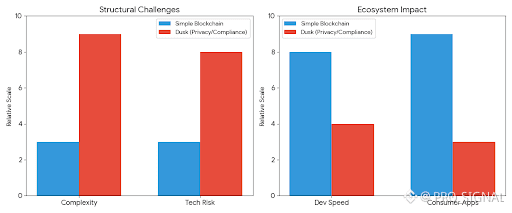
There are also limits and trade-offs. A system that supports privacy, compliance, and complex assets is more complex than a simple public blockchain. This can mean slower development, higher technical risk, and fewer simple consumer applications. It also depends on regulators and institutions being willing to use on-chain systems, which is still a gradual process. Dusk does not remove these challenges, it only provides a technical foundation to deal with them.
In the long run, crypto markets will not grow only through speculation and simple token transfers. They will grow through settlement systems that can handle real financial activity, real assets, and real rules. Dusk is built as one of these systems. By combining a layer 1 blockchain with modular design, built-in privacy, and auditability, it offers a way for money, assets, and obligations to move on-chain in a controlled and reliable way. This kind of infrastructure matters because it supports the quiet work behind trading and finance, which is what allows markets to scale beyond early-stage crypto into something that can carry long-term economic value.
