
The friction of managing volatile gas tokens is the last major barrier to mainstream crypto adoption. Here's how a fundamental redesign of fee mechanics is solving it.
For years, we've accepted a cumbersome reality: to use the revolutionary financial tools of Ethereum and similar blockchains, you must first stock up on a separate, volatile commodity—the native gas token. This process is a relic of a developer-centric past, creating unnecessary friction, risk, and complexity for everyday users.
Projects like Plasma are now challenging this dogma with a "Stablecoin-First Gas" model. Let's explore why the old way is holding us back and how this new paradigm builds trust and simplifies Web3 for everyone.
The High Cost of Volatile Gas: More Than Just Fees
The problem isn't just about paying fees; it's about the cognitive and financial overhead required before any transaction even begins.
The Pre-Funded Wallet Dilemma: Imagine needing to buy a separate, fluctuating "fuel" currency just to send USD from your digital bank account. This is the reality for crypto users. You must estimate how much ETH you'll need, purchase it via an exchange or on-ramp, and wait for it to arrive in your wallet—all before executing your actual transaction. If gas prices spike, your transaction fails. If they drop, you're left with stranded, unspent crypto.
The Business Barrier: For merchants, this volatility is a non-starter. Data shows that nearly 90% of businesses accepting crypto instantly convert it to fiat or stablecoins to eliminate volatility risk. If even revenue-generating businesses avoid holding volatile crypto, why should users be forced to hold it just to pay for gas?
A Real Scenario: Alex's DeFi Hassle
Alex wants to mint a new NFT or provide liquidity. She checks the network fee: it's 0.005 ETH. She goes to an exchange, buys 0.006 ETH to be safe, and transfers it to her wallet. By the time she's ready, network congestion has eased. The fee is now 0.003 ETH. She completes her transaction but is left with 0.003 ETH she didn't originally want—a small, unplanned, and volatile investment. This micro-management kills seamless user experience.
Plasma's Blueprint: Gas as a Service, Not a Commodity
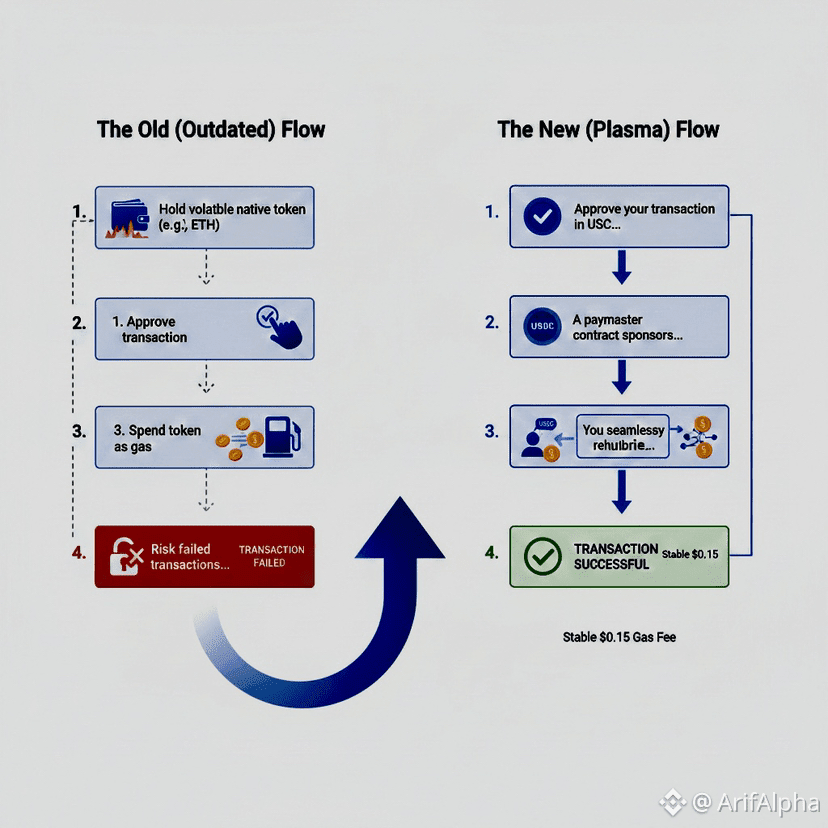
Plasma's approach uses account abstraction (ERC-4337) and a concept called a paymaster to fundamentally separate the action from the fuel payment. Here’s how it reimagines the process:
The Old (Outdated) Flow:
1. Hold volatile native token (e.g., ETH).
2. Approve transaction.
3. Spend token as gas.
4. Risk failed transactions if balance or price is wrong.
The New (Plasma) Flow:
1. Approve your transaction in USDC or another stable asset.
2. A paymaster contract sponsors the gas fee on the network in the native token.
3. You seamlessly reimburse the paymaster in your chosen stablecoin.
4. Transaction succeeds without you ever touching a volatile gas token.
This isn't just a theoretical improvement. Major financial infrastructures like Visa have already built prototypes proving this model's viability, highlighting its potential to "simplify the entry point for new crypto users".
Building Trust Through Familiarity and Predictability
The "Stablecoin-First" model isn't just convenient; it's a powerful trust-building mechanism.
Financial Predictability: Users can finally understand the exact cost of a transaction in a dollar-denominated value at the moment they sign. No more guessing games with gwei or fearing a market swing between buying ETH and using it.
Reduced Cognitive Load: By removing the requirement to hold a second volatile asset, Plasma reduces the steps to failure. This aligns with the core Web3 promise of user sovereignty—giving users control without forcing them to become technical experts or portfolio managers.
Enterprise-Grade Logic: This model mirrors what savvy businesses already do: use crypto for its utility (permissionless transactions, smart contracts) while immediately managing volatility exposure. Plasma brings this prudent, professional financial logic to the end-user experience.
The Bigger Picture: A Mindshare Shift
Adopting this model requires a shift in mindset—from viewing gas as a speculative network resource to treating it as a utility service with a stable price. Projects that prioritize this user experience are competing for more than transactions; they're competing for mindshare by demonstrating a deep understanding of real user pain points.
The recent update to Binance's CreatorPad scoring, which launched alongside the Plasma campaign, emphasizes "real mindshare" and quality engagement. This aligns perfectly. Content and projects that educate about these fundamental UX improvements—moving beyond surface-level hype to explain why a change matters—are building the durable trust that the ecosystem needs.
Visualizing the Trust Shift:
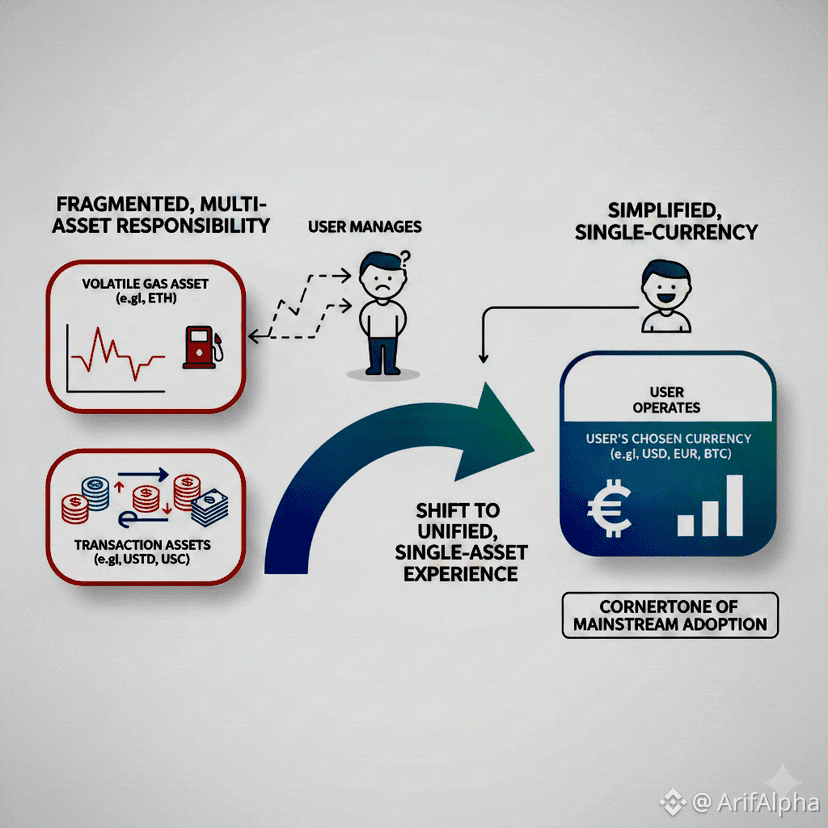
The move is from a fragmented, multi-asset responsibility (user manages volatile gas + transaction assets) to a unified, single-asset experience (user operates solely in their chosen currency). This simplification is the cornerstone of mainstream adoption.
A Question for the Community
We've redesigned wallets, bridges, and exchanges. Now, the final frontier of user experience is the basic transaction fee itself. If you could never worry about holding ETH for gas again, what new use case or application would you finally feel comfortable trying?

