

Retail payments in high-adoption countries do not behave like crypto demos. They behave like infrastructure under pressure. When money is used every day — for groceries, transport, wages, and small trade — tolerance for uncertainty collapses. Systems are not judged by ideology or innovation. They are judged by whether they work, every time, without explanation.
Plasma is designed with that environment in mind.
In many emerging economies, crypto adoption is not aspirational. It is practical. People use stablecoins because local systems are unreliable, fragmented, or exclusionary. That context exposes weaknesses in blockchains that were designed around speculation first and payments later. Plasma assumes the opposite order.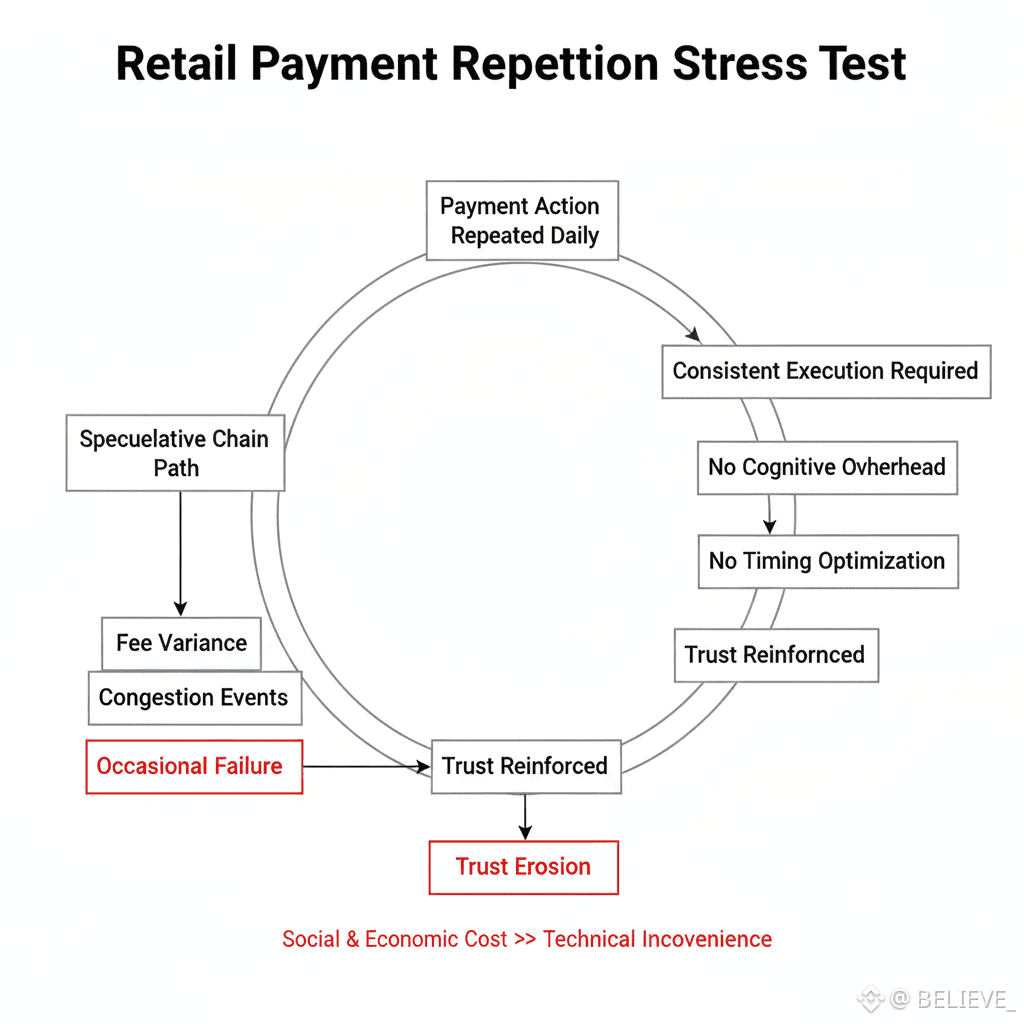
The first challenge retail economies introduce is repetition. A payment system may succeed once and still fail as infrastructure. What matters is whether the same action can be performed dozens of times a day without cognitive effort or operational surprises. Speculative chains often succeed in bursts — when conditions are favorable, fees are low, and congestion is absent. Retail usage removes those favorable conditions.
Plasma treats repetition as a primary requirement. The system is built so that the same payment action behaves identically regardless of time, load, or surrounding activity. This consistency is not a UX detail; it is a trust mechanism. In retail environments, trust is built through sameness, not speed.
Another pressure point is economic fragility. In high-adoption regions, users are often operating close to margins. Small disruptions matter. A delayed payment can interrupt a supply chain. A failed transaction can halt a sale. Systems that assume users can retry, wait, or absorb minor losses misunderstand retail reality.
Plasma’s architecture assumes that failure has social cost. That assumption influences how execution is prioritized and how payment flow is protected from unrelated activity. The network does not treat retail transfers as background noise competing with speculative events. It treats them as the core signal the system exists to serve.
Volatility leakage is another area where speculative chains struggle. Even when stablecoins are used, instability enters through fees, congestion, and unpredictable execution behavior. Retail users experience this as randomness. Randomness feels dangerous when money is involved.
Plasma reduces this exposure by structuring the network around stablecoin flow rather than asset diversity. Stablecoins are not guests on the system; they define its behavior. This alignment reduces the psychological and operational volatility retail users experience, even when the broader market is unstable.
Access friction is equally decisive. In retail contexts, onboarding is not a funnel — it is a test. Users do not read guides or learn mechanics. They try once and decide. Systems that require multiple assets, balance management, or technical understanding fail silently. Adoption stops without complaint.
Plasma assumes users will not learn the system. The system must learn the user. Payment interactions are designed to feel complete, not instructive. This lowers the barrier to first use and, more importantly, to continued use.
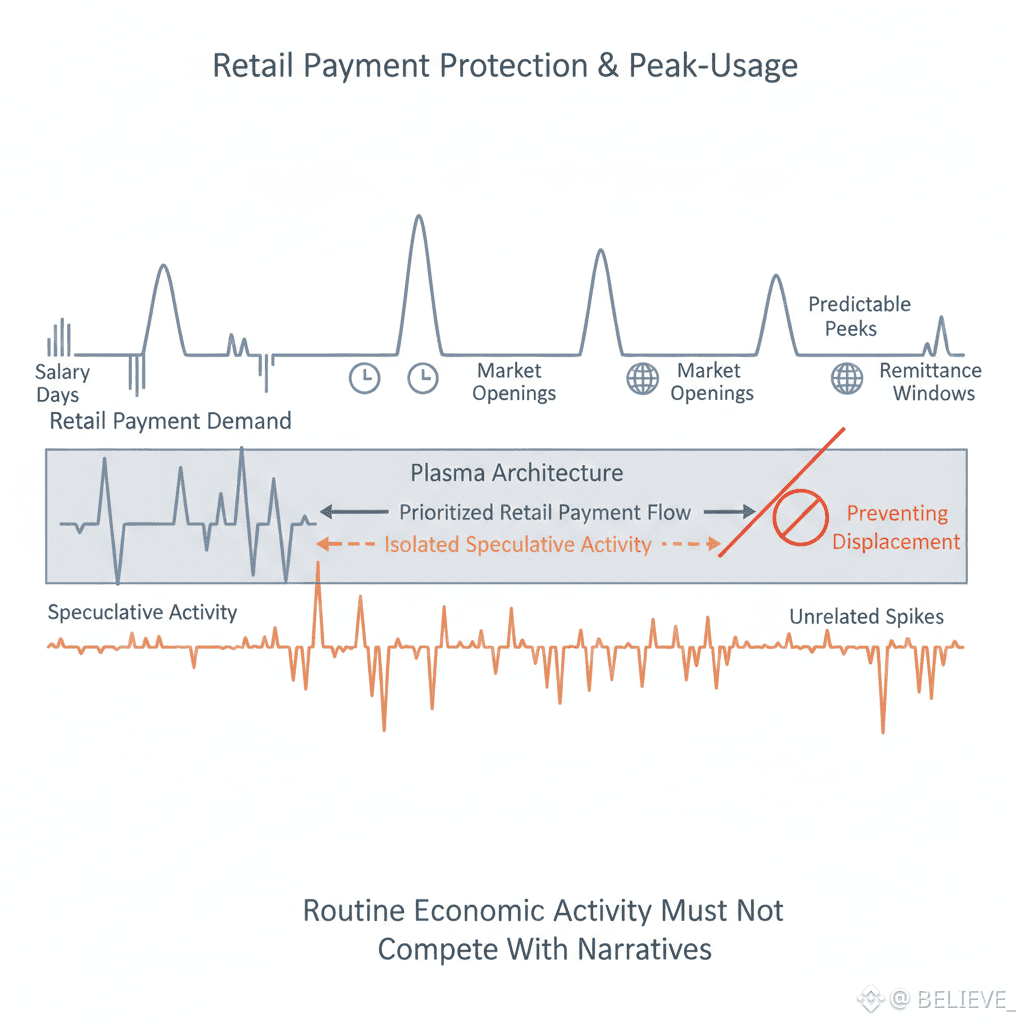
There is also a timing dimension unique to retail economies. Usage concentrates around predictable moments: market openings, salary days, remittance windows. Speculative chains are optimized for unpredictable bursts driven by narratives and events. When those bursts collide with retail demand, retail users lose.
Plasma is designed to protect payment continuity during these predictable peaks. This is not about maximizing throughput on paper. It is about ensuring that routine economic activity is not displaced by unrelated behavior elsewhere in the network.
Longevity matters more in these regions as well. Retail systems are adopted with the expectation of persistence. Frequent changes, shifting rules, or evolving requirements erode confidence. Plasma’s restrained evolution philosophy aligns with environments where stability is valued over novelty.
Perhaps the most important factor is social proof. In retail economies, adoption spreads through observation. People trust what they see working repeatedly in front of them. A system that fails even occasionally loses momentum quickly. Plasma’s emphasis on predictable, repeatable behavior supports this organic adoption dynamic.
What emerges is a clear contrast. Speculative blockchains are optimized for optionality — many things can happen, depending on conditions. Retail economies demand obligation — one thing must happen, every time.
Plasma is built around that obligation.
It does not assume patience.
It does not assume technical curiosity.
It does not assume forgiveness.
It assumes that when someone pays, the system has one job: finish the moment cleanly and disappear.
In high-adoption retail economies, that is not a feature.
It is the minimum requirement.
And it is exactly where Plasma is designed to operate.

