

@Plasma If you build for payments long enough, you stop romanticizing complexity. You start caring about what happens when a cashier line is long, when a remittance needs to land before a cutoff, when a support ticket is not about “alpha” but about rent. Plasma feels like it was designed from that tired, honest place where money has to work even when nobody is impressed.
Plasma treats stablecoin transfers as the main job of the chain, not something optional. That decision matters most when the network is under pressure, because everything is tuned for reliable payments. As a builder, you feel the goal immediately: Plasma wants the blockchain to disappear for the user. No confusion, no “chain anxiety”—just a normal payment flow. When a stablecoin transfer requires a second asset just to pay the toll, people hesitate, delay, or make mistakes. Plasma’s recent documentation is unusually direct about removing that friction for simple USD₮ transfers through a chain-maintained sponsorship flow, with tight scoping and controls aimed at stopping abuse. It’s not just convenience. It’s an attempt to remove the tiny moments of fear that accumulate into people avoiding onchain payments altogether.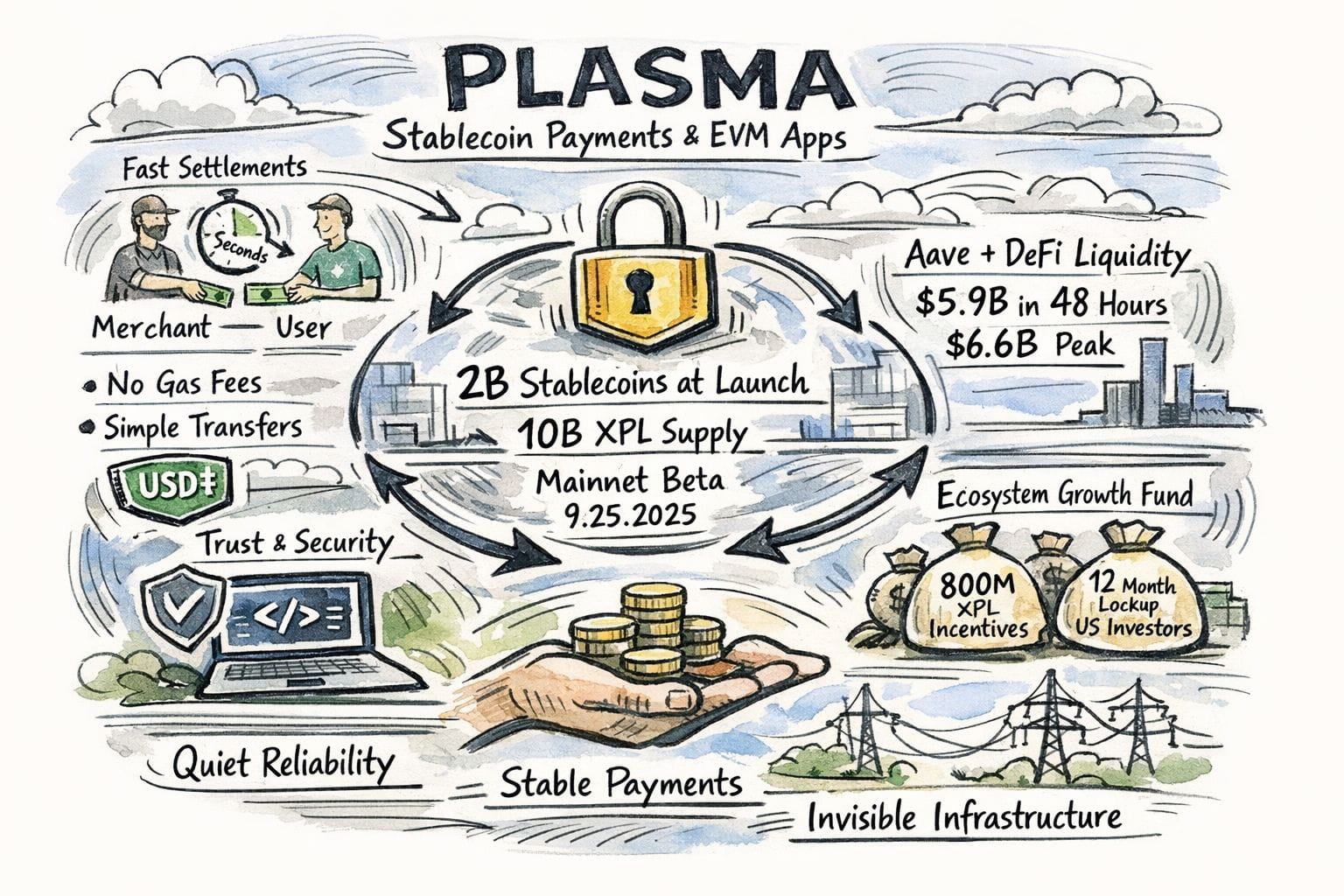
Underneath that user calm, Plasma is making a harder promise to developers: settlement should feel deterministic, not probabilistic. When you are building a payment experience, ambiguity becomes a product bug. The docs describe a consensus approach built for low-latency finality, where confirmation is meant to be decisive within seconds rather than socially negotiated over time. That matters most in messy moments: when mempools surge, when markets spike, when a merchant or an exchange support team needs a clear answer that can be defended without drama.
The title you gave includes “EVM-compatible apps,” but the real point isn’t compatibility as a checkbox. It’s emotional continuity for builders. Plasma explicitly positions itself as a place where existing Ethereum tooling and familiar contract patterns can come across without rewriting the world, so teams can spend their attention on payments, credit flows, treasury behavior, dispute handling, and UX—not on re-learning an ecosystem just to move dollars faster. That matters because most failures in fintech products are not cryptographic failures. They are attention failures.
Plasma’s recent public timeline also matters because it signals how seriously it takes “day one conditions.” The project set September 25, 2025 for its mainnet beta and the launch of XPL, and framed that moment around arriving with large stablecoin liquidity rather than arriving with a story. In its own update, Plasma said $2 billion in stablecoins would be active from day one, with capital expected to be deployed across a broad set of DeFi partners, explicitly aiming for immediate utility rather than a slow warm-up period. That’s not a marketing flex as much as an admission: payment networks are judged immediately, because people try them with real money. 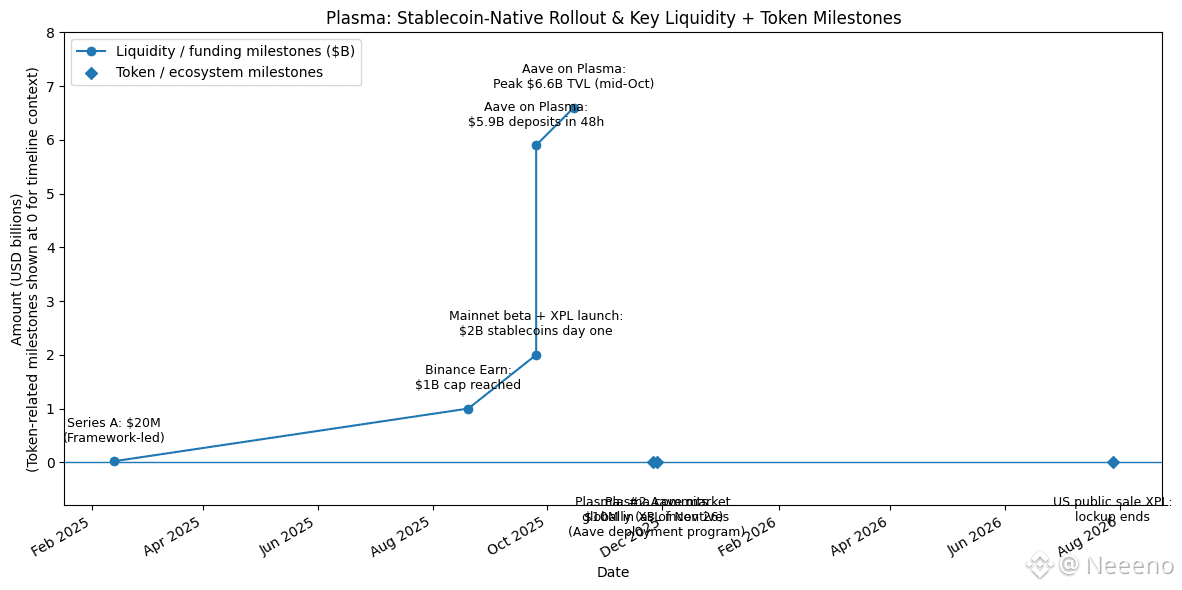
When you look at XPL, you can see Plasma trying to align long-term behavior with the reality that payment infrastructure can’t be run like a short-lived campaign. The docs state an initial supply of 10,000,000,000 XPL at mainnet beta launch, with distribution split across public sale, ecosystem and growth, team, and investors
The unlock timing tells you a lot about how Plasma is trying to manage community tension. Non-US public sale tokens were available from day one, while US buyers can’t access theirs until July 28, 2026 after a one-year lock. These timelines matter even for non-traders, because they influence expectations about supply, market activity, participation incentives, and the overall “story” people believe about the next phase.
The ecosystem allocation reads like Plasma admitting the obvious truth: adoption is expensive, and pretending otherwise breaks networks
The docs lay out a simple plan: 4B XPL are kept for growing the network. 800M XPL unlock at the start of the mainnet beta to kickstart activity and support liquidity. After that, the leftover amount unlocks gradually each month for three years. . This is not the language of “number go up.” It’s the language of provisioning—accepting that if you want stablecoin rails to be reliable, you have to pay for liquidity depth, integrations, and operational resilience before the public is kind to you.
Team and investor unlock structures matter for a different reason: they determine whether builders believe the chain will still be cared for when the spotlight moves. Plasma’s documentation describes a one-year cliff for a portion of team tokens, with the rest unlocking monthly over the following two years, reaching full unlock at three years from public mainnet beta. That kind of vesting is not just about retention. It’s about giving the ecosystem confidence that the people maintaining the hardest parts of the system have a reason to stay through the boring months, the incident reports, and the inevitable edge cases that only appear at scale.
Recent ecosystem numbers also show what Plasma is optimizing for: thick, fast liquidity that makes stablecoin behavior feel normal. In a late-2025 Plasma update centered on Aave’s deployment, Plasma said it committed an initial $10 million in XPL as part of a broader incentive program, and reported that deposits into Aave on Plasma reached $5.9 billion within 48 hours of mainnet launch, later peaking at $6.6 billion by mid-October. Whether you personally care about lending markets or not, those figures translate into a simple user experience outcome: the ability to move size without feeling the floor wobble. 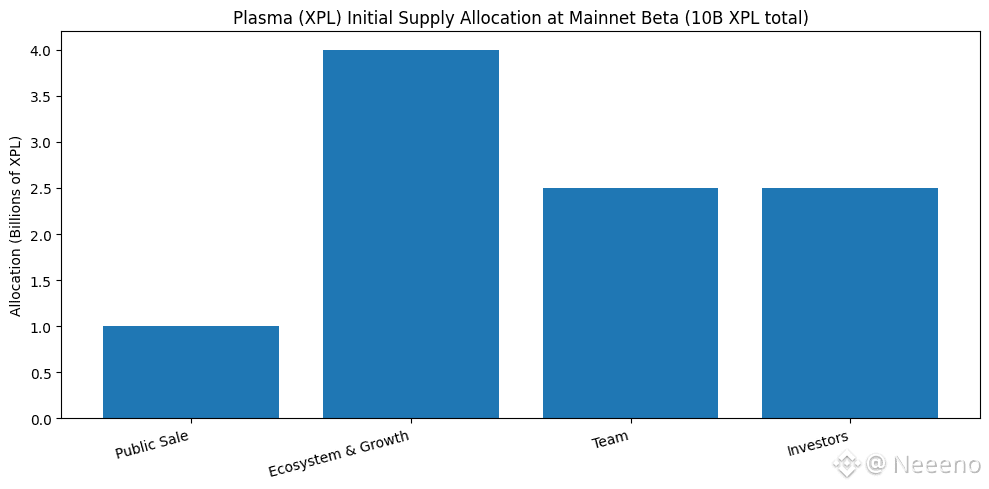
None of this removes the messy parts of reality. Stablecoin payments still collide with human error, fraud attempts, sanctions risk, regional compliance differences, and the uncomfortable fact that “free” transfers can be spammed if incentives are misaligned. Plasma’s own description of its sponsored-transfer flow emphasizes tight scoping and identity-aware controls to prevent abuse, which is a quiet acknowledgment that payments are adversarial by default. People will try to drain anything that looks like a subsidy. Designing for that isn’t cynicism. It’s respect for how systems get attacked in the real world.
It also helps to understand why Plasma exists at all in the broader financing context. Early 2025 reports said Plasma raised $20 million in a Series A round led by Framework Ventures. The idea behind the funding was simple: stablecoins are being used more than anything else in crypto in the real world, so they should run on infrastructure designed specifically for payments. That matters because it signals Plasma isn’t trying to do every type of blockchain job. It’s aiming to do one thing well—move stablecoin payments quickly, cheaply, and predictably. It is trying to be dependable where dependability is rare—where users punish you instantly for latency, cost surprises, and unclear settlement.
If you build on Plasma, you’re not just choosing a stack. You’re choosing a posture: you’re agreeing that the best payment infrastructure is the kind people forget exists. XPL’s supply schedule, the explicit unlock dates, the early liquidity posture at mainnet beta, and the insistence on decisive settlement all point to the same ethic—quiet responsibility. Most networks are built to be watched. Plasma is trying to be used. And in payments, reliability is not a nice-to-have. It’s the difference between trust and fear, between a product that becomes routine and a product that becomes a story people warn their friends about.

