

@Vanarchain Vanar Chain makes more sense when you stop seeing it as a “platform” and start seeing it as a system that must still work on a bad day. Your title captures the uncomfortable truth: if AI is truly part of Web3, the base chain can’t be built for demos. It has to behave like infrastructure—reliable when users rush, information is incomplete, rewards tempt bad behavior, and attackers try to bend the rules.
The easiest mistake people make about AI on-chain is assuming the hard part is intelligence. In practice, the hard part is memory you can trust. Anyone can generate an answer. The question is whether the answer can be traced back to something stable, something that survives stress, something that doesn’t quietly change because the loudest actor had the most resources for a few blocks. Vanar’s public narrative leans into that idea of making data feel closer to logic than to paperwork—documents turning into something a program can check and act on—because that’s where AI becomes dangerous or useful.
That’s why time matters so much here, and Vanar is unusually explicit about it. In its whitepaper, the chain proposes a block cadence capped at 3 seconds, paired with a 30 million gas limit, framing it as the baseline needed for responsive applications instead of ceremonial settlement. When you live inside an ecosystem, you stop romanticizing throughput and start thinking about human pacing: the pause before a confirmation that makes someone hesitate, the extra second that turns a smooth checkout into a support ticket, the jitter that makes users feel like the system is “moody” even when it’s technically fine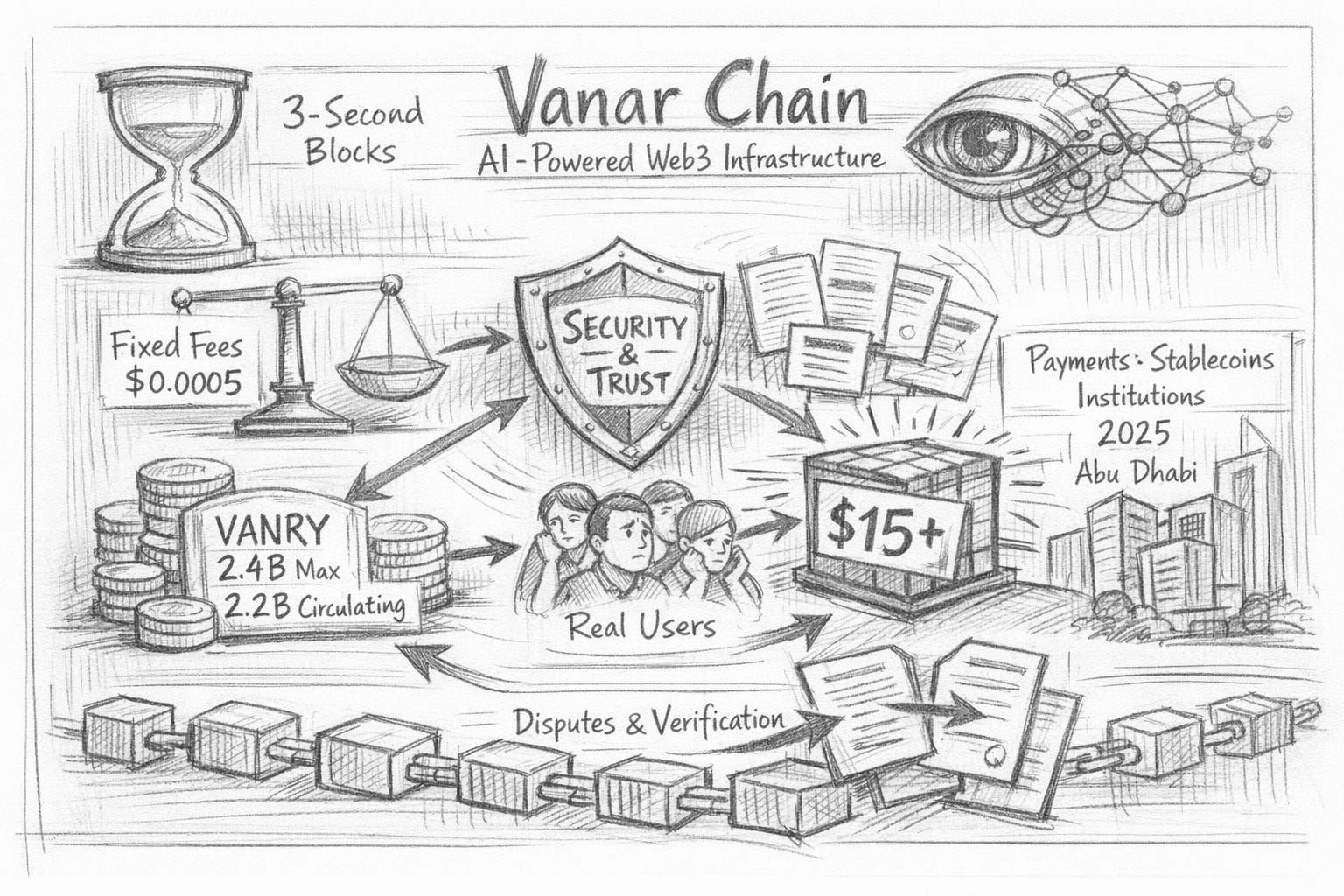
But speed without fairness just creates a faster way to lose trust. Vanar’s approach to ordering, as described in the same whitepaper, is rooted in the idea that when fees are fixed and predictable, the chain can justify taking transactions in the order they arrive rather than letting urgency be purchased.That sounds small until you’ve watched what happens when users believe the rules can be bent. People don’t only fear losing money; they fear being treated as second-class participants inside a system that claims neutrality. A chain that wants to carry AI-driven workflows has to be emotionally safe in that very specific way: the rules feel boring, consistent, and hard to negotiate with.
The fixed-fee choice is not just a user-experience preference; it’s an economic stance on how honest behavior is made cheaper than dishonest behavior. Vanar’s documentation describes fixed fees as a way to keep costs stable for most activity, with the stated aim that roughly 90% of transaction types remain around $0.0005. In the whitepaper, the team goes further and spells out an attack-shaped thought experiment: if a chain charges a flat $0.0005 no matter what, then 10,000 block-filling transactions could choke a 3-second chain for about 8 hours and 20 minutes for roughly $5—an absurd mismatch between harm and cost.That’s the kind of detail you include only if you’ve already pictured the failure and decided to design for it.
So the system starts building “friction” on purpose, not as punishment, but as self-defense. The same section proposes fee tiers that rise steeply for very large transactions—up to $15 for the largest bracket—so that consuming a whole block stops being a cheap prank and becomes an expensive decision. I think about this as a quiet moral argument written into economics: if you want to take more than your share of a public resource, you should feel the weight of that choice in a way the network can enforce without needing to identify who you are.
All of this loops back to the token, because in a chain like this the token isn’t just a price chart—it’s the social contract people are asked to hold. Vanar’s docs are direct about VANRY being the native gas token used to pay transaction fees. That matters because fixed fees and fast blocks create a particular kind of expectation: users start treating the chain like a utility, and utilities don’t get to be unpredictable without consequences. When VANRY is the meter that measures usage, it also becomes the place where frustration collects if anything about that usage feels unfair.
The market data adds another layer of realism that the ecosystem has to live with. As of the most recent public snapshots, VANRY is reported with a max supply of 2.4 billion and a circulating supply a little over 2.2 billion on CoinMarketCap. The same broader market pages also surface details like the ERC-20 contract address commonly used for tracking and custody—0x8de5b80a0c1b02fe4976851d030b36122dbb8624—reminding you that user trust is partly operational: people need to know what they’re holding and where it lives.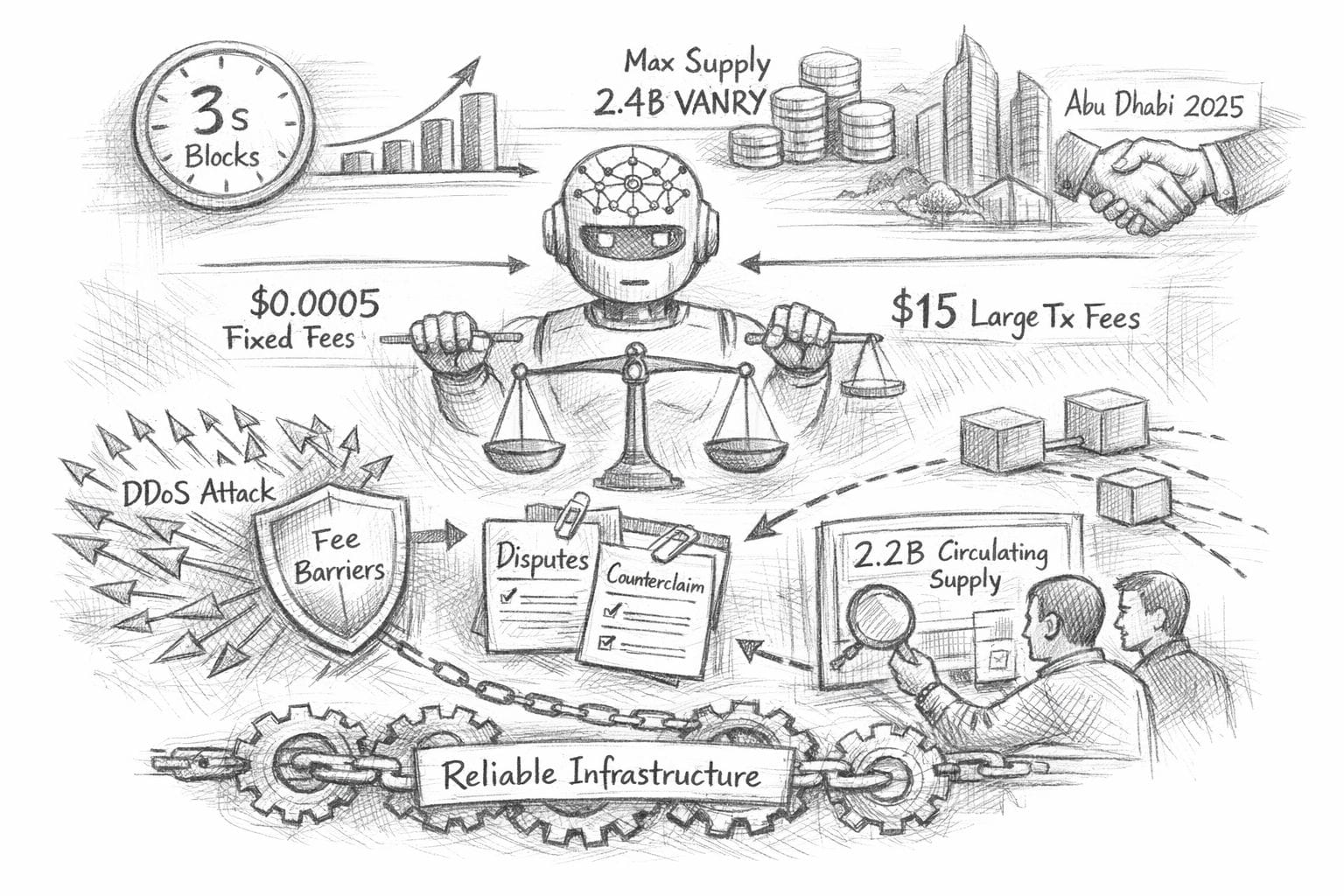
Where the “AI-powered infrastructure” claim stops being abstract is when the project starts showing up in rooms where failure has consequences and jargon doesn’t help. In late December 2025, Vanar publicly positioned itself at Abu Dhabi Finance Week with messaging focused on stablecoins, tokenized assets, and the practicalities that institutions care about—onboarding, dispute handling, treasury operations, and moving between traditional and digital rails—alongside Worldpay. This is the moment a chain gets tested in a different way: not by how clever the architecture sounds, but by whether the team can talk about exceptions, controls, and what happens when real money flows don’t match the happy path.
The hiring and organizational signals around the same period point in that direction too. Vanar’s own blog teasers around December 8, 2025 describe bringing in a payments veteran, framing the work as “modernizing payment networks” and explicitly tying the next phase to AI-driven money flows, stablecoins, tokenization, and autonomous agents. You can read this cynically as marketing, but from inside an ecosystem it feels like something else: a quiet admission that the hardest problems are not cryptographic, they’re operational and human—edge cases, reversals, reconciliation, policy, and the slow work of earning institutional trust.
This is also where messy information becomes the central theme, not an afterthought.
AI can guess, exaggerate, and treat gaps as facts. It may speak with confidence even when it’s incorrect. An AI-native chain should punish false claims and reward easy proof, since the world usually doesn’t line up perfectly. Two parties will present two documents. Two sensors will report different readings. A user will claim they never authorized something. The chain doesn’t get to “understand” truth in a human sense; it has to provide a place where claims can be anchored to verifiable inputs and where the cost of spamming the system is high enough that honest participants aren’t drowned out.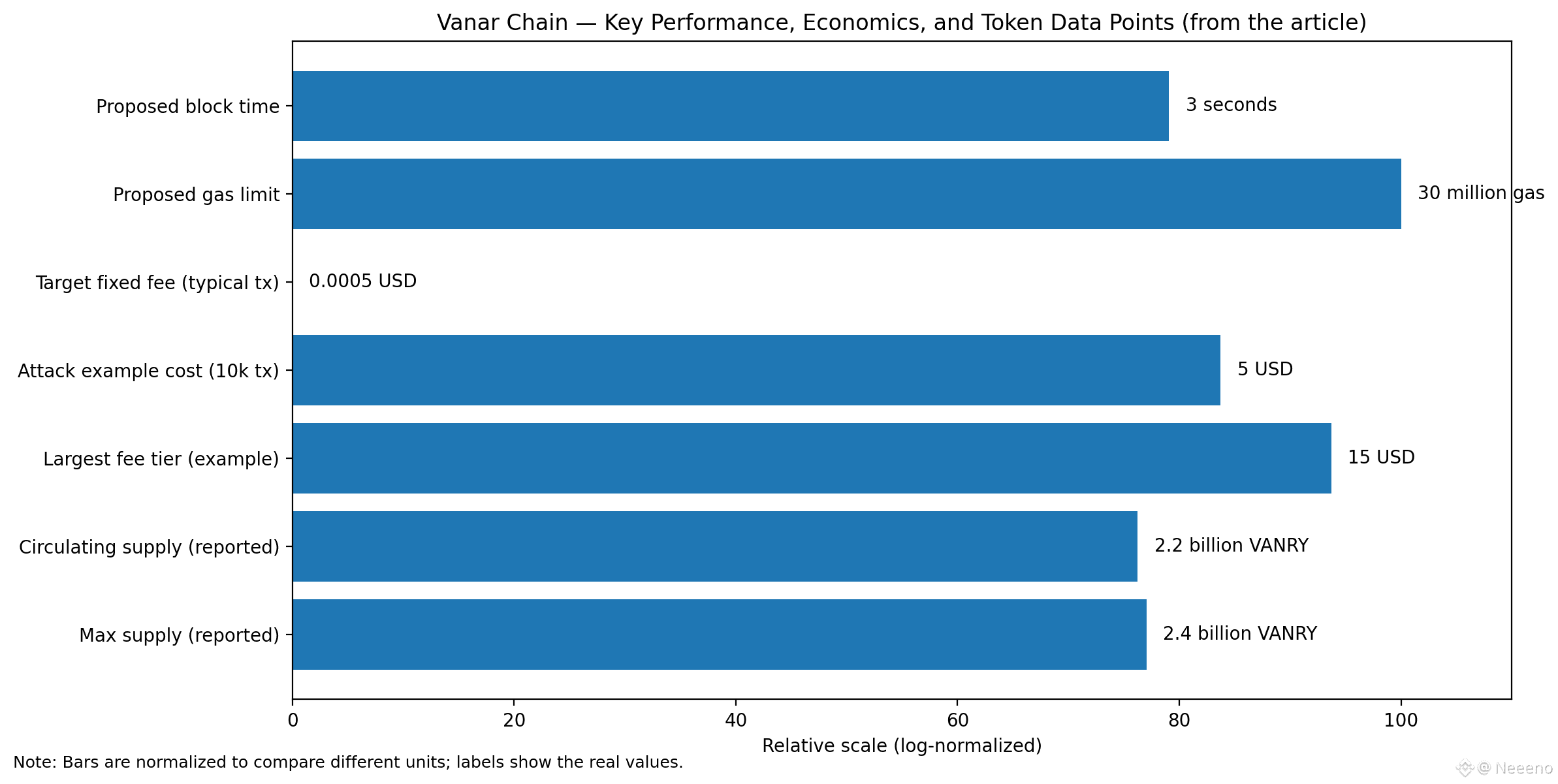
What I find most revealing about Vanar’s design choices, at least in the way they’re described publicly, is that the project keeps circling back to predictability. Three-second blocks are predictability. Fixed fees are predictability. Even the attack example in the whitepaper is really about predictability: if you can predict the cost to harm the network and it’s negligible, then the harm is inevitable. And once AI is part of the loop—once software can initiate actions without a human pausing to feel doubt—predictability becomes a safety feature, not a convenience.
So the future implied by your title isn’t a future where Vanar gets the most attention. It’s a future where Vanar behaves like a reliable substrate that people stop thinking about, because it stops giving them reasons to worry. The data points—3-second block timing, the 30 million gas ceiling, the explicit $0.0005 target for most activity, the steep fee steps meant to make abuse expensive, the hard max supply of 2.4 billion VANRY, and the very recent push into payments conversations in late 2025—are not just numbers to recite. They’re signals of what the system is trying to be accountable for.
In the end, “AI-powered Web3 infrastructure” only earns its right to exist if it treats quiet responsibility as the product
Not grand claims or polished demos—just careful design that assumes problems will happen, so when they do, users feel looked after instead of vulnerable. The best infrastructure disappears into habit. It becomes the thing you trust enough to forget, and that’s the highest compliment a chain like Vanar can ever receive.
