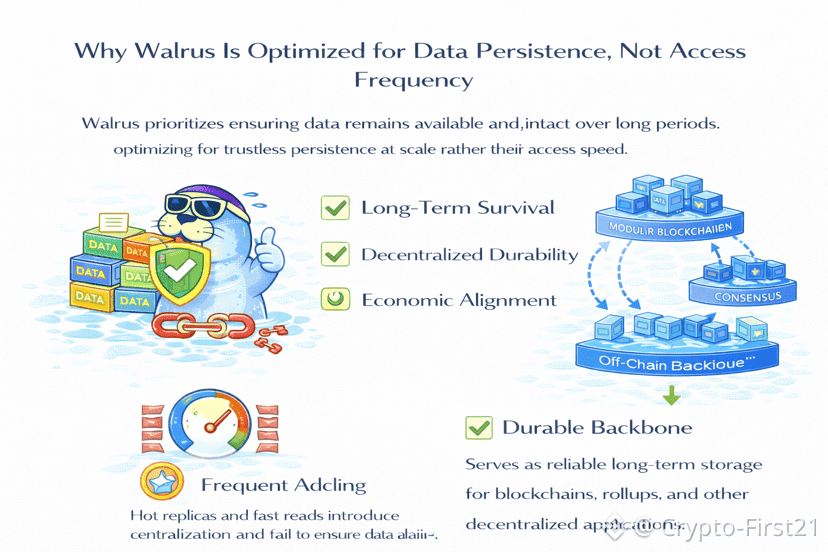
Walrus is designed with a clear priority, ensuring that data remains available, verifiable, and recoverable over long periods of time, rather than being optimized for ultra fast or frequent access. This design choice reflects a fundamental understanding of what decentralized storage is best suited for and where centralized systems still dominate. Instead of competing with CDNs or traditional databases on read latency, Walrus focuses on solving the harder problem of trustless data persistence at scale.
Walrus assumes that decentralized storage must survive failures, churn, and adversarial behavior without relying on a central authority. To achieve this, it uses erasure coding, shard distribution, and quorum based guarantees that ensure data can always be reconstructed even if a large portion of storage nodes go offline. These mechanisms are computationally and network intensive, but they dramatically increase durability. Optimizing for persistence means Walrus can tolerate slow nodes, temporary outages, and even coordinated failures, while still preserving data integrity.
Frequent access optimization often requires hot replicas, aggressive caching, and centralized coordination to route reads efficiently. Walrus intentionally avoids building these assumptions into the base protocol because they introduce centralization pressure and economic inefficiencies. In Walrus, storing hot copies everywhere would significantly increase storage overhead and cost, undermining its goal of long-term sustainability. Instead, Walrus treats access acceleration as an optional layer that can be added on top, for example through external caches, aggregators, or application specific indexing.
Another key reason for this design is economic alignment. Walrus storage nodes are incentivized to hold data correctly, not to serve it at the lowest latency possible. By tying rewards and penalties to availability proofs, challenges, and long term commitments, the system ensures nodes prioritize correctness and persistence. If access frequency were the main optimization target, incentives would shift toward bandwidth races and short-term performance, which are easier to game in decentralized environments.
Walrus fits naturally into a modular architecture for Web3. Blockchains, rollups, social networks, and archival systems often need strong guarantees that data will exist tomorrow, next year, or a decade from now, regardless of how often it is accessed. Walrus fills this role as a durable data backbone, while leaving fast access to specialized layers built on top. By separating persistence from access frequency, Walrus avoids unnecessary trade-offs and delivers what decentralized storage needs most: reliability without central trust.