
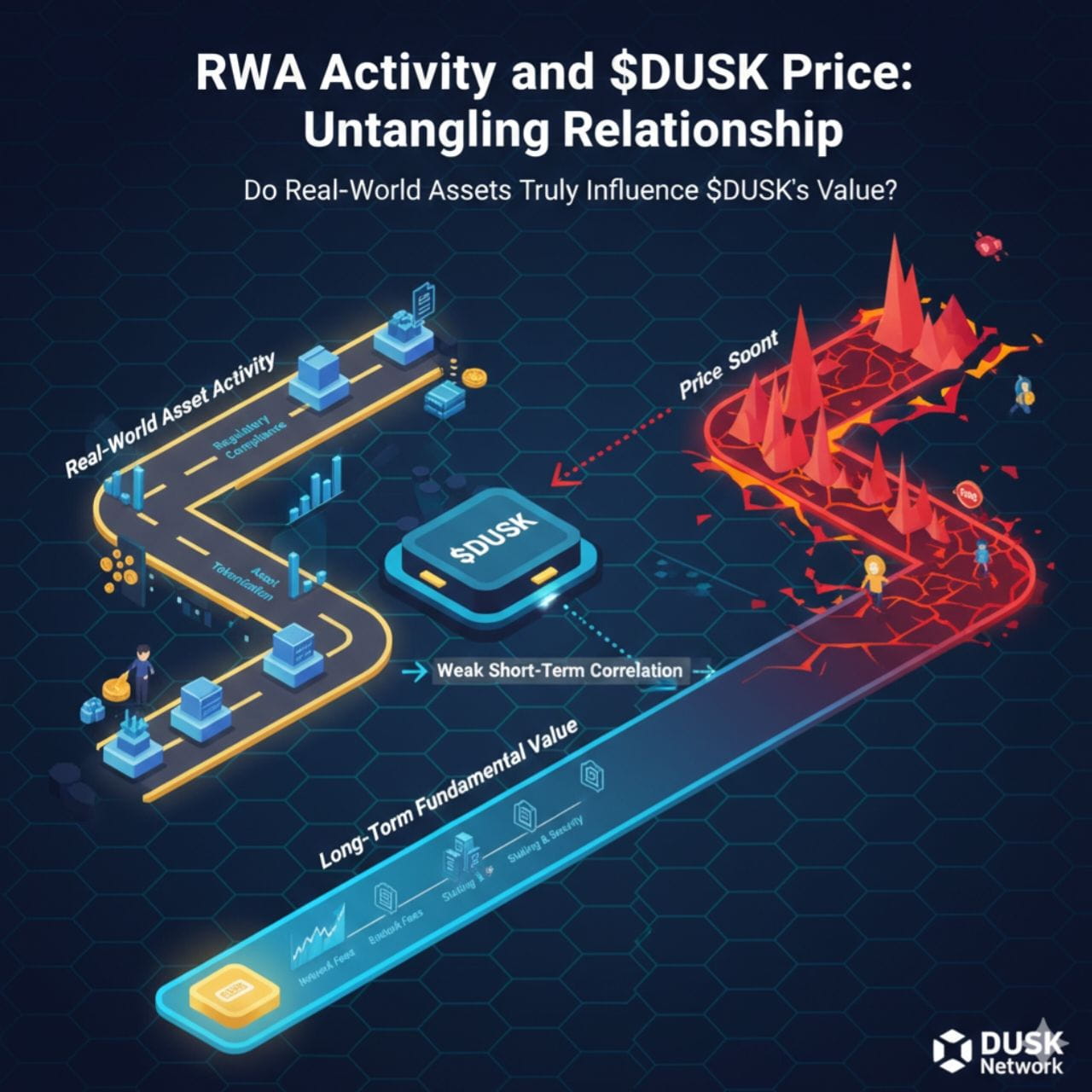
Do Real-World Assets Truly Influence $DUSK’s Value?
Real-world assets (RWAs) are often touted as the critical bridge between traditional finance and the emerging world of blockchain. For Dusk, whose value proposition centers on privacy and compliance-first infrastructure, RWAs go beyond passing hype—they’re integral to the platform’s vision. The implication is that as more real-world financial instruments become digitized and regulated on-chain, Dusk becomes the rails for an entirely new asset ecosystem.
But that raises a practical and persistent question: Does increased RWA activity on Dusk actually translate to movement in the $DUSK token price? Or are we simply assuming a link that isn’t there?
Let’s break down what’s really happening, looking past surface-level assumptions and focusing on the actual mechanics, data, and market behavior.
1. Defining RWA Volume on Dusk: Beyond Simple Transactions
When people reference RWA volume on Dusk, they’re talking about institutional-grade activities: issuing regulated tokenized securities, moving compliant digital bonds, or settling complex financial contracts. Unlike DeFi’s rapid, retail-driven swaps and trades, RWA activity on Dusk is methodical. Each transaction must pass regulatory muster, comply with audits, and satisfy onboarding procedures for large organizations.
This institutional nature is crucial. Retail traders can react instantly to market news, but institutional product cycles are slow, deliberate, and often opaque. The connection between activity and token price is therefore less direct, often muted in the short term, and heavily reliant on large-scale adoption rather than speculative surges.
2. The Theoretical Mechanisms: How RWA Growth Could Affect $DUSK
In theory, growing RWA adoption could impact Dusk in several ways:
— Increased network usage means more transaction fees, which are often paid in $DUSK, generating consistent, utility-driven demand for the token.
— Validators and network participants may need to stake Dusk to support and process regulated transactions, locking up supply and raising the technical barrier to entry.
— Certain models might burn or lock portions of Dusk as part of fee mechanisms, incrementally reducing supply.
— As institutions integrate with Dusk, they may require stable, predictable access to the token for ongoing compliance and settlement, creating a foundational layer of demand.
But in practice, these effects don’t materialize overnight. There’s a lag between the onboarding of real-world assets and any visible price movement, especially given the slow adoption curve and the sometimes subtle accumulation of network usage.
3. Market Reality: Short-Term Price Correlation Is Weak
Historical data and chart analysis show that surges in RWA announcements or pilot launches on Dusk rarely correspond with immediate, significant price action in $DUSK. Frequently, $DUSK’s price responds more to macro market sentiment, overall crypto liquidity, or even unrelated token news than to the organic growth of on-chain RWA activity.
This disconnect can be frustrating for traders looking for clear catalysts. The reality is that most institutional RWA deployments are announced well before their effects are felt in terms of network revenue, and the broader market may not fully digest the implications until much later—if at all.
4. Why RWA Growth and Market Response Are Out of Sync
RWA volume doesn’t explode overnight; it grows at the speed of legal reviews, compliance approvals, and institutional onboarding. Each step takes time, and much of it happens behind closed doors. Unlike the viral growth seen in some DeFi or NFT projects, RWA adoption is a slow build, requiring coordination between regulators, traditional finance entities, and blockchain engineers.
As a result, there can be a significant lag between the start of substantive RWA activity and any meaningful impact on $DUSK’s price. Sometimes, the market never reacts at all, particularly if the growth is steady but unspectacular. Think of it more like constructing a skyscraper than flipping a switch—the foundation gets laid quietly, often before anyone notices the skyline changing.
5. The Long-Term Picture: Building Structural Value, Not Chasing Spikes
When you take a step back, the real value of growing RWA volume is its impact on Dusk’s long-term stability and fundamentals. Consistent RWA activity means regular network fees, a healthy validator ecosystem, and increasingly robust infrastructure—all of which contribute to a more resilient and less speculative token economy.
This doesn’t necessarily translate to sharp, short-term price rallies. Instead, it helps prevent major collapses by ensuring there’s real, sustainable utility underpinning the token. Over time, this can attract a different kind of investor—one looking for foundational value rather than pure price momentum. In the future, as more institutions trust Dusk with their assets, this structural support could provide a significant competitive edge, even if the price impact is gradual and cumulative rather than dramatic.
6. For Traders: RWA Metrics Signal Health, Not Imminent Gains
Many traders make the mistake of expecting RWA growth to behave like a classic catalyst. In reality, RWA adoption is more like an insurance policy or a warranty—it proves the network is being used for serious applications, but it doesn’t guarantee instant price appreciation.
Instead, RWA metrics should be seen as a barometer for the network’s health and long-term staying power. When you see RWA volume climbing, it’s a sign that Dusk is gaining institutional trust and relevance—a vital indicator for anyone thinking about the project’s future. But if you’re trading on short-term horizons, it’s wise to treat these metrics as context, not a buy signal.
7. What Could Tighten the Link Between RWA Volume DUSK Price ?
For RWA activity to become a more decisive driver of $DUSK’s price, several conditions need to be met:
— Sustained, transparent RWA transaction growth that’s visible to the entire market, not just insiders or partners.
— Fee mechanisms that directly impact $DUSK’s circulating supply, such as automatic burns or significant staking requirements.
— A less volatile, more mature crypto market environment, where fundamental developments matter more than fleeting sentiment.
— Regular, detailed reporting from Dusk on RWA adoption and network usage, allowing traders and analysts to accurately assess the impact.
Until these factors align, the relationship between RWA volume and $DUSK price will remain inconsistent—sometimes correlated, often not, and always subject to larger market forces.
FAQs
Q: If RWA volume goes up, does $DUSK price automatically rise?
A: No. While higher RWA volume strengthens the platform’s fundamentals and long-term prospects, price moves are shaped by a range of factors, many of which are external to RWA activity.
Q: Why don’t short-term traders react to RWA growth?
A: Because institutional RWA adoption is a slow, incremental process that rarely offers the kind of immediate, dramatic news that drives speculative rallies.
Q: Is tracking RWA volume still important?
A: Absolutely. RWA metrics are one of the best indicators of genuine network use and future potential, even if they don’t predict the next price move.
Conclusion
Ultimately, real-world asset growth is vital for Dusk’s adoption and credibility, anchoring the project in the regulated financial world. But traders and analysts should temper expectations—don’t expect every increase in RWA volume to be reflected in the token price right away. Instead, focus on the bigger picture: RWAs are about building lasting value and real-world impact, not just fueling short-lived speculation. Over time, this foundation may become the most important driver of $DUSK’s success, even if the market takes a while to catch up.
Disclaimer:Not Financial Advice
