
Smart contracts are at the core of how modern blockchain systems move from simple transactions to fully automated digital processes.
In the Walrus Protocol, smart contracts play a critical role by enabling predefined rules to be executed automatically, without the need for intermediaries or manual oversight. This approach is not about flashy features or short-term trends. It is about building reliable infrastructure that can operate consistently under real-world conditions.
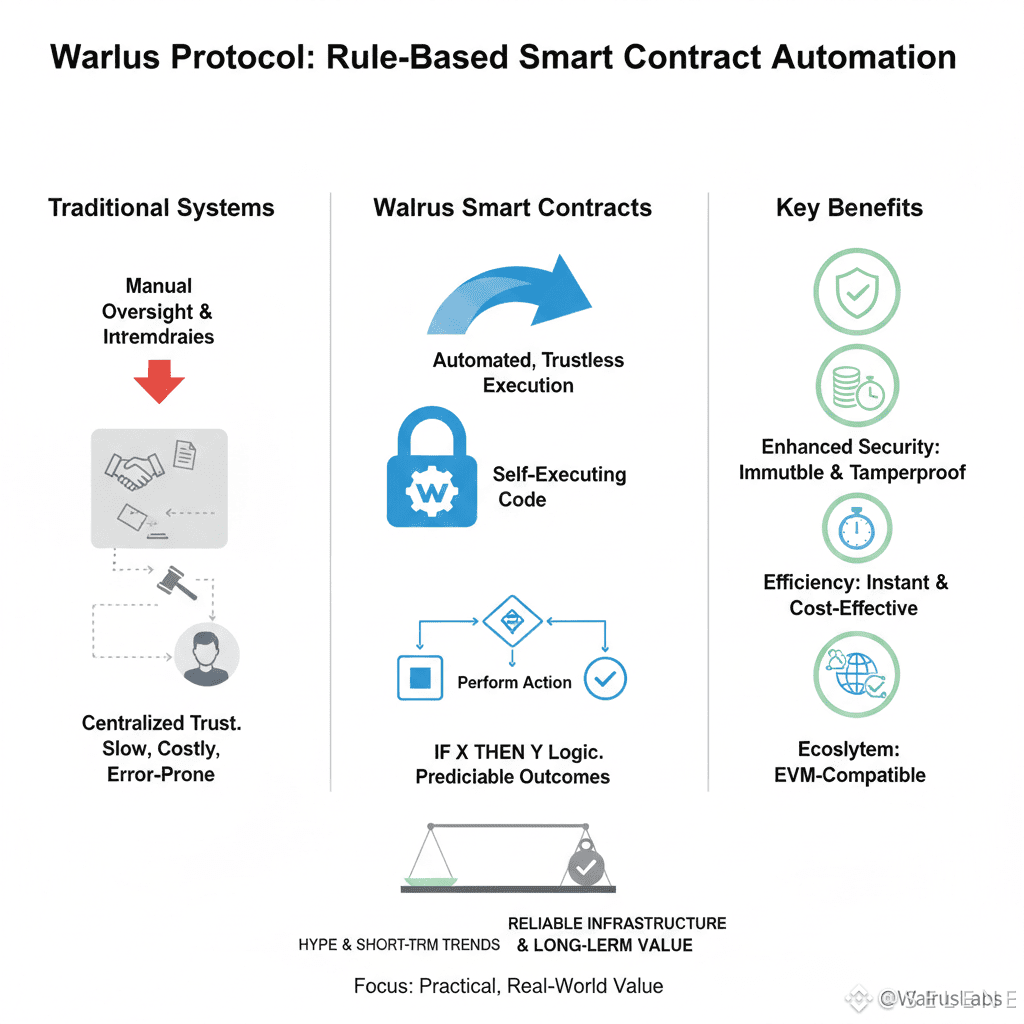
At a basic level, smart contracts are self-executing programs stored on the blockchain. They follow logic such as “if this condition is met, then perform this action.” In the Walrus Protocol, this logic is applied in a way that supports secure data handling, efficient execution, and predictable outcomes. Once deployed, these contracts operate exactly as written, reducing uncertainty and minimizing the risk of human error or manipulation.
One of the key strengths of Walrus smart contracts is their emphasis on rule-based automation. Every interaction is governed by predefined conditions that are transparent and verifiable. This makes it easier for developers and organizations to design systems where outcomes are known in advance. Payments, access controls, data usage permissions, and process triggers can all be encoded directly into the contract logic. As a result, complex workflows can run smoothly without constant monitoring.
Automation through smart contracts also improves trust between participants. In traditional systems, trust often depends on centralized authorities, legal agreements, or third-party verification. Walrus replaces much of this dependency with code-based guarantees. When all parties can inspect and verify the contract rules before engaging, confidence increases. Each participant knows that the same logic applies to everyone, and that no single actor can alter the rules after deployment.
Another important aspect of Walrus smart contracts is their compatibility with broader blockchain ecosystems. By supporting EVM-compatible development, Walrus allows developers to leverage familiar tools, languages, and frameworks. This lowers the barrier to entry and encourages experimentation. Developers can focus on designing meaningful applications rather than relearning core infrastructure. Over time, this leads to a richer ecosystem of applications built on consistent and secure foundations.
Security is a central consideration in any smart contract system, and Walrus addresses this through a combination of deterministic execution and constrained design. Predefined rules limit unexpected behavior and reduce the attack surface. Once contracts are deployed, they cannot be altered arbitrarily, which protects users from sudden changes or hidden modifications. This immutability ensures that agreements remain stable over their intended lifespan.
Smart contracts in Walrus are also designed with real-world use cases in mind. Many blockchain projects focus on theoretical models that struggle when exposed to regulatory, operational, or scalability constraints. Walrus takes a more practical approach. By aligning contract logic with real-world requirements such as compliance, data integrity, and controlled access, the protocol makes it easier for institutions and enterprises to participate.
Another benefit of predefined, automated execution is efficiency. Manual processes are slow, costly, and prone to delays. Smart contracts remove unnecessary steps by executing actions instantly once conditions are met. This can significantly reduce operational overhead and improve responsiveness. Whether it is settling transactions, managing permissions, or coordinating multi-party interactions, automation enables systems to move at digital speed.
Over time, the impact of rule-based smart contracts extends beyond individual applications. As more processes are automated and standardized, ecosystems become more resilient. Systems can scale without proportional increases in complexity or cost. Walrus smart contracts contribute to this long-term stability by offering a framework where logic is clear, execution is predictable, and outcomes are verifiable.
In summary, smart contracts in the Walrus Protocol are not just technical components. They are foundational tools that enable trust, automation, and efficiency through predefined rules. By focusing on practical execution rather than hype, Walrus demonstrates how blockchain technology can support real, lasting value. As adoption grows, these smart contracts will continue to serve as quiet but essential infrastructure powering the next generation of decentralized applications.

