

@Dusk Network is a Layer 1 with a modular design where DuskDS handles consensus/settlement, and its node software uses Kadcast — a UDP-based structured overlay — to propagate network messages (including consensus messages), aiming to keep communication efficient and predictable for the network.
If you spend enough time around Dusk, you stop thinking of peer-to-peer communication as plumbing and start treating it like posture. In regulated environments, the system is judged by how it behaves when people are nervous, when the market is moving, when operators are rushing upgrades, when a few machines go dark and nobody has the luxury of pretending that “the network is probably fine.” Dusk didn’t choose to build its own message propagation approach to win points for originality. It did it because the network’s emotional contract with its users depends on whether everyone can converge on the same truth at roughly the same time, without wasting the network’s breath shouting the same thing in every direction.
Kadcast makes sense the first time you feel the difference between “a block exists” and “a block is known.” On a chain like Dusk, that gap is where fear lives. The gap is where rumors form in operator chats, where traders quietly widen their risk buffers, where builders blame themselves for behavior that’s actually just timing. When message flow is messy, honest nodes can disagree simply because they heard different parts of the story first. And in finance, disagreement doesn’t stay technical for long; it becomes suspicion. Kadcast is Dusk trying to reduce how often that suspicion ever gets a reason to appear.
The most practical clue is also the least glamorous one: Dusk tells operators plainly that the node uses Kadcast and that it runs over UDP, with specific port-forwarding expectations, including 9000/udp for consensus messages. That detail matters because it shows Dusk is willing to make networking an explicit responsibility rather than an invisible assumption. It’s a quiet admission that reliability is not something you “add later.” Reliability begins at the point where packets either arrive or they don’t.
People often misunderstand what “predictable” means here. It’s not primarily about being fast on a good day. It’s about reducing the number of strange days. Kadcast is described by Dusk as a structured overlay that directs message flow, reducing bandwidth use and making latency more predictable than random broadcast approaches. That predictability is a kind of fairness, because timing advantages compound into influence. If some participants routinely hear first, they routinely act first, and the network quietly grows a hierarchy nobody voted for. Dusk building Kadcast is Dusk resisting that drift. 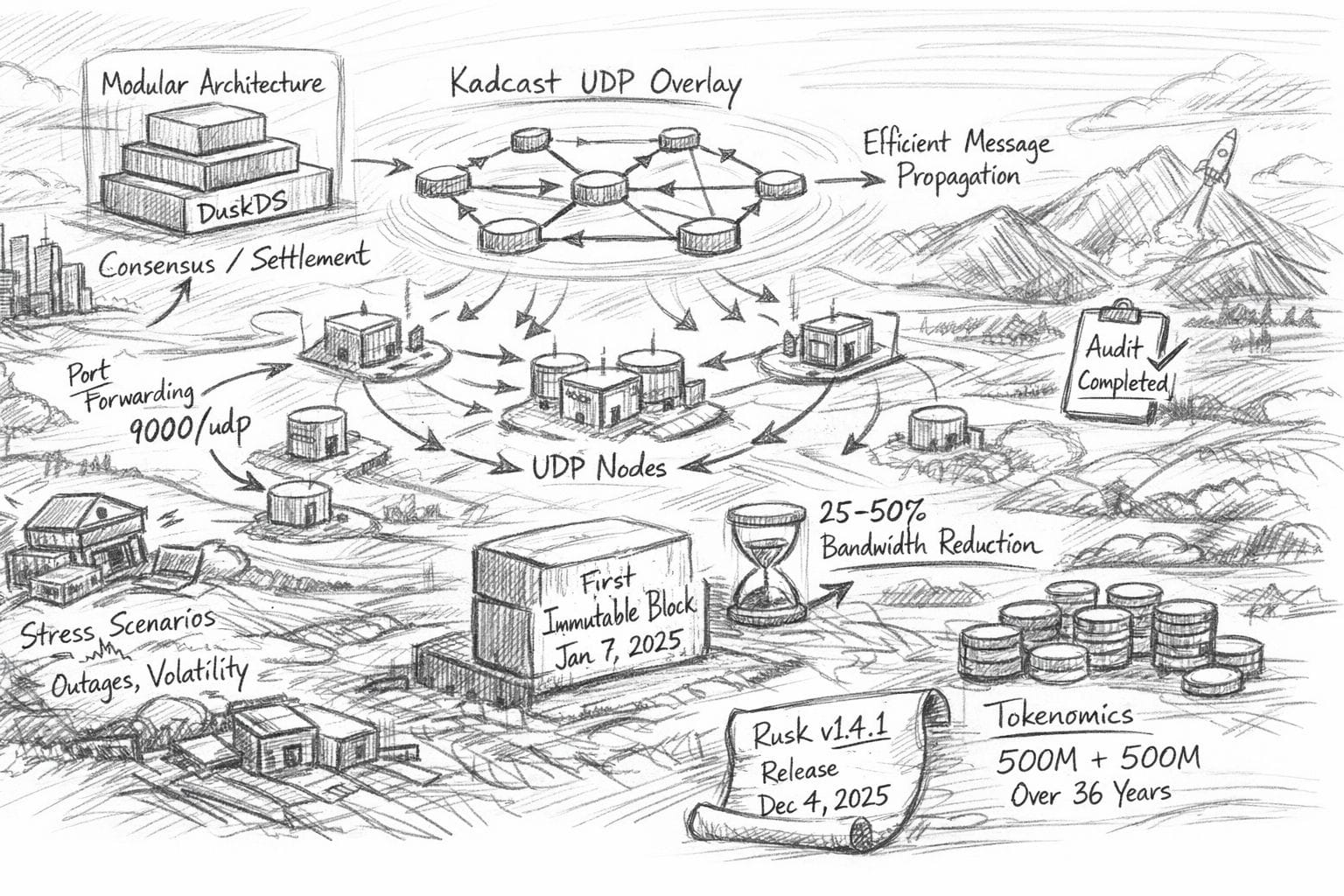
Dusk even puts a number to the intent in its updated whitepaper: Kadcast is credited with a 25–50% reduction in bandwidth use compared with popular gossip-style approaches. That kind of savings isn’t just about efficiency. It’s about reducing congestion-driven weirdness—those moments when the network isn’t “down,” it’s just uneven, and unevenness is where user confidence decays. Less wasted bandwidth means fewer accidental chokepoints, fewer invisible winners, and fewer reasons for participants to question whether the chain is treating them equally.
This is also why Dusk treats Kadcast as security surface, not just performance surface. It’s the layer that decides whether honest participants can find one another and stay part of the same conversation during churn. Dusk has been explicit enough about Kadcast’s importance that it commissioned third-party scrutiny, and it has published updates pointing to the audit completion. That’s not marketing polish; it’s a signal that Dusk expects its networking assumptions to be attacked, not admired.
If you want to feel what “messy reality” looks like inside Dusk, read the operator troubleshooting notes. “NETWORK MISMATCH” shows up when your node and the peers it finds aren’t aligned on the same chain state or version. Dusk explains it’s often safe to ignore—unless your node is out of date. It says something bigger, too: decentralized networks aren’t perfectly synchronized machines; they’re groups of humans moving at different speeds, so temporary disagreement is part of the real world. . The important part is whether the system stays calm while humans catch up. Kadcast is one of the tools Dusk uses to keep that calm from turning into chaos.
The recent history of Dusk makes the choice feel even more logical.
More human tone Dusk didn’t flip the switch all at once. It rolled mainnet out in phases, and the moment it became “real” was when the first immutable block was produced on January 7, 2025. Rollouts like that are where networking either proves itself or becomes the hidden reason everything feels shaky. Dusk’s decision to invest in message propagation long before the moment of public pressure is the kind of quiet preparation you only appreciate when you’ve lived through the opposite. 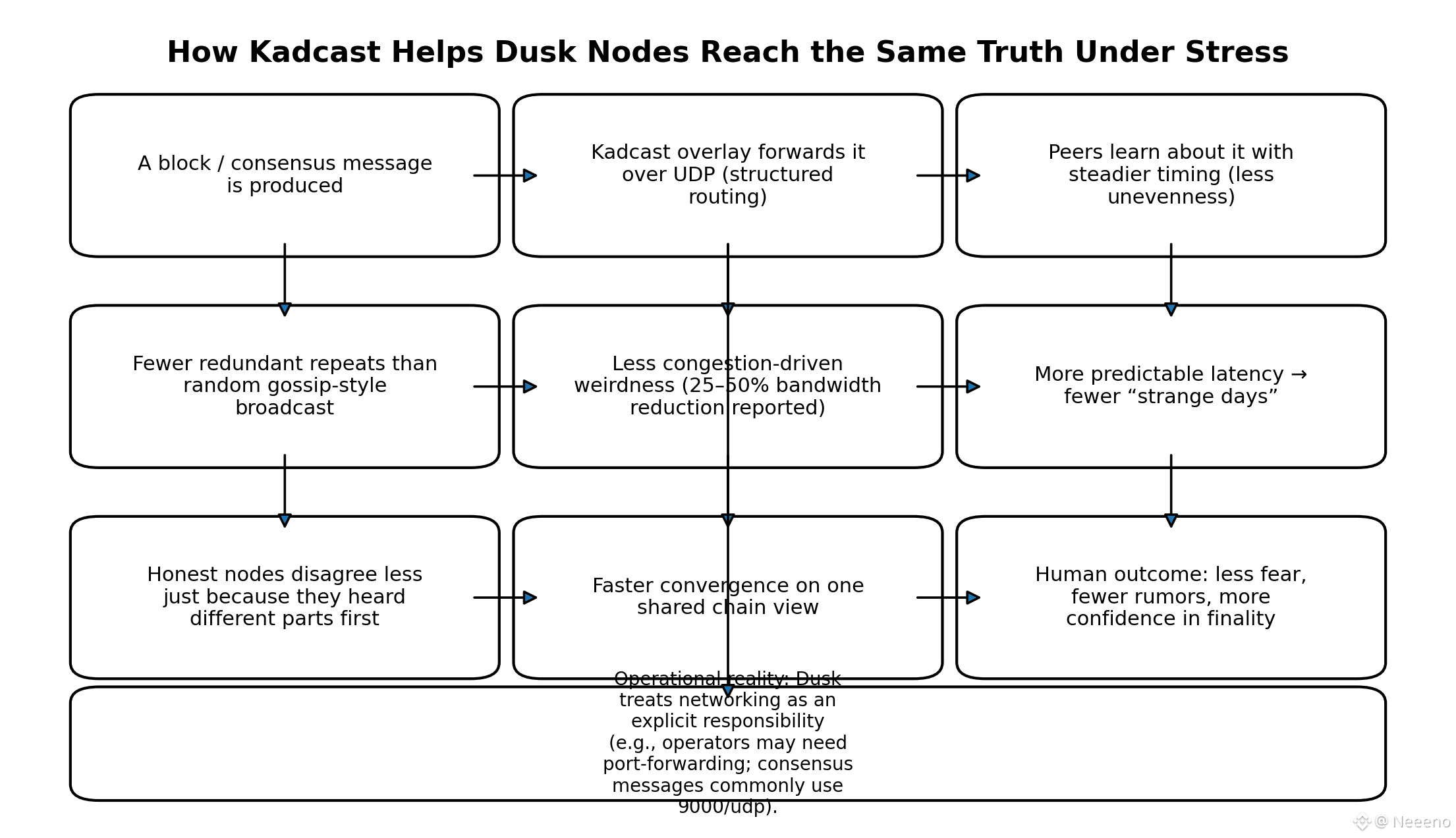
You can see the same maturity in how the core implementation keeps moving. Rusk—the node implementation—has continued shipping releases, including a v1.4.1 release dated December 4, 2025, with changes that read like the slow work of making a system more legible, more stable, and easier to integrate. A chain that expects serious usage can’t treat the node as “done.” It has to keep tightening the seams, because the seams are where incidents are born.
Token economics also belongs in this conversation, because message propagation quietly shapes who gets to participate as an equal. Dusk’s official tokenomics describes an initial supply of 500,000,000 DUSK and an additional 500,000,000 emitted over 36 years, for a maximum supply of 1,000,000,000. That’s a long horizon, which means Dusk is implicitly committing to decades of network operation. Over decades, the biggest risks aren’t only cryptographic—they’re operational and social. A network layer that reduces waste and smooths coordination is part of how you keep participation from becoming an insider’s game over time.
And yes, people will still watch price, because people are human. As of January 25, 2026, CoinMarketCap shows DUSK with a circulating supply just under 500 million and a max supply of 1 billion, along with live market cap and volume that reflect how quickly attention can swing. In those swings, infrastructure gets stressed in ways whitepapers can’t simulate: more nodes spin up, more endpoints get hammered, more impatient users show up with less context. Kadcast is not a promise that nothing will ever go wrong. It’s Dusk acknowledging that when markets are loud, the network must stay quiet. 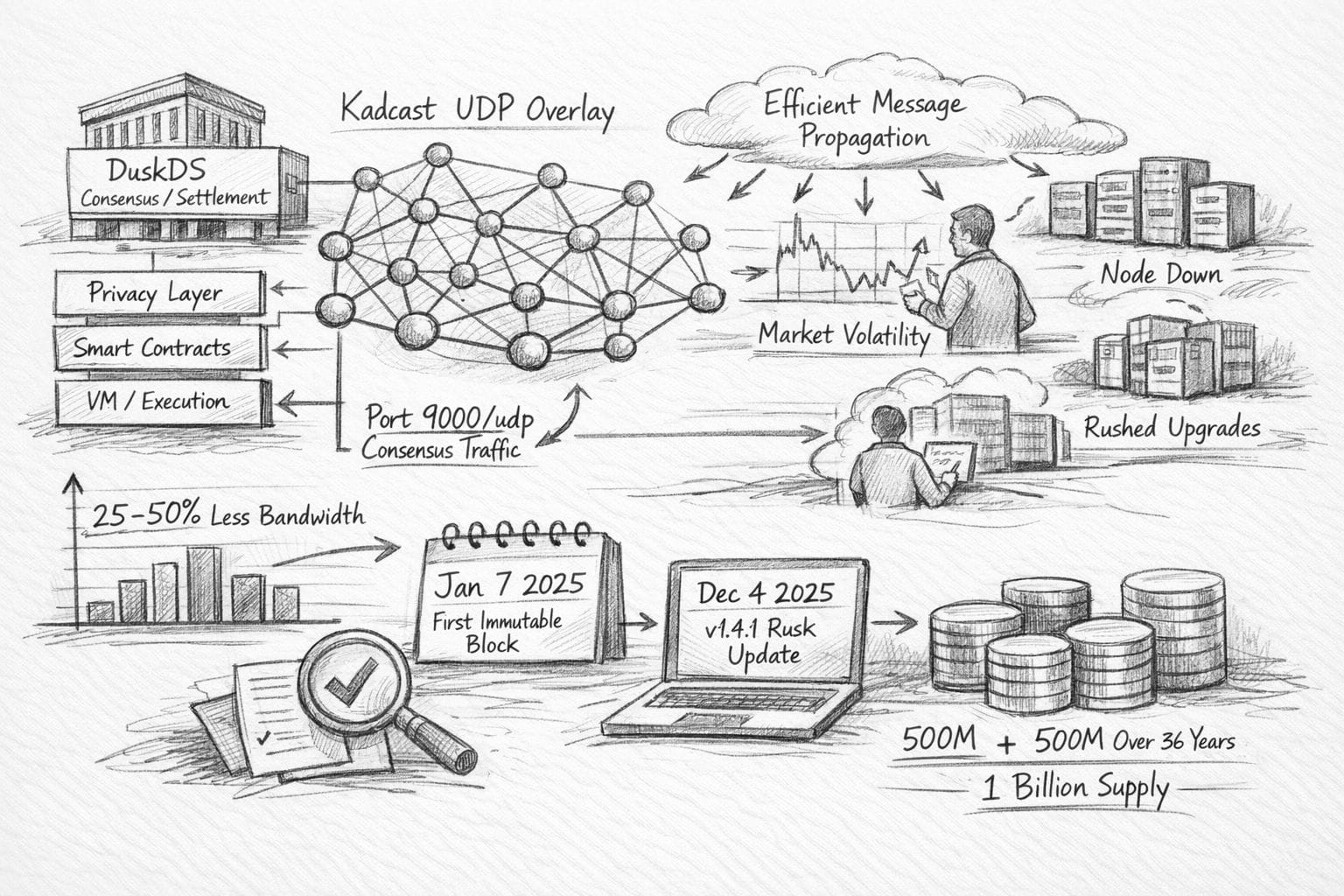
So when you ask why Dusk built Kadcast, the honest answer is that Dusk is building a Layer 1 where coordination is not optional and ambiguity is expensive. DuskDS can make a strong claim about settlement only if the network can carry the conversation that produces settlement without turning every period of stress into a social crisis. Kadcast is Dusk putting seriousness into the part nobody screenshots, because that’s where reliability actually lives.
In the end, this is the kind of work that rarely gets applause, because success looks like nothing happening. No drama in the mempool, no strange gaps in what different nodes believe, no creeping sense that “the chain feels off today.” Quiet responsibility is choosing to build the invisible paths that truth travels before anyone is watching, and then continuing to refine them after the market starts looking. Dusk doesn’t need Kadcast to be admired. It needs Kadcast to hold the line—patiently, repeatedly, without asking for attention—because in financial infrastructure, reliability matters more than attention ever will.
