
Ownership feels final.
Once something is on-chain, it’s easy to treat it as settled. Decisive. Finished. A transaction confirms, the state updates, and whatever doubt existed beforehand disappears. “On-chain” carries that weight. It sounds like an ending.
The confidence lasts longer than it should.
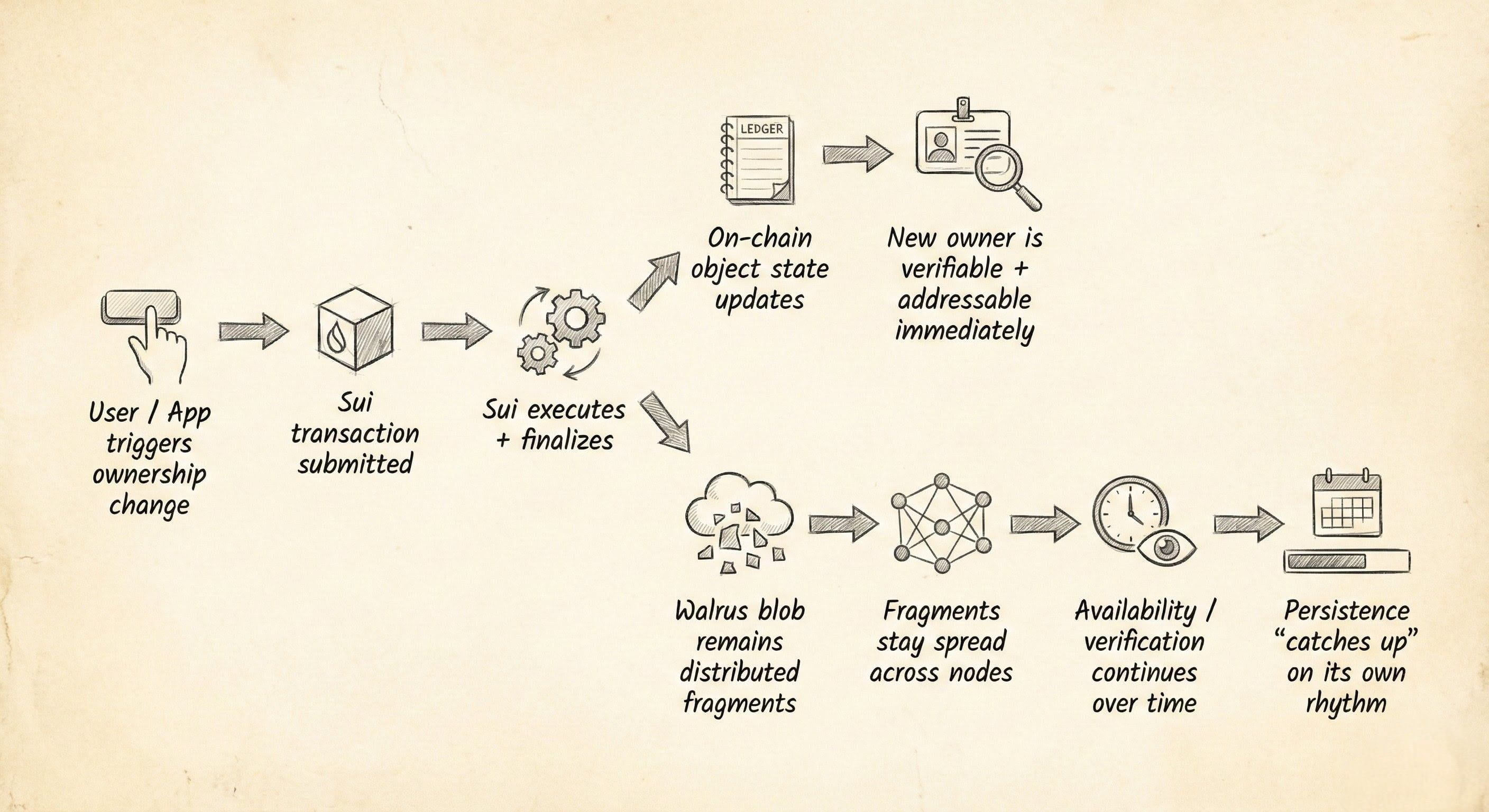
A Walrus (@Walrus 🦭/acc ) blob changes hands through a Sui interaction. The transaction completes cleanly. No rollback. No hesitation. Ownership is clear enough to point at. And yet, the moment doesn’t feel closed. Nothing is wrong, but something hasn’t quite finished arriving.
There’s no error to blame. No signal to react to. Just a faint sense of waiting that doesn’t belong to the transaction itself.
The object now lives in two places at once.
On Walrus the Sui blockchain, it behaves like any other owned object. Verifiable. Addressable. Accounted for. A programmable storage object with a clear owner and a clear state. That side of the story resolves quickly.
Elsewhere, the same Walrus blob exists as distributed fragments. Reconstructible. Persistent. Spread across a decentralized network that doesn’t move at the same rhythm. That state doesn’t contradict ownership but it doesn’t hurry to match it either.
Both are true at the same time.
Trust begins to separate.
Ownership feels immediate. You can see it, reference it, rely on it. Persistence takes longer to register. It works quietly, without ceremony, and refuses to announce when it’s done. Trust no longer sits in one place. It stretches across states that don’t resolve together.
Certainty softens.
People tend to trust what they can point to. A hash. An address. A confirmed interaction. “On-chain” feels concrete in a way persistence doesn’t, at least at first. The distributed side stays abstract until a delay makes it tangible.
“It’s already owned,” someone says.
That statement isn’t wrong. It’s just incomplete.
Verification continues without offering comfort. Proof of availability keeps doing its work. Reconstruction behavior remains intact. The Walrus data can be recovered under the right conditions. Nothing about persistence is failing. But verification doesn’t rush to reassure the moment ownership changes. It operates on its own terms.
The gap becomes noticeable.
Ownership happens immediately. Readiness does not. The gap between the two isn’t dramatic enough to trigger concern, but it’s noticeable enough to change how trust feels. It no longer arrives all at once. It has to be observed.
Not everyone notices this shift right away. Some assume the second state will catch up. Others forget it exists until they need it. The Walrus system doesn’t intervene to clarify which instinct is safer. It allows both interpretations to coexist.
Eventually, the focus drifts.
Not who owns this?
But where does trust live right now?
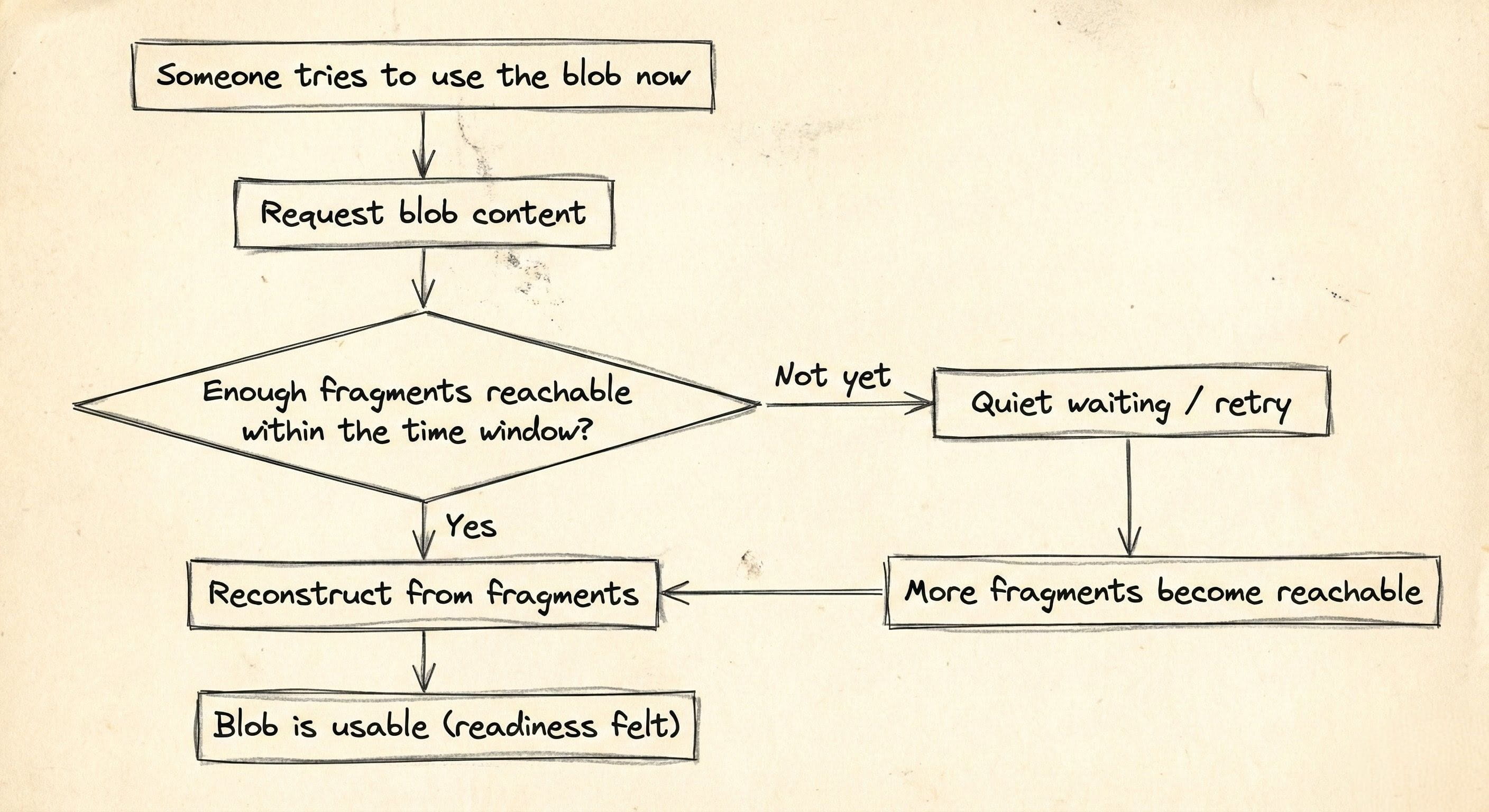
Walrus doesn’t reconcile the answer for you. The on-chain state remains valid. Distributed persistence continues under its own constraints. Both move forward without collapsing into one another. Ownership stays decisive. Persistence stays patient.
The two truths continue side by side.
And the only way to understand where it sits is to keep watching Walrus.


