

@Walrus 🦭/acc When a bug bounty goes live, teams usually don’t celebrate. It feels more like opening the doors of a building, turning on every light, and letting strangers walk around to see what’s weak. Walrus did this publicly in late March 2025, right when it was asking real people to trust it with real data.
The announcement wasn’t framed as a victory lap. It read like an acceptance of responsibility: if you’re going to hold other people’s files, images, proofs, archives, and application state, you don’t get to pretend your own confidence is enough.
What I appreciate most is the way the program defines “harm” in human terms, not just technical ones. Walrus didn’t emphasize edge-case tricks or obscure academic goals. It put weight on two ordinary fears that show up the minute a storage network stops being an idea and starts being relied on: the fear that data can be quietly corrupted, and the fear that the economics can be quietly gamed. The bounty explicitly calls out those two areas—data integrity and the economic model—as places where the most valuable discoveries live. That’s a mature admission. It’s also an honest one, because those are exactly the places where users rarely notice a problem until it’s too late. 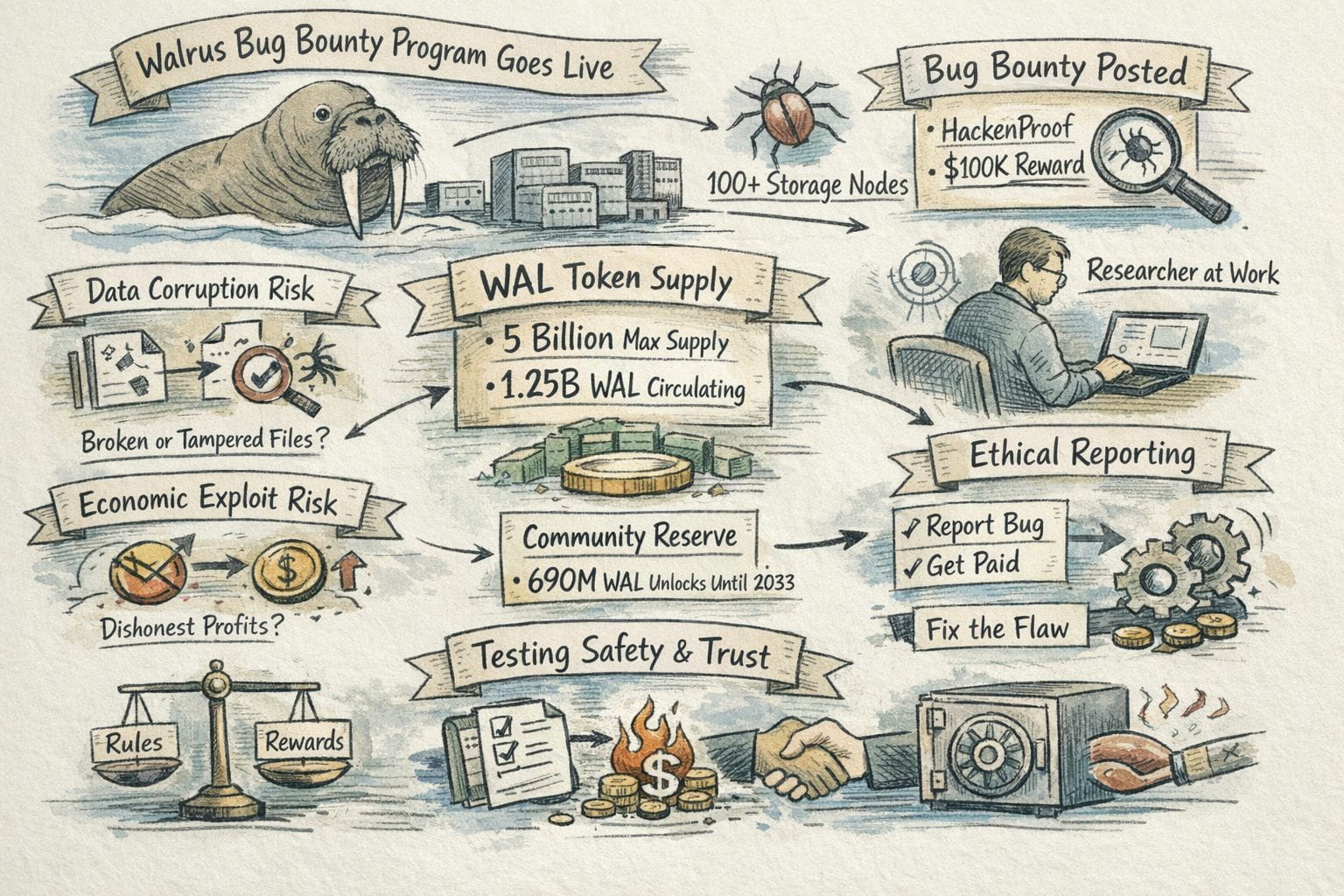
People outside the ecosystem sometimes assume bug bounties are marketing. Inside, they feel closer to insurance. You’re paying for someone else’s imagination, because your own team can only think in the shape of what they already built. Walrus chose to run submissions through HackenProof and set the top reward at $100,000, which is large enough to attract serious researchers and small enough to signal that the goal is breadth of scrutiny rather than spectacle. The reward ladder published by HackenProof’s write-up—ranging from low-severity amounts up to that six-figure ceiling—also quietly acknowledges something users understand instinctively: not all failures are equal, and the worst ones are the ones that can move value or truth without being seen.
Timing matters here. Walrus mainnet went live on March 27, 2025, and the bug bounty post followed immediately after, in the same narrow window where a protocol transitions from controlled conditions into public reality. If you’ve ever watched a production system meet the internet for the first time, you know what that week feels like. Traffic patterns change. Assumptions about “normal” behavior fall apart. People do things in the wrong order, or with the wrong expectations, or with an intensity you didn’t model. Walrus’ own documentation describes a decentralized network already operating with over 100 storage nodes at mainnet launch, and even that simple fact carries a social weight: once there are that many independent operators, the system is no longer just code. It’s a living set of incentives, shortcuts, miscommunications, and honest effort.
This is where the bug bounty becomes more than a security exercise. Storage isn’t just about keeping bytes somewhere. It’s about keeping a promise across time, across churn, across disagreement, across failed machines and imperfect humans. Walrus has to translate that promise into on-chain commitments and off-chain behavior without letting the edges fray. If the incentives are slightly mispriced, you don’t just get “a bug.” You get operators who learn, rationally, that some forms of corner-cutting are profitable. If the integrity checks can be fooled, you don’t just get “incorrect data.” You get the quiet collapse of confidence that happens when users no longer believe the system can tell the difference between what is stored and what is merely claimed to be stored.
The program’s emphasis on economic issues is a subtle tell that the team understands where real attacks often live. An attacker doesn’t need to destroy the network to harm it. They only need to find a way to be paid for work they didn’t do, or to shift costs onto honest participants so that good behavior feels naive. That’s why I read the bounty as a governance gesture as much as a technical one. It’s the protocol saying: if you can show us how our incentives break under pressure, we would rather pay you now than let the network pay later.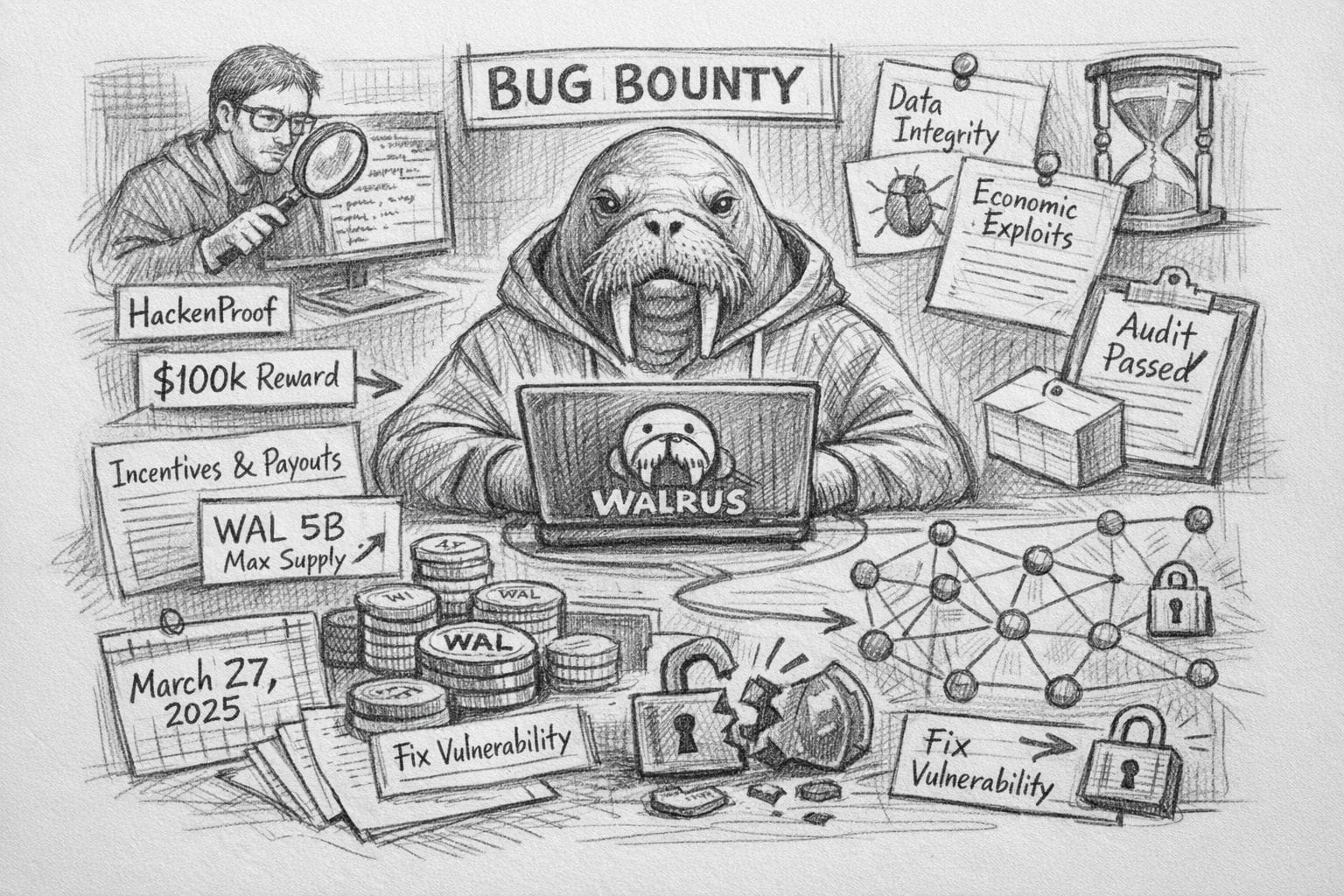
The WAL token sits right in the middle of that bargain, and the numbers are not decorative. Walrus’ official token page sets WAL’s max supply at 5,000,000,000, with an initial circulating supply of 1,250,000,000.Over 60% is allocated to the community through a mix that includes a community reserve, user distributions, and subsidies, while 30% is allocated to core contributors and 7% to investors.The community reserve alone is 43% of supply, with 690,000,000 WAL available at launch and the remainder unlocking linearly until March 2033. These schedules matter because they shape the emotional weather of a network: who feels like a long-term steward, who feels like a short-term renter, and how much patience exists when something goes wrong.
The way Walrus describes payment flows also hints at what it believes “fairness” should mean in a storage economy. It frames storage costs in stable terms—paid upfront for a fixed duration—while distributing those payments over time to operators and stakers. That design choice is not just about smoothing user pricing. It’s about matching reward to responsibility: if you’re being compensated over time, you’re being asked to behave over time. And when the protocol talks about penalties and burning portions of slashed amounts, it’s trying to encode a social lesson into economics: the community shouldn’t have to endlessly subsidize low-quality service, and attackers shouldn’t be able to turn failure into a repeatable business model.
A bug bounty, then, becomes a stress test of that moral posture. In a live network, mistakes aren’t always malicious. Someone misconfigures a machine. Someone copies an old script. Someone misunderstands a parameter. Those errors still create openings, and the openings still have economic consequences. The bounty program is a way to surface the places where the protocol is too fragile to ordinary human messiness. It’s also a way to discover where the protocol is too trusting of its own abstractions—places where the chain believes a story about the off-chain world that the off-chain world can’t reliably uphold.There’s another point people don’t talk about enough: security work is changing quickly. By late 2025, many in the industry were saying AI tools make it cheaper and easier to find weaknesses, so more people can do it—for good reasons or bad ones.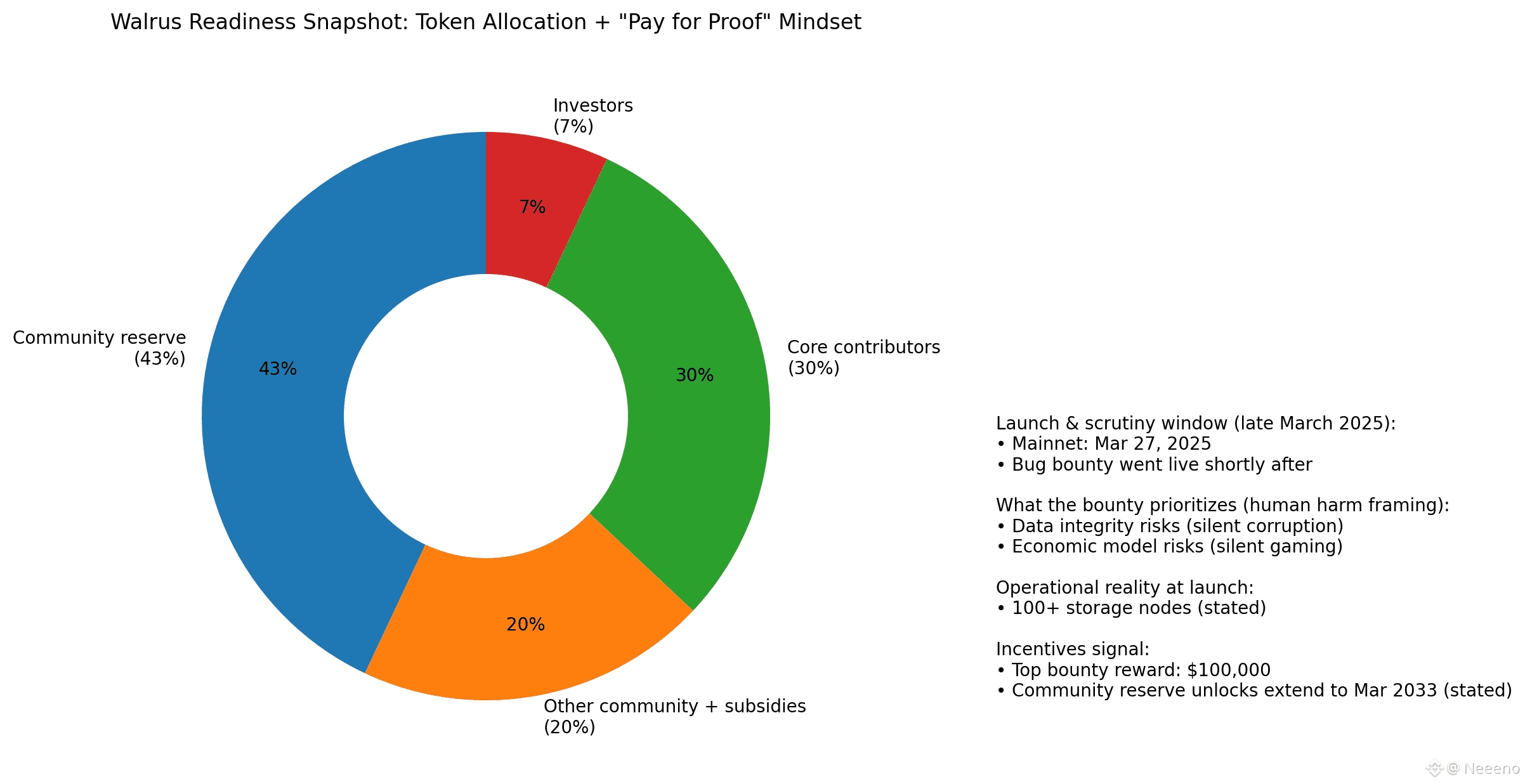
In that climate, “we’ve audited it” doesn’t feel like a conclusion anymore. It feels like a timestamp. Walrus launching a public bounty right after mainnet reads like an acceptance of that reality. The protocol is not asking you to believe it’s perfect. It’s building a standing invitation for the world to keep checking.
And that’s where this title—“Walrus Bug Bounty Program Goes Live”—lands emotionally for me. It’s not the thrill of catching hackers. It’s the quieter relief of knowing there is a sanctioned path for truth to enter the system. When a researcher finds a flaw, they don’t have to choose between silence and harm. They can choose repair, recognition, and a payout that signals respect for their time. That pathway reduces fear for builders who are deciding whether to store something important, because it tells them the protocol expects to discover uncomfortable things and has budgeted for that discomfort.
The recent updates around that launch window reinforce the same theme: Walrus was not only turning on mainnet, it was turning on the surrounding institutions that make a network feel inhabitable. The official news feed in late March 2025 clusters the mainnet launch, staking guidance, and the bug bounty announcement together, like the protocol is drawing a boundary around what “going live” really means.It’s not only ready to use. It’s also ready to be inspected and improved in public, instead of hiding problems behind closed doors
A network with a known supply curve, explicit long unlock schedules, and a large community allocation is making a claim that it expects to be around for a while. A network that goes live with a broad operator set is making a claim that it is not a single company’s private service wearing a decentralized costume. And a network that invites adversarial review with meaningful rewards is making the most important claim of all: when the world inevitably finds ways the system can fail, the system wants to learn in the open rather than deny in the dark.
I don’t think reliability feels exciting from the inside. It feels repetitive. It feels like checking the same assumptions again, and again, with new eyes. A bug bounty is part of that repetition. It’s the protocol admitting that trust is not something you win once, but something you maintain while the token unlocks continue for years, while operators come and go, while user expectations harden into norms, while the world gets better at breaking things. In Walrus’ case, the dates and numbers make that long view hard to ignore: a max supply of 5 billion WAL, community reserve unlocks extending to March 2033, and a mainnet that declared itself live on March 27, 2025—then immediately opened a standing door for outsiders to challenge it.
In the end, “goes live” is a phrase that sounds simple until you live through what it actually demands. It demands humility. It demands budgets for bad news. It demands that incentives be designed for the moments when people are tired, markets are noisy, nodes are failing, and someone is actively trying to turn ambiguity into profit. Walrus choosing to formalize that reality through a public bounty—managed through a real submission pipeline, priced with real money, focused on the two kinds of harm users actually feel—reads to me as quiet responsibility. The best infrastructure rarely asks for attention. It asks for the chance to be dependable, even when no one is watching, and especially when something goes wrong.

