

@Walrus 🦭/acc When people hear “consensus,” they usually picture money moving and blocks stacking up, as if agreement is only about keeping a ledger clean. Inside Walrus, consensus is treated more like nervous-system work: it’s the part that decides what the network should believe about storage commitments, membership, and the right to act. The files themselves don’t need to be endlessly copied like blockchain state. But the decisions about those files—who is responsible, what was promised, what can be proven, and what happens when something goes wrong—absolutely need a shared reality that doesn’t bend under pressure.
The title “Walrus Leverages High-Performance SMR” lands on a subtle truth: the classical state-machine replication mindset is powerful precisely because it is strict. It assumes disagreement is normal, and it designs for a world where messages arrive late, participants fail, and some actors will try to cheat. Walrus starts from that same hard posture, but then applies it to storage control rather than pretending blob storage should look like a normal chain. The Walrus research makes the point plainly: SMR is great for replicated computation, but it becomes wasteful when the goal is simply to store and retrieve large blobs without computing on them.
That distinction matters emotionally more than it sounds. In storage, the terror isn’t “my transaction got reorged.” It’s “my data is quietly missing,” or worse, “my data exists but can’t be proven,” which is how trust dies in slow motion. Walrus is trying to remove that particular kind of fear by treating storage promises as first-class consensus objects. If you can get the network to agree on who owes you what, for how long, and under what proof, then the chaos moves from the user’s mind into the protocol, where it belongs.
This is where the “high-performance” part becomes meaningful. Walrus isn’t chasing speed for bragging rights; it’s chasing speed so that coordination doesn’t become the bottleneck that drags reliability down. The system is designed to run with real churn and still keep availability intact through committee transitions—because storage networks don’t get to pause the world when operators rotate, machines die, or incentives change. The Walrus paper explicitly calls out a multi-stage epoch change protocol intended to handle storage-node churn while keeping availability uninterrupted during committee transitions. That’s not just a technical flourish—it’s a promise to users that the network won’t become fragile at the exact moment it has to reorganize itself.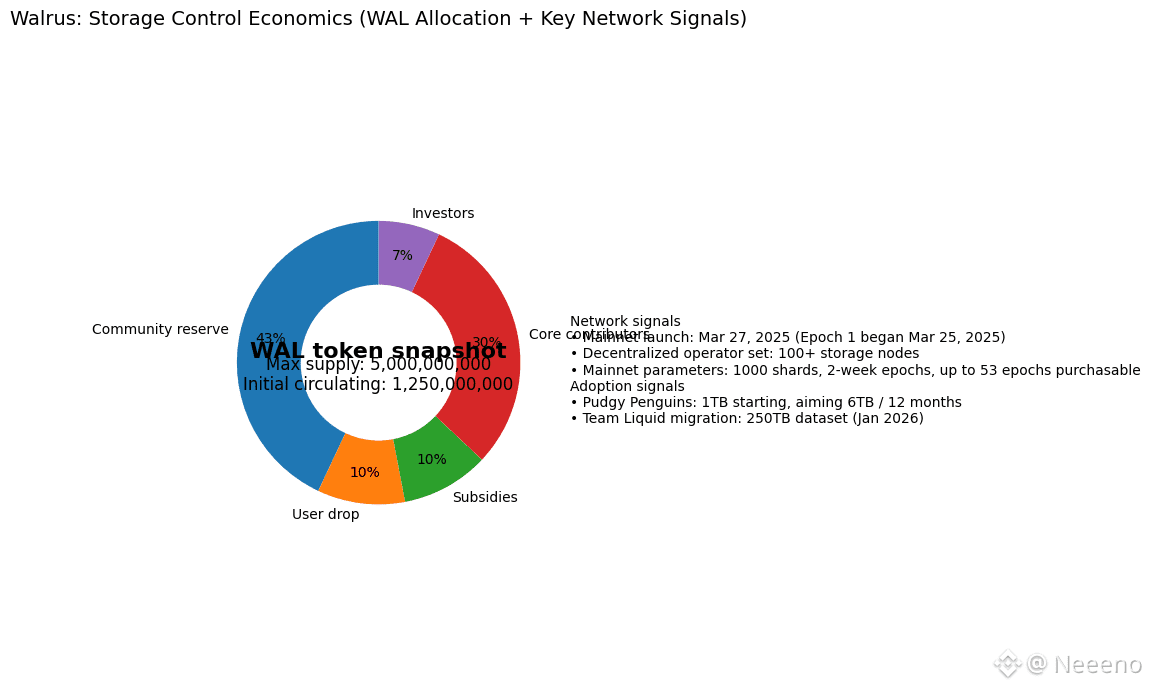
Walrus Mainnet going live in late March 2025 is the point where this stops being theoretical comfort and becomes a lived constraint.Walrus said its real network is now running with more than 100 different storage operators, not just one company.Walrus began working for real on March 25, 2025. Then on March 27, 2025, it was opened for everyone to use. It feels safer because many different groups run it, not just one person.
It’s another to rely on a system where coordination has to hold across a large, independent operator set, day after day, without the safety blanket of “we’ll fix it manually.
What I’ve noticed is that the real psychological shift for builders happens when they stop thinking about storage as “upload a file” and start thinking about storage as “enter into a contract with the network.” Walrus leans into that. Storage is purchased for time, not vibes, and the control-plane logic—who is in the committee, what is owed, what is certified—has to be consistent even when off-chain reality is messy. Walrus puts this into its economics language too: payment for storage is designed so users pay upfront for a fixed amount of time, and the value is distributed across time to operators and stakers. That time dimension is not just accounting. It’s how the network makes “I will keep this” legible and enforceable.
The WAL token is where Walrus makes incentives feel concrete instead of moral. WAL is positioned as the payment asset for storage, the security asset through delegated staking, and the governance weight that tunes penalties and parameters. If you’ve spent any time watching distributed systems fail, you learn that “good intentions” do not survive load, and “community spirit” does not survive a clean exploit. Walrus builds its honesty story around the uncomfortable idea that nodes should do the right thing because it is economically rational, and doing the wrong thing should be costly enough to be unattractive even to clever adversaries.
The token numbers matter because they anchor that story in something testable. WAL’s max supply is listed as 5,000,000,000, and the initial circulating supply is stated as 1,250,000,000. The distribution is also unusually explicit: 43% community reserve, 10% user drop, 10% subsidies, 30% core contributors, 7% investors. Those percentages aren’t just tokenomics trivia—they’re governance gravity. They shape who can influence parameter changes, how resilient the staking base can become, and how quickly the network can fund real operational maturity rather than just attention.
Walrus also ties these allocations to time in a way that mirrors how storage itself is sold. The community reserve is described as having 690M WAL available at launch with linear unlock until March 2033, while subsidies unlock linearly over 50 months, and a portion for Mysten Labs unlocks until March 2030.The point isn’t that long unlocks are automatically “good.” The point is that Walrus is structurally trying to reward staying power, because storage is a long game. If a network can’t keep incentives coherent for years, it shouldn’t be entrusted with data meant to last.
The “storage control” part of the title becomes clearest when you look at how Walrus discourages cheap manipulation. Walrus describes penalty fees for short-term stake shifts because churny stake movement creates migration costs—real externalities that the network has to pay in bandwidth and operational stress.It also describes a future where slashing for low-performing nodes burns a portion of fees, framing WAL as deflationary with explicit burning mechanisms. You can read that as token design, but it’s also a behavioral design: Walrus is trying to make it emotionally safe to rely on the network by making it financially unsafe to game it.
Recent operational updates reinforce that this is not a “paper network.” Walrus publishes a release schedule that states mainnet runs 1000 shards and uses 2-week epochs, with a maximum of 53 epochs for which storage can be bought. Those are the sorts of parameters that signal seriousness: long enough epochs to stabilize membership and economics, bounded storage purchase windows to keep obligations explicit, and a shard count that implies planning for scale rather than a toy deployment.
Then there are the adoption signals, which matter because they test the system’s claims in public. In April 2025, Walrus announced Pudgy Penguins would begin with 1TB of decentralized storage via Tusky and aims to scale to 6TB over 12 months. In January 2026, Walrus announced Team Liquid’s 250TB migration—framed as the largest single dataset entrusted to the protocol at that time.You don’t have to romanticize these announcements to understand what they imply: large datasets punish coordination weaknesses. They turn “maybe” bugs into “certain” incidents. They force the control plane to behave like a system, not a demo.
Security posture is another form of “recent update” that reveals maturity. Walrus’ bug bounty program advertises rewards up to $100,000 and explicitly includes categories like data loss/deletion, integrity and availability breaches, and economic abuse. That scope is telling. It acknowledges that storage isn’t just about uptime—it’s about preventing silent corruption, preventing cheap storage hacks that break the economic model, and preventing integrity failures where “certification” becomes theater. In other words, it treats the control layer as attack surface, not as marketing copy.
If you zoom out, you can see why SMR thinking fits Walrus so well. SMR is not “a consensus algorithm” in the shallow sense; it’s a discipline of refusing ambiguity. Walrus takes that discipline and aims it at the parts of storage that can’t be hand-waved: membership, commitments, certification, and transition. The research frames the whole motivation as escaping the replication explosion that comes from applying SMR to blob data itself.But it doesn’t escape the need for shared truth; it relocates shared truth to where it actually matters.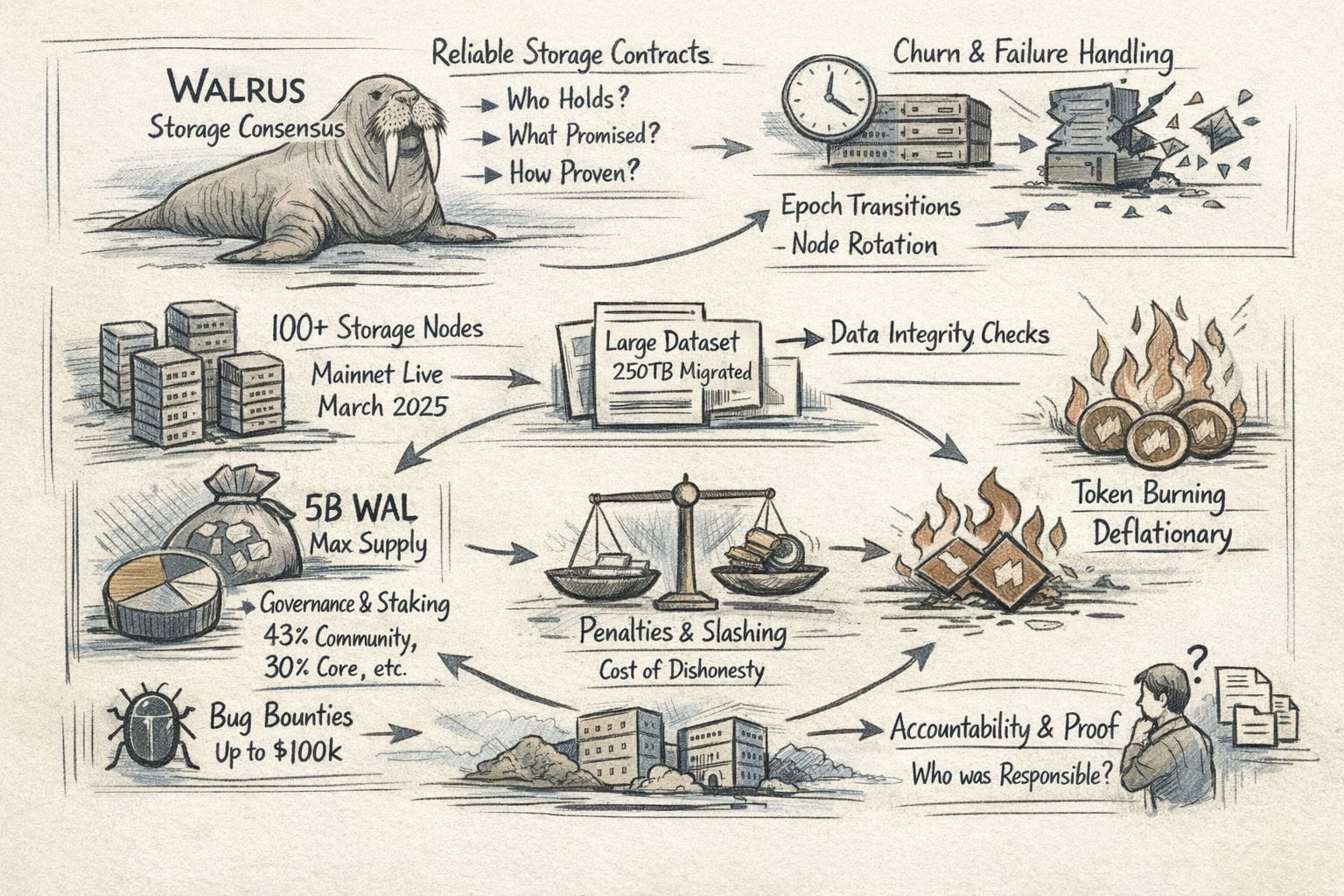
That relocation is also where off-chain reality collides with on-chain logic in the most human way. Real organizations don’t store data in clean, single-owner boxes. People disagree about what version is “the real one.” Teams ship updates, revoke access, lose keys, change vendors, and panic when something doesn’t load. Walrus is trying to make those messy workflows survivable by building a system where responsibility is legible. Not perfect. Not magical. Just legible enough that when things go wrong, you can ask the network a hard question—“who was responsible, and what was promised?”—and get a consistent answer.
And that’s where Walrus’ token design loops back into the emotional layer. When WAL is used for payment over time, when staking influences committee selection, when governance tunes penalties, and when burning and slashing punish behavior that harms the network, Walrus is effectively saying: reliability is not an accident. It’s an economic commitment.The network doesn’t ask you to trust a brand. It asks you to trust a structure that keeps working when people are tired, when markets are loud, when someone tries something clever, and when coordination would be easiest to fake.
Walrus doesn’t need to be dramatic about this. The most important infrastructure almost never is. Mainnet dates, node counts, epoch lengths, shard counts, supply numbers, unlock horizons—these are not the parts that go viral. But they are the parts that decide whether a protocol quietly deserves the right to hold other people’s data. The responsibility here is ordinary and heavy: keep your promises, don’t lose what you were paid to keep, don’t let governance become a power grab, and don’t let performance become a shortcut that breaks integrity. Walrus is building toward a world where the most meaningful compliment is also the least visible one—that nothing happened, because reliability held, and nobody had to think about it.

