
'When 'carbon neutrality' becomes a necessity, the environmental attribute of a public chain is its billion-dollar entry ticket.'
[Preface: The invisible 'compliance ceiling']
After studying for so long@Vanarchain Only then did I realize that we cannot just look at 'price increase' (ROI), but should really study the 'corporate compliance thresholds' (ESG rating).
Many investors do not understand why so many Web2 giants (like Starbucks, Nike) want to enter Web3 but have yet to take action.
It's not because the technology is difficult, but because of 'reputational risk'.
In the mainstream business world, blockchain is often labeled as 'high energy consumption' and 'not environmentally friendly'. If a listed giant uses a high-energy public chain, its ESG rating will decline, which in turn affects its stock price.
Vanar keenly captured this pain point. It is not just creating a single chain; it is making a 'green pass'. Today, we analyze how Vanar utilizes green infrastructure based on the business logic of 'carbon neutrality', having passed the rigorous scrutiny of Google and NVIDIA.

Chapter 1: ESG - The Shackles on Giants
In traditional crypto circles, people only care about TPS and airdrops. But in the boards of Fortune 500 companies, they care about ESG (Environmental, Social, and Governance).
Red line: Many multinational companies have clear 'zero-carbon commitments'. This means their supply chains (including digital infrastructure) must be green.
Dilemma: The energy consumption of Bitcoin and early Ethereum is enormous, making them 'untouchable forbidden zones' for these companies.
That's why Vanar has made 'Eco-friendly' one of its core narratives.
This is not for sentiment; it’s for business.
Vanar is like an industrial park that has received ISO environmental certification. Only with this certification will world-class factories (Web2 giants) dare to move their production lines in.

Chapter 2: Vanar's Green Moat - Technology and Partners
How does Vanar achieve 'green'? It's not just a slogan; it’s written into the underlying architecture.
1. Extreme Energy Efficiency Consensus Mechanism
Vanar has adopted an efficient Proof of Stake (PoS) / Proof of Authority (PoA) variant.
Comparison: A transaction on a traditional public chain may consume the electricity of a household for several days.
Vanar: The energy consumption of a transaction is minimal, even lower than that of sending a tweet. This is thanks to its 3-second block time and lightweight node design.
2. Google's Green Endorsement
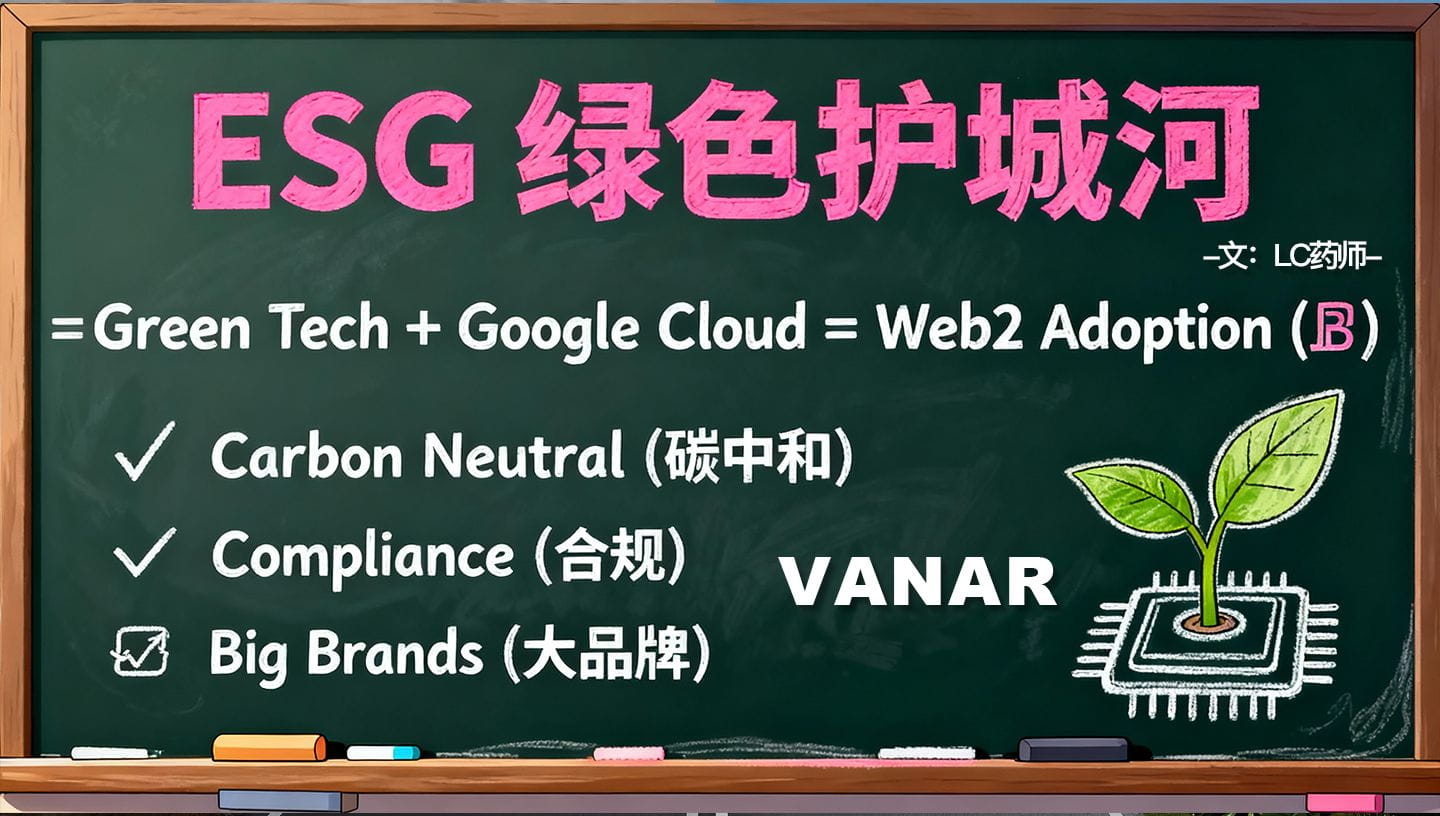
This is the most critical link. Vanar's core nodes run on Google Cloud.
Google Cloud is one of the cleanest cloud service providers in the world, committed to 100% renewable energy usage.
This means:
Vanar's underlying computing power naturally inherits Google's 'carbon neutrality attributes'.
When companies deploy applications on Vanar, they can directly state in their ESG reports: 'Our blockchain infrastructure is powered by 100% renewable energy.'
This statement is invaluable for the compliance departments of publicly listed companies.
Chapter 3: Commercial Implementation - Why Do Brands Prefer Vanar?
Let’s reason why Vanar ($VANRY) can secure Hollywood IP and collaborations with big brands.
Scenario 1: Fashion Brands Launch NFTs
If LV or Gucci wants to release NFTs, they would never dare to use a high-energy-consuming chain, as they would face backlash from environmental organizations. Vanar's green label allows them to safely explore Web3 without public relations risks.Scenario 2: Chain Transformation for Gaming Giants
If large gaming companies want to bring hundreds of millions of users onto the chain, they must consider their carbon footprint. Vanar's low energy consumption + high performance perfectly resolves the contradiction between 'scalability' and 'environmental protection'.
Chapter 4: The Underestimated 'Compliance Premium'
In the current valuation system, the market has not yet priced in 'ESG attributes'.
But in the future, as regulations tighten, 'compliance' will become the most scarce resource.
Vanar has preemptively laid out a green track, which is essentially paving the way for institutional funding's entrance.
When ESG-focused whales like BlackRock start allocating Web3 assets, clean targets like Vanar will enjoy significant compliance premiums.
[Conclusion]
In the early wild growth of Web3, whoever is crazier wins.
But in the second half of Web3, as it moves towards the mainstream, those who are more compliant, more environmentally friendly, and better able to integrate into the mainstream business system will survive longer.
Vanar is not taking a rough path; it’s a red carpet leading to the desks of companies listed on the New York Stock Exchange.
It has knocked on the tightly closed door of Web2 giants with its green infrastructure.
