Introduction:
In the rapidly evolving landscape of blockchain technology, the quest for a truly scalable, secure, and user-friendly payment infrastructure has been the "Holy Grail." While Bitcoin introduced decentralized value and Ethereum brought programmable money, the industry still struggles with high transaction costs and network congestion during peak times. This is where @plasma enters the fray, offering a sophisticated Layer-1 solution specifically engineered for the next generation of global payments and stablecoin settlements.
In this comprehensive analysis, we will explore why #plasma is not just another blockchain, but a specialized settlement layer designed to bridge the gap between traditional finance (TradFi) and decentralized finance (DeFi). With its native token $XPL, the network is poised to redefine how we perceive digital transactions.


1. Understanding the Core Vision of @Plasma
Most blockchain networks today attempt to be "jacks-of-all-trades," hosting everything from complex DeFi protocols to high-frequency gaming and NFT marketplaces. This often leads to fragmented liquidity and unpredictable gas fees. @Plasma takes a different approach by focusing on a specific niche: High-throughput Stablecoin Payments.
The vision behind Plasma is to create a "Gasless" environment where users can transact with stablecoins as easily as they send an email. By integrating the security of Bitcoin with the flexibility of the Ethereum Virtual Machine (EVM), Plasma provides a robust framework for institutional-grade financial applications.
2. Technical Architecture: The Power of PlasmaBFT and Bitcoin Anchoring
The backbone of #plasma is its unique consensus mechanism known as PlasmaBFT. Based on the advanced HotStuff consensus (the same lineage as Libra/Diem), it allows the network to achieve sub-second finality.
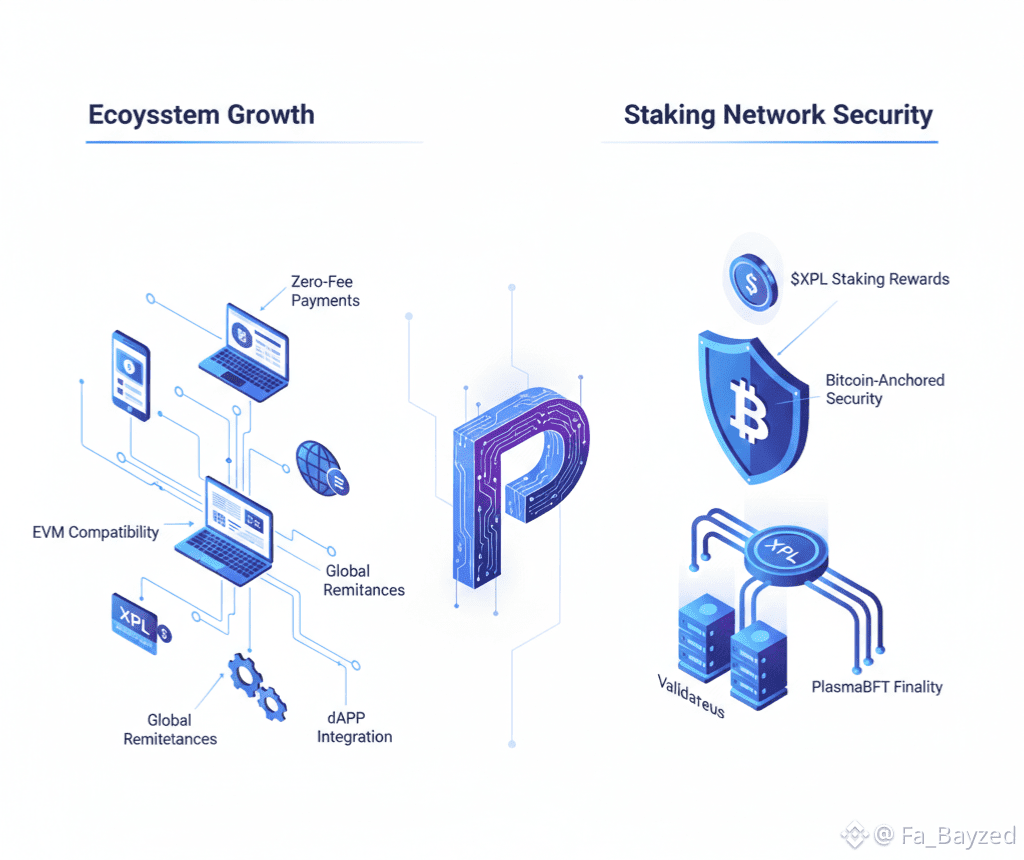
Bitcoin-Anchored Security: Security is paramount in finance. Plasma periodically anchors its state to the Bitcoin blockchain. This means to compromise Plasma, an attacker would theoretically need to overpower the massive hashing power of the entire Bitcoin network.
High Throughput: The network is designed to handle over 1,000+ transactions per second (TPS), making it capable of competing with traditional payment processors like Visa or Mastercard.
EVM Compatibility: For developers, this is a massive win. Any decentralized application (DApp) written for Ethereum can be deployed on Plasma with zero code changes, allowing the ecosystem to grow exponentially.
3. The $XPL Token: Utility, Governance, and Value Accrual
The $XPL token is the lifeblood of the Plasma ecosystem. It is designed with a sustainable economic model to ensure long-term value for its holders and participants.
Staking and Network Security: To maintain a decentralized and secure network, validators must stake $XPL. This creates a direct link between the network's growth and the token's utility.
The Paymaster Protocol (Gasless Transactions): One of the most innovative features of @plasma is the ability for users to pay transaction fees directly in stablecoins (like USDT or USDC). The network then uses $XPL behind the scenes to settle these fees, creating a seamless experience for the end-user while maintaining demand for the native token.
Deflationary Mechanisms: Similar to EIP-1559 on Ethereum, a portion of the transaction fees in the Plasma network is burned. As adoption increases and more transactions occur, the circulating supply of $XPL potentially decreases, creating upward pressure on its value.
4. Why Institutions are Moving Toward #plasma
Institutional adoption requires more than just fast transactions; it requires compliance, privacy, and reliability. Plasma's infrastructure is built to support
5. Ecosystem Growth and Future Roadmap
The journey of is supported by industry giants and a growing community of developers. With strategic backing from major venture capitals and partnerships with leading liquidity providers, the ecosystem is expanding its reach into cross-border remittances, merchant payments, and decentralized identity.
The upcoming roadmap includes the launch of advanced "Zk-proof" integrations to further enhance privacy and the expansion of the "Plasma Bridge," which will allow seamless asset transfers between Plasma and other major chains like Ethereum, Solana, and Binance Smart Chain.
Conclusion: Is $XPL the Next Big Leap?
As the world shifts toward a digital-first economy, the need for a dedicated, high-speed, and low-cost payment rail is undeniable. @Plasma has positioned itself at the intersection of security and scalability. By solving the "gas fee" problem and leveraging Bitcoin’s unrivaled security, it provides a compelling case for both retail users and institutional players.
For any crypto enthusiast or investor, keeping an eye on $XPL and the developments within the #plasma ecosystem is essential. We are witnessing the birth of a new standard for global finance.