
I didn’t notice Dusk because it was fast. I noticed it because it made me uncomfortable in a quiet way.
The moment came during a conversation that wasn’t supposed to be about blockchain at all. Someone from a traditional finance background was explaining how privacy usually works in regulated environments. Halfway through, they stopped and said something that stuck with me:
“We don’t mind privacy. We mind not knowing when we’re supposed to see through it.”
That sentence kept echoing when I later started paying attention to Dusk (@Dusk ).
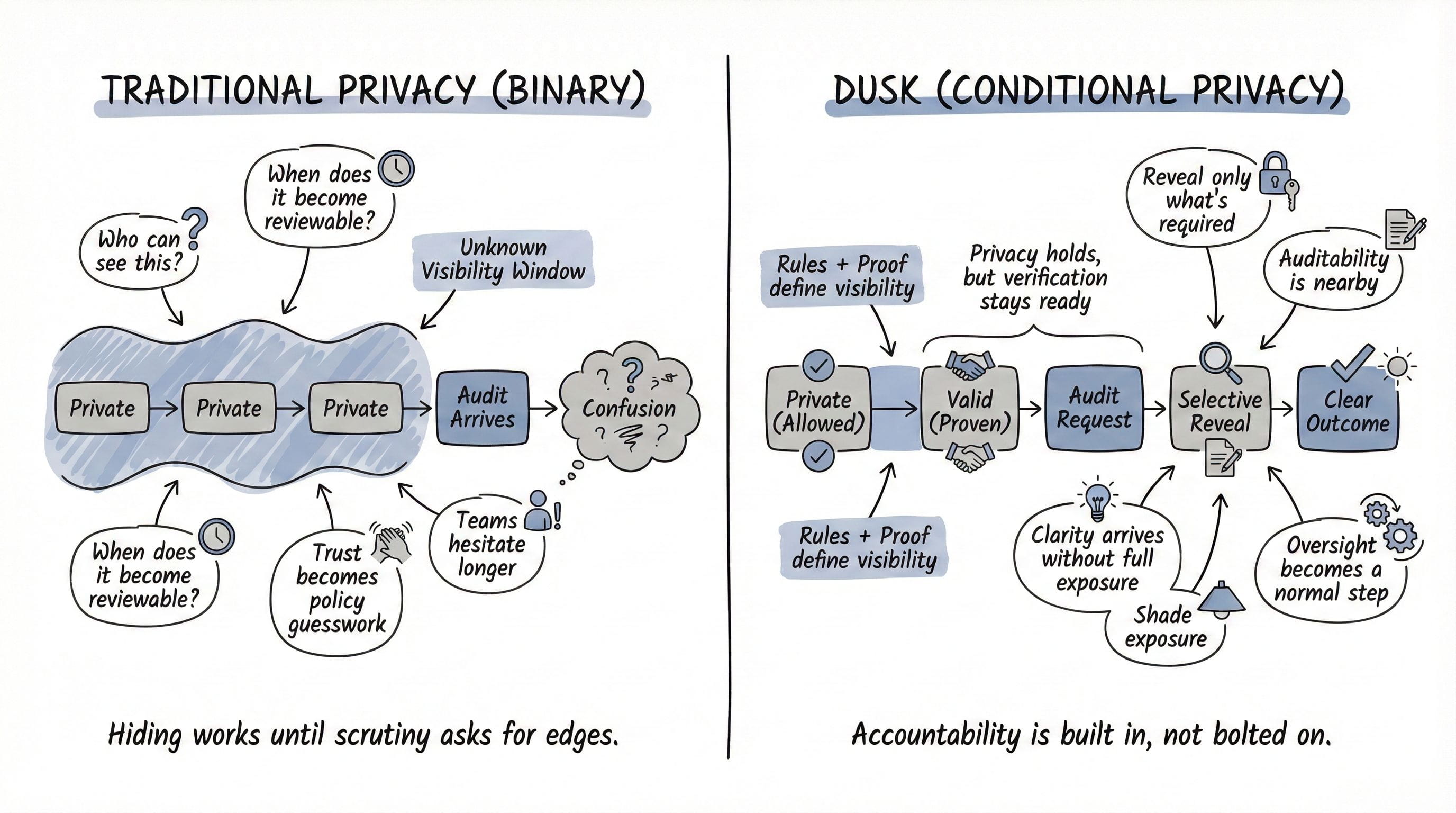
What felt different wasn’t the promise of privacy. Plenty of systems promise that. It was the assumption that privacy would eventually be questioned, not celebrated, not marketed, just examined. On Dusk (#Dusk ), privacy doesn’t feel like a shield you hold up. It feels like a state you’re temporarily allowed to occupy until someone, somewhere, needs clarity.
That changes how everything behaves.
In most systems, privacy is treated like a permanent condition. If data is hidden, it’s hidden. If it’s visible, it’s visible. On Dusk, that line feels softer. Privacy-preserving transactions exist, but they don’t pretend scrutiny won’t arrive. Auditability is always nearby, not as a threat, but as an expectation.
I noticed this most when thinking about institutional workflows. Institutions don’t rush. They wait. They assume time will reveal what intention doesn’t. In that environment, systems that rely on trust alone eventually feel brittle. Systems that assume verification will happen start behaving differently.
Dusk feels built for that second category.
Nothing dramatic happens. No alarms. No failures. Just a subtle shift in responsibility. Data isn’t simply private it’s conditionally private. Compliant DeFi doesn’t announce compliance. It waits for it to be required. Tokenized real-world assets don’t exist to impress. They exist to survive review.
That waiting has a cost, but not a financial one. It’s the cost of coordination. Of timing. Of knowing that if something can be audited, it eventually will be. Teams hesitate longer. Decisions take more care. Assumptions don’t live as long.
That’s where the phrase “institutional-grade” starts to mean something beyond marketing. Institutional systems aren’t designed for speed first. They’re designed for accountability under pressure. Dusk’s regulated financial infrastructure feels aligned with that reality. Privacy and auditability aren’t fighting each other they’re pacing each other.
I’ve seen projects talk about privacy as freedom. Dusk frames it more like responsibility. Zero-knowledge proofs and homomorphic encryption aren’t presented as magic tricks. They’re tools that let privacy exist without pretending oversight won’t knock later.
That mindset matters when you think about what’s coming next. Platforms like DuskTrade and the movement of tokenized securities on-chain aren’t interesting because of size or numbers. They’re interesting because they assume regulation won’t adapt to crypto, crypto will adapt to regulation.
That assumption changes design choices long before products launch.
At some point, privacy stops being something you claim and starts being something you maintain. It stops being optional. It becomes contextual. Temporary. Accountable.
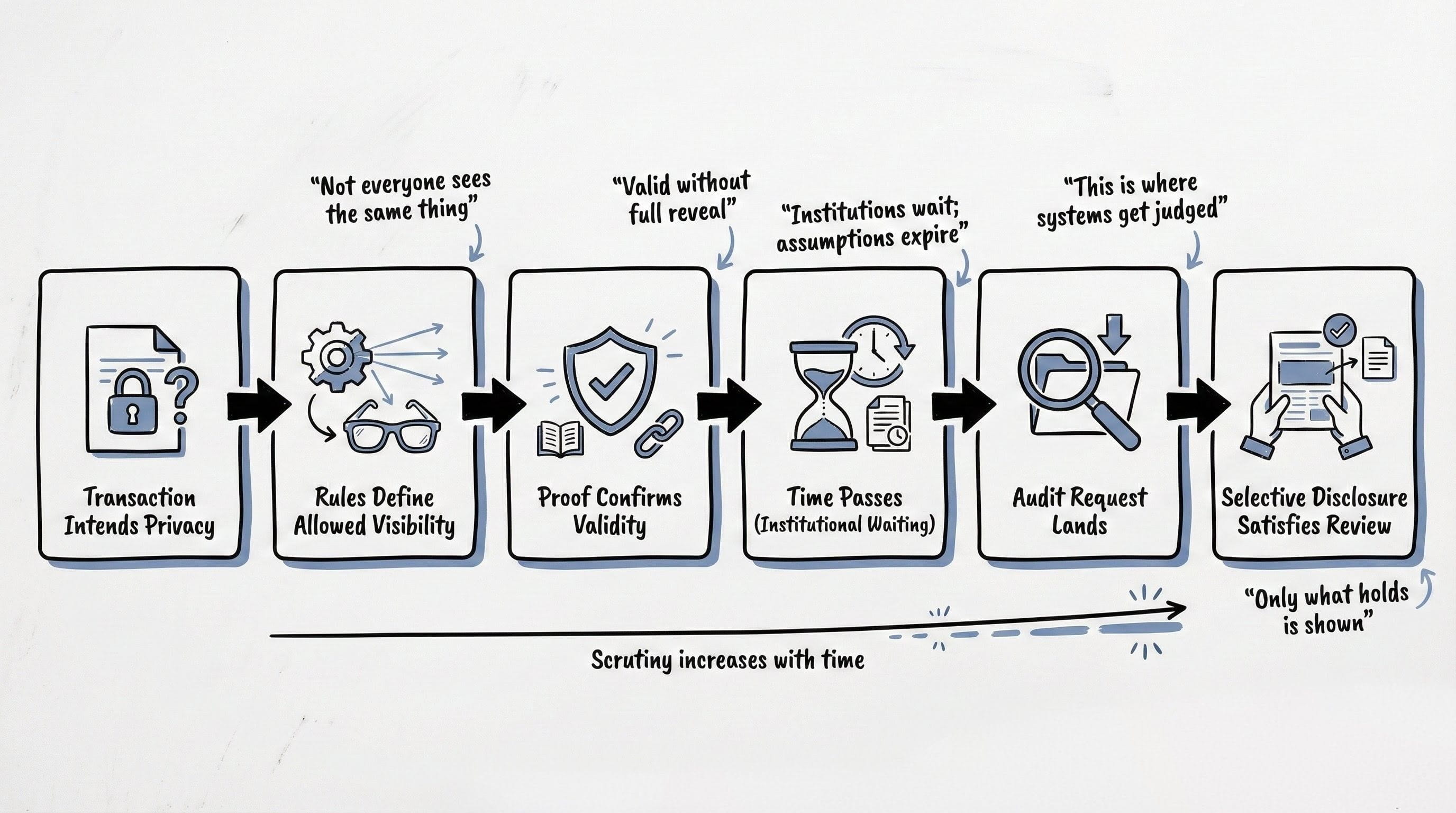
That’s the feeling I associate with Dusk ($DUSK ) now. Not excitement. Not hype. A quieter confidence that comes from expecting scrutiny instead of avoiding it.
And once you notice that expectation baked into the system, it’s hard to unsee it. Privacy doesn’t disappear. It just learns how to exist under rules it can’t ignore.
